Diplopoda
Millipedes are a group of arthropods that are characterised by having two pairs of jointed legs on most body segments; they are known scientifically as the class Diplopoda, the name derived from this feature. Each double-legged segment is a result of two single segments fused together. Most millipedes have very elongated cylindrical or flattened bodies with more than 20 segments, while pill millipedes are shorter and can roll into a tight ball. Although the name "millipede" derives from Latin for "thousand feet", no species was known to have 1,000 or more until the discovery in 2020 of Eumillipes persephone, which can have over 1,300 legs. There are approximately 12,000 named species classified into 16 orders and around 140 families, making Diplopoda the largest class of myriapods, an arthropod subphylum which also includes centipedes and other multi-legged creatures.

Golovatch, S.; Mikhaljova, E.; Chang, H. Hedin, Marshal Ioannou, N. VandenSpiegel, D., Golovatch, S. Chen, C.; Golova… · CC BY 4.0 · via Wikipedia/Commons. May be a photograph of a specimen, or an artist’s reconstruction — an interpretation of a skeleton, since colour and soft tissue are almost never preserved.
On record
Recorded, not inferred- Also called
- millipedePBDB
- Sits inside
- DignathaPBDB
- Motility
- actively mobilePBDB, for Arthropoda
Time the record covers
At least 426 million years on record.
The record covers at least 426.7 Mya to 11.7 ka. No occurrence read is dated outside 432.9 Mya to 0 Mya.
401 occurrences of Diplopoda on record, most of them in the Carboniferous. The Paleobiology Database records this as a living group. Bar height is expected occurrences, not a count: each fossil is spread across the span it is dated to, so a tall narrow bar means tight dating and a low wide one means loose.
When
401 occurrences- Silurian2%
- Devonian4%
- Carboniferous51%
- Permian2%
- Early Triassicunder 1%
- Middle Triassicunder 1%
- Early Jurassicunder 1%
- Early Cretaceousunder 1%
- Late Cretaceous14%
- Eocene7%
- Oligocene2%
- Miocene11%
- Plioceneunder 1%
- Pleistocene3%
- Holoceneunder 1%
These are dates about fossils, not the animal: the record can only begin after it arose and end before it died out, so either end may reach further. Shares are expected occurrences: a fossil dated to a span is counted partly in each period it straddles. More on what this infers.
Found in
60 formations
- Carbondale Formation · Kewanee Group56
- Kladno Formation31
- Cowie Formation · Stonehaven Group8
- Joggins Formation · Cumberland Group8
- Lower Saarbrucker layer Formation8
- Dundee Flagstone Formation · Arbuthnott-Garvock Group7
Loading coastlines…
The named rock units Diplopoda has been recovered from, largest first. Drawn where the rock is now, not where it formed. 36 further formations hold fewer occurrences each and are not listed. 208 occurrences have no formation on record, which is common for older literature.
Diplopoda and its relatives
CarboniferousWhere Diplopoda and its relatives were recorded in the Carboniferous.
Found in the same rock
4,669 taxa- Arthropleura22 sites
- Arthropleura armata22 sites
- Euphoberia armigera9 sites
- Polydesmida9 sites
- Acantherpestes major6 sites
- Archimylacridae6 sites
- Palaeocampa anthrax6 sites
- Protosilvestria sculpta6 sites
- Salticinae6 sites
- Araneae5 sites
- Architarbus rotundatus5 sites
- Arthropleura maillieuxi5 sites
- Arthropleura mammata5 sites
- Aves5 sites
- Eucaenus ovalis5 sites
- Euphoberia ferox5 sites
- Euphoberia granosa5 sites
- Kampecaris forfarensis5 sites
- Pleurojulus biornatus5 sites
- Aphantomartus pustulatus4 sites
- Arthropoda4 sites
- Calamites4 sites
- Cyperites4 sites
- Eoscorpius carbonarius4 sites
The Paleobiology Database records 197 sites for Diplopoda, and this reads all of them. The number is how many of those sites it was catalogued from too. The 24 sharing the most are listed.
This is not a list of everything alive at the time. It is only what has come out of the same ground as this animal and been written down.
Entered from
120 references- Checklist of the Myriapoda in Cretaceous Burmese amber and a correction of the Myriapoda identified by Zhang (2017)34
- New Carboniferous Myriapoda from Illinois27
- Millipeds from Dominican amber, with the description of two new species (Diplopoda: Siphonophoridae) of Siphonophora20
- Fritsch, 189919
- Archipolypoda, a subordinal type of spined myriapods from the Carboniferous formation18
- The millipedes and centipedes of Chiapas amber16
- La faune continentale du terrain houiller de la Belgique16
- Die Arthropoden aus dem Carbon und Perm des Saar-Nahe-Pfalz-Gebietes15
- Footnotes and taxonomic names, in Die im Bernstein befindlichen Crustaceen, Myriapoden, Arachniden und Apteren der Vorwelt15
- Fritsch, 189911
- Morphology and taxonomy of Paleozoic millipedes (Diplopoda: Chilognatha: Archipolypoda) from Scotland8
- Mummified Palaeogene Spirostreptida and Julida (Arthropoda, Diplopoda) from southern France7
Each of the 401 occurrences read was entered from one of these publications, ordered by how many each accounts for. This is not a search for papers mentioning the name. 108 further references are not listed. Entries link to doi.org where the Paleobiology Database holds an identifier, and to its own record where it does not. Relayed as the Paleobiology Database holds them, not checked against what they resolve to.
Media and terms
Media content1
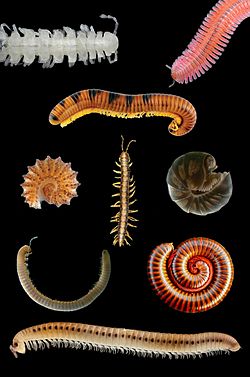
Picture of Diplopoda
- Source
- Wikipedia/Commons
- Credit
- Golovatch, S.; Mikhaljova, E.; Chang, H. Hedin, Marshal Ioannou, N. VandenSpiegel, D., Golovatch, S. Chen, C.; Golova…
- Licence
- CC BY 4.0
- Commercial use
- the licence allows it
No 3D scan of Diplopoda was found in Sketchfab.
Smithsonian Open Access and MorphoSource were not reached for this taxon, so this list is what the others held rather than everything there is.
The description on this site
- Source
- Wikipedia, “Millipede”
- Licence
- CC BY-SA 4.0
This is what the site found, which is not the same as what exists.
Keep going
What may have been alongside itDignatha through timeFormations of the CarboniferousThe world it lived on
Occurrence data from the Paleobiology Database, CC BY 4.0. (Gervais 1844)