Vermiceras
Searched as Discoceras. The Paleobiology Database treats Vermiceras as the accepted name.
Discoceras is an extinct marine cephalopod mollusk, a member of the Trocholitidae in the Tarphycerida. It is distinct from Discosorus, It is characterized by closely coiled, gradually expanding shells with a subquadrate cross section, that may be ribbed or smooth. The sides are broadly rounded; the venter is wide and slightly rounded. The maximum width is slightly dorsal of the middle. The dorsum has a slight to moderate impression. The siphuncle starts off central for the first half whorl then becomes marginodorsal in the succeeding two whorls, then subdorsal at maturity. As with Trocholites, the dorsal siphuncle in Discoceras probably indicates an orientation during life that places the back of the living chamber high in the shell.

Kittil hagen · Public Domain · via Wikipedia/Commons. May be a photograph of a specimen, or an artist’s reconstruction — an interpretation of a skeleton, since colour and soft tissue are almost never preserved.
On record
Recorded, not inferred- Sits inside
- ArietitinaePBDB
- Diet
- carnivorePBDB, for Ammonoidea
- Life habit
- nektonicPBDB, for Ammonoidea
- Motility
- fast-movingPBDB, for Ammonoidea
- Vision
- well-developedPBDB, for Cephalopoda
- Environment
- marinePBDB, for Cephalopoda
Time the record covers
At least 376 million years on record.
The record covers at least 477.1 Mya to 100.5 Mya. No occurrence read is dated outside 486.85 Mya to 93.9 Mya.
337 occurrences of Vermiceras on record, most of them in the Early Jurassic. Bar height is expected occurrences, not a count: each fossil is spread across the span it is dated to, so a tall narrow bar means tight dating and a low wide one means loose.
When
337 occurrences- Ordovician26%
- Late Triassicunder 1%
- Early Jurassic55%
- Middle Jurassicunder 1%
- Late Cretaceous18%
These are dates about fossils, not the animal: the record can only begin after it arose and end before it died out, so either end may reach further. Shares are expected occurrences: a fossil dated to a span is counted partly in each period it straddles. More on what this infers.
Found in
90 formations
- Last Creek Formation40
- Graylock Formation25
- Sandilands Formation · Kunga Group16
- Sunrise Formation12
- Vasalemma Formation10
- Baota Formation7
Loading coastlines…
The named rock units Vermiceras has been recovered from, largest first. Drawn where the rock is now, not where it formed. 66 further formations hold fewer occurrences each and are not listed. 82 occurrences have no formation on record, which is common for older literature.
Vermiceras and its relatives
Early JurassicWhere Vermiceras and its relatives were recorded in the Early Jurassic.
Found in the same rock
305 taxa- Paracaloceras rursicostatum32 sites
- Badouxia canadensis30 sites
- Sunrisites brimblecombei12 sites
- Eolytoceras tasekoi11 sites
- Coroniceras8 sites
- Eolytoceras chongi8 sites
- Badouxia columbiae7 sites
- Eolytoceras constrictum7 sites
- Gyrophioceras supraspiratum6 sites
- Paracaloceras varaense6 sites
- Badouxia castlensis5 sites
- Coroniceras (Arietites) bucklandi5 sites
- Coroniceras rotiforme5 sites
- Discamphiceras silberlingi5 sites
- Paracaloceras coregonense5 sites
- Phylloceras psilomorphum5 sites
- Sunrisites chilcotinensis5 sites
- Angulaticeras marmoreum4 sites
- Arietites4 sites
- Arnioceras4 sites
- Discamphiceras4 sites
- Gyrophioceras morganense4 sites
- Gyrophioceras praespiratissimum4 sites
- Pseudaetomoceras victoriense4 sites
The Paleobiology Database records 92 sites for Vermiceras, and this reads all of them. The number is how many of those sites it was catalogued from too. The 24 sharing the most are listed.
This is not a list of everything alive at the time. It is only what has come out of the same ground as this animal and been written down.
Entered from
98 references- Late Hettangian (Early Jurassic) ammonites from Taseko Lakes, British Columbia, Canada33
- Paradiscamphiceras : un nouveau genre d'ammonites du Lias inférieur21
- The Upper Ordovician Cephalopods of the Oslo Area19
- Die Ammoniten-Fauna des südamerikanischen Hettangium (basaler Jura), Teil 113
- Middle and late Hettangian (Early Jurassic) ammonites from the Queen Charlotte Islands, British Columbia, Canada12
- Cephalopods from reef limestone of the Vasalemma Formation, northern Estonia (latest Sandbian, Upper Ordovician) and the establishment of a local warm-water fauna11
- Hettangian ammonite faunas of the Taseko Lakes area British Columbia9
- The middle ordovician of the Oslo region, Norway 10. Nautiloid Cephalopods9
- Paléontologie Française - Description zoologique et géologique de tous les animaux mollusques et rayonnés fossiles de France - Terrains jurassiques. [Céphalopodes]9
- Frühe Arietitidae (Ammonoidea) aus dem Hettangium (Angulata-Zone, Unt. Lias) von Württemberg (SW-Deutschland)8
- Lower and Middle Cenomanian ammonites from the Morondava Basin, Madagascar6
- Hettangian and Sinemurian ammonoid zonation for the western Cordillera of North America6
Each of the 337 occurrences read was entered from one of these publications, ordered by how many each accounts for. This is not a search for papers mentioning the name. 86 further references are not listed. Entries link to doi.org where the Paleobiology Database holds an identifier, and to its own record where it does not. Relayed as the Paleobiology Database holds them, not checked against what they resolve to.
Media and terms
Media content2

Picture of Vermiceras
- Source
- Wikipedia/Commons
- Credit
- Kittil hagen
- Licence
- Public Domain
- Commercial use
- the licence allows it
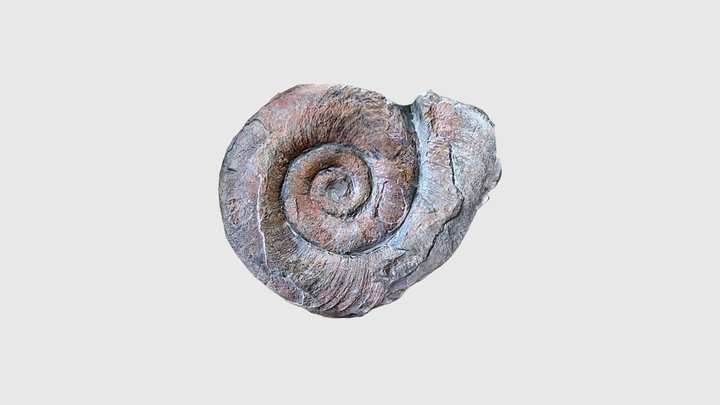
3D model
- Source
- Sketchfab
- Credit
- Adrian Gyllingberg
- Licence
- CC Attribution-NonCommercial-ShareAlike
- Commercial use
- the licence does not allow it
The description on this site
- Source
- Wikipedia, “Discoceras”
- Licence
- CC BY-SA 4.0
This is what the site found, which is not the same as what exists.
Keep going
What may have been alongside itArietitinae through timeFormations of the Early JurassicThe world it lived on
Occurrence data from the Paleobiology Database, CC BY 4.0. Hyatt 1867