Dissorophoidea
Dissorophoidea is a clade of medium-sized, temnospondyl amphibians that appeared during the Moscovian in Euramerica, and continued through to the Late Permian and the Early Triassic of Gondwana. They are distinguished by various details of the skull, and many species seem to have been well adapted for life on land.

Jay Malone from Casselberry, FL, USA · CC BY 2.0 · via Wikipedia/Commons. May be a photograph of a specimen, or an artist’s reconstruction — an interpretation of a skeleton, since colour and soft tissue are almost never preserved.
On record
Recorded, not inferred- Sits inside
- RhachitomiPBDB
- Diet
- carnivorePBDB, for Temnospondyli
- Life habit
- amphibiousPBDB, for Temnospondyli
- Motility
- actively mobilePBDB, for Temnospondyli
- Environment
- brackish,freshwater,terrestrialPBDB, for Tetrapoda
Time the record covers
At least 66 million years on record.
The record covers at least 318.6 Mya to 251.902 Mya. No occurrence read is dated outside 358.86 Mya to 247 Mya.
255 occurrences of Dissorophoidea on record, most of them in the Permian. The Paleobiology Database records this as a living group, and the chart stops with its fossils rather than at the present. Bar height is expected occurrences, not a count: each fossil is spread across the span it is dated to, so a tall narrow bar means tight dating and a low wide one means loose.
When
255 occurrencesThese are dates about fossils, not the animal: the record can only begin after it arose and end before it died out, so either end may reach further. Shares are expected occurrences: a fossil dated to a span is counted partly in each period it straddles. More on what this infers.
Found in
67 formations
- Meisenheim Formation · Glan Group20
- Arroyo Formation · Clear Fork Group13
- Pottsville Formation12
- Katberg Formation · Beaufort Group11
- Cutler Formation10
- Kladno Formation8
Loading coastlines…
The named rock units Dissorophoidea has been recovered from, largest first. Drawn where the rock is now, not where it formed. 43 further formations hold fewer occurrences each and are not listed. 51 occurrences have no formation on record, which is common for older literature.
Dissorophoidea and its relatives
PermianWhere Dissorophoidea and its relatives were recorded in the Permian.
Found in the same rock
750 taxa- Apateon pedestris15 sites
- Eryops15 sites
- Diadectes12 sites
- Micropholis stowi12 sites
- Captorhinus aguti11 sites
- Diplocaulus11 sites
- Platyhystrix rugosus10 sites
- Sphenacodon ferox10 sites
- Dimetrodon9 sites
- Ophiacodon9 sites
- Trimerorhachis9 sites
- Sclerocephalus haeuseri8 sites
- Xenacanthus8 sites
- Acanthodes7 sites
- Apateon flagrifer7 sites
- Dissorophus multicinctus7 sites
- Ophiacodon mirus7 sites
- Aspidosaurus6 sites
- Brachydectes newberryi6 sites
- Chenoprosopus milleri6 sites
- Edaphosaurus6 sites
- Eryops grandis6 sites
- Melanerpeton6 sites
- Trimerorhachis insignis6 sites
The Paleobiology Database records 145 sites for Dissorophoidea, and this reads all of them. The number is how many of those sites it was catalogued from too. The 24 sharing the most are listed.
This is not a list of everything alive at the time. It is only what has come out of the same ground as this animal and been written down.
Entered from
108 references- Handbook of Paleoherpetology Part 3A2 Temnospondyli I66
- The amphibamid Micropholis from the Lystrosaurus Assemblage Zone of South Africa11
- Vertebrate faunal horizons in the Texas Permo-Carboniferous red beds9
- Footprints from the coal measures of Alabama7
- Early Permian Vertebrate Assemblage and its Biostratigraphic Significance, Arroyo del Agua, Rio Arriba County, New Mexico6
- On the fossil Amphibia from the Gas Coal of Nyrany and other deposits of Czechoslovakia5
- Research by the Museum of Eastern Bohemia in Hradec Králové on significant localities with Permian faunas in the Bohemian Massif – Part I – Krkonoše Piedmont Basin, Rudník member4
- Morphology, Phylogeny, and Evolution of Diadectidae (Cotylosauria: Diadectomorpha)4
- Dissorophoid amphibians from the Carboniferous-Permian boundary of France3
- Earliest ‘nursery ground’ of temnospondyl amphibians in the Permian3
- Reappraisal of the Early Permian amphibamid Tersomius texensis and some referred material3
- Climatic and biotic changes around the Carboniferous/Permian boundary recorded in the continental basins of the Czech Republic3
Each of the 255 occurrences read was entered from one of these publications, ordered by how many each accounts for. This is not a search for papers mentioning the name. 96 further references are not listed. Entries link to doi.org where the Paleobiology Database holds an identifier, and to its own record where it does not. Relayed as the Paleobiology Database holds them, not checked against what they resolve to.
Media and terms
Media content2
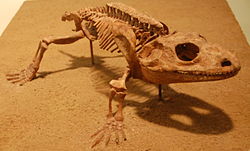
Picture of Dissorophoidea
- Source
- Wikipedia/Commons
- Credit
- Jay Malone from Casselberry, FL, USA
- Licence
- CC BY 2.0
- Commercial use
- the licence allows it
CT scan
- Source
- MorphoSource
- Licence
- In Copyright
- Commercial use
- cannot be read from the licence given — check the record
- Specimen
- Dissorophoidea indet. · fmnh:PR 558
Smithsonian Open Access was not reached for this taxon, so this list is what the others held rather than everything there is.
The description on this site
- Licence
- CC BY-SA 4.0
This is what the site found, which is not the same as what exists.
Keep going
What may have been alongside itRhachitomi through timeFormations of the PermianThe world it lived on
Occurrence data from the Paleobiology Database, CC BY 4.0. (Bolt 1969)