Dreissena
Dreissena is a genus of small freshwater mussels in the family Dreissenidae in the class Bivalvia. They are found attached to firm substrates by threads from underneath the shells and are the only freshwater bivalves to attach to hard substrates in high densities while having a planktonic larval stage. They are considered the most aggressive freshwater invader in the world because of their ability to invade environments in every one of their life cycle.

Uncredited · Public Domain · via Wikipedia/Commons. May be a photograph of a specimen, or an artist’s reconstruction — an interpretation of a skeleton, since colour and soft tissue are almost never preserved.
On record
Recorded, not inferred- Sits inside
- DreissenidaePBDB
- Diet
- suspension feederPBDB, for Dreissenidae
- Life habit
- epifaunalPBDB, for Dreissenidae
- Motility
- stationary, attachedPBDB, for Dreissenidae
- Vision
- blindPBDB, for Bivalvia
Time the record covers
At least 72 million years on record.
The record covers at least 72.2 Mya to 129 ka. No occurrence read is dated outside 83.6 Mya to 11.7 ka.
25 occurrences of Dreissena on record, most of them in the Miocene. The Paleobiology Database records this as a living group. Bar height is expected occurrences, not a count: each fossil is spread across the span it is dated to, so a tall narrow bar means tight dating and a low wide one means loose.
When
25 occurrences- Late Cretaceous8%
- Eocene20%
- Oligocene4%
- Miocene56%
- Pleistocene12%
These are dates about fossils, not the animal: the record can only begin after it arose and end before it died out, so either end may reach further. Shares are expected occurrences: a fossil dated to a span is counted partly in each period it straddles. More on what this infers.
Found in
6 formations
- facies à Congeria Formation7
- Headon Beds Formation2
- Corsicana Marl Formation1
- Black Creek Formation1
- Hempstead Formation1
- Boteni Formation1
Loading coastlines…
The named rock units Dreissena has been recovered from, largest first. Drawn where the rock is now, not where it formed. 12 occurrences have no formation on record, which is common for older literature.
Dreissena and its relatives
MioceneWhere Dreissena and its relatives were recorded in the Miocene.
Found in the same rock
319 taxa- Pontalmyra8 sites
- Agriolimacidae7 sites
- Anguinae7 sites
- Apodemus atavus7 sites
- Apodemus gudrunae7 sites
- Centralomys benericettii7 sites
- Chiroptera7 sites
- Cochlostoma esuanum7 sites
- Glis minor7 sites
- Lacerta7 sites
- Latonia7 sites
- Limax fossilis7 sites
- Melanoides curvicosta7 sites
- Melanopsis narzolina7 sites
- Micromys bendai7 sites
- Milacidae7 sites
- Muscardinus vireti7 sites
- Neocricetodon7 sites
- Neomyiini indet.7 sites
- Nordsieckia pontica7 sites
- Occitanomys brailloni7 sites
- Paraethomys7 sites
- Parasorex ibericus7 sites
- Parmacella7 sites
The Paleobiology Database records 22 sites for Dreissena, and this reads all of them. The number is how many of those sites it was catalogued from too. The 24 sharing the most are listed.
This is not a list of everything alive at the time. It is only what has come out of the same ground as this animal and been written down.
Entered from
11 references- Late Messinian mollusks and vertebrates from Moncucco Torinese, north-western Italy. Paleoecological and paleoclimatological implications7
- Nekotoryye novyye dannyye o ponte Kolkhidy. Some new data on the Pontian in Colchis.6
- The Late Pleistocene mollusk fauna of Selitrennoye (Astrakhan province, Russia): A natural baseline for endemic Caspian Sea faunas3
- The Upper Eocene, comprising the Barton and Upper Bagshot Formations2
- Patterns of molluscan extinction and recovery across the Cretaceous-Tertiary boundary in east Texas; report on new outcrops1
- The Black Creek-Peedee formational contact (Upper Cretaceous) in the Cape Fear river region of North Carolina1
- Asupra unor Prosodacnine din Pontianul de la Boteni (jud. Arges) [Pontian Prosodacninae from Boteni (Arges Province)]1
- A Dorog környeki Eocen biofacies-vizsgalata [Study of the biofacies in the Eocene of the Dorog region]1
- A geological reconnaissance of the Dominican Republic1
- On the Tertiary fluvio-marine formation of the Isle of Wight1
- On the discovery of an alligator and of several new Mammalia in the Hordwell Cliff; with observations upon the geological phenomena of that locality1
Each of the 25 occurrences read was entered from one of these publications, ordered by how many each accounts for. This is not a search for papers mentioning the name. Entries link to doi.org where the Paleobiology Database holds an identifier, and to its own record where it does not. Relayed as the Paleobiology Database holds them, not checked against what they resolve to.
Media and terms
Media content2
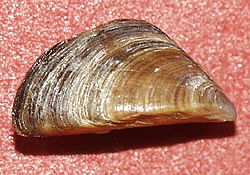
Picture of Dreissena
- Source
- Wikipedia/Commons
- Credit
- nobody named on the record
- Licence
- Public Domain
- Commercial use
- the licence allows it
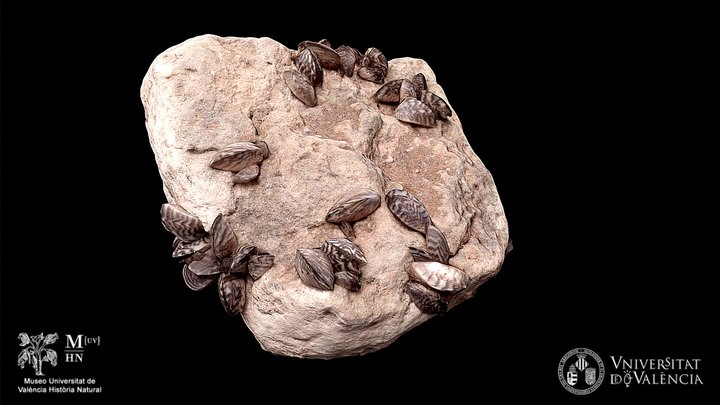
3D model
- Source
- Sketchfab
- Licence
- CC Attribution
- Commercial use
- cannot be read from the licence given — check the record
Smithsonian Open Access and MorphoSource were not reached for this taxon, so this list is what the others held rather than everything there is.
The description on this site
- Source
- Wikipedia, “Dreissena”
- Licence
- CC BY-SA 4.0
This is what the site found, which is not the same as what exists.
Keep going
What may have been alongside itDreissenidae through timeFormations of the MioceneThe world it lived on
Occurrence data from the Paleobiology Database, CC BY 4.0. Beneden 1835