Echinidae
Echinidae is a family of sea urchins in the order Camarodonta. Members of the family are found in the Atlantic Ocean and the Antarctic.

Marco Busdraghi · CC BY 3.0 · via Wikipedia/Commons. May be a photograph of a specimen, or an artist’s reconstruction — an interpretation of a skeleton, since colour and soft tissue are almost never preserved.
On record
Recorded, not inferred- Sits inside
- EchinideaPBDB
- Diet
- grazer, deposit feederPBDB, for Echinoidea
- Life habit
- epifaunalPBDB, for Echinoidea
- Motility
- actively mobilePBDB, for Echinoidea
- Vision
- limitedPBDB, for Echinoidea
- Environment
- marinePBDB, for Echinodermata
Time the record covers
At least 372 million years on record.
The record covers at least 372.15 Mya to 11.7 ka. No occurrence read is dated outside 382.31 Mya to 0 Mya.
139 occurrences of Echinidae on record, most of them in the Miocene. The Paleobiology Database records this as a living group. Bar height is expected occurrences, not a count: each fossil is spread across the span it is dated to, so a tall narrow bar means tight dating and a low wide one means loose.
When
139 occurrences- Devonian2%
- Middle Triassicunder 1%
- Early Jurassic1%
- Middle Jurassicunder 1%
- Early Cretaceous18%
- Late Cretaceous2%
- Paleoceneunder 1%
- Eocene8%
- Oligocene5%
- Miocene26%
- Pliocene8%
- Pleistocene19%
- Holocene8%
These are dates about fossils, not the animal: the record can only begin after it arose and end before it died out, so either end may reach further. Shares are expected occurrences: a fossil dated to a span is counted partly in each period it straddles. More on what this infers.
Found in
49 formations
- Yorktown Formation · Chesapeake Group6
- San Julian Formation4
- Casamayor Formation4
- calcaires à Choffatelles et Dasycladacées Formation3
- Marno-calcaires à Heteraster oblongus Formation3
- Kattendijk, Lillo Formation2
Loading coastlines…
The named rock units Echinidae has been recovered from, largest first. Drawn where the rock is now, not where it formed. 25 further formations hold fewer occurrences each and are not listed. 69 occurrences have no formation on record, which is common for older literature.
Echinidae and its relatives
MioceneWhere Echinidae and its relatives were recorded in the Miocene.
Found in the same rock
1,706 taxa- Paracentrotus29 sites
- Psammechinus29 sites
- Ostrea21 sites
- Pecten16 sites
- Cardium15 sites
- Turritella14 sites
- Chlamys12 sites
- Serpulidae12 sites
- Choffatella decipiens11 sites
- Bryozoa10 sites
- Conus10 sites
- Glycymeris10 sites
- Arca9 sites
- Cidaris9 sites
- Clypeaster9 sites
- Decapoda9 sites
- Anadara8 sites
- Cypraea8 sites
- Miliolidae8 sites
- Ostreidae8 sites
- Panopea8 sites
- Serpula8 sites
- Vermetus8 sites
- Chordata7 sites
The Paleobiology Database records 120 sites for Echinidae, and this reads all of them. The number is how many of those sites it was catalogued from too. The 24 sharing the most are listed.
This is not a list of everything alive at the time. It is only what has come out of the same ground as this animal and been written down.
Entered from
60 references- Humans and marine resource interaction reappraised: Archaeofauna remains during the late Pleistocene and Holocene in Cantabrian Spain27
- Recherches géologiques sur le Crétacé inférieur de l'Estremadura (Portugal)18
- Note sur la géologie et la paléontologie de la Patagonie7
- Les formations recifales coralliennes du Miocene superieur d'Algerie et du Maroc [Upper Miocene coral reef formations from Algeria and Morocco]5
- Upper Miocene Echinoids from the Yorktown Formation of Virginia and their environmental significance5
- Cenozoic Regular Echinoids of Eastern United States5
- Jura Vaudois et Neuchatelois5
- Middle to Late Eocene invertebrate fauna from the San Julian Formation at Punta Casamayor, Santa Cruz Province, Southern Argentina4
- Drowning, extinction, and subsequent facies development of the Devonian Hönne Valley Reef (northern Rhenish Massif, Germany)3
- Echinoid assemblages from the early Miocene of Funtanazza (Sardinia): A tool for reconstructing depositional environments along a shelf gradient3
- Macrofauna del Pleistocene inferiore di Cinisi (Sicilia)3
- Palaeoecology and taphonomy of spatangoid-dominated echinoid assemblages: A case study from the Early-Middle Miocene of Sardinia, Italy2
Each of the 139 occurrences read was entered from one of these publications, ordered by how many each accounts for. This is not a search for papers mentioning the name. 47 further references are not listed. Entries link to doi.org where the Paleobiology Database holds an identifier, and to its own record where it does not. Relayed as the Paleobiology Database holds them, not checked against what they resolve to.
Media and terms
Media content1
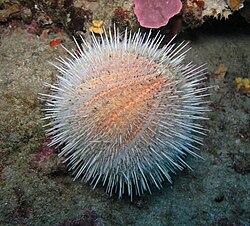
Picture of Echinidae
- Source
- Wikipedia/Commons
- Credit
- Marco Busdraghi
- Licence
- CC BY 3.0
- Commercial use
- the licence allows it
No 3D scan of Echinidae was found in MorphoSource and Sketchfab.
Smithsonian Open Access was not reached for this taxon, so this list is what the others held rather than everything there is.
The description on this site
- Source
- Wikipedia, “Echinidae”
- Licence
- CC BY-SA 4.0
This is what the site found, which is not the same as what exists.
Keep going
What may have been alongside itEchinidea through timeFormations of the MioceneThe world it lived on
Occurrence data from the Paleobiology Database, CC BY 4.0. Gray 1825