Cidaris
Cidaris is a genus of pencil sea urchins.

Didier Descouens · CC BY-SA 3.0 · via Wikipedia/Commons. May be a photograph of a specimen, or an artist’s reconstruction — an interpretation of a skeleton, since colour and soft tissue are almost never preserved.
On record
Recorded, not inferred- Sits inside
- CidaridaePBDB
- Diet
- grazer, omnivorePBDB, for Cidaroida
- Life habit
- low-level epifaunalPBDB, for Cidaroida
- Motility
- slow-movingPBDB, for Cidaroida
- Vision
- limitedPBDB, for Echinoidea
- Environment
- marinePBDB, for Cidaroida
Time the record covers
At least 244 million years on record.
The record covers at least 245.19 Mya to 774 ka. No occurrence read is dated outside 251.902 Mya to 11.7 ka.
395 occurrences of Cidaris on record, most of them in the Late Triassic. The Paleobiology Database records this as a living group. Bar height is expected occurrences, not a count: each fossil is spread across the span it is dated to, so a tall narrow bar means tight dating and a low wide one means loose.
When
395 occurrences- Early Triassicunder 1%
- Middle Triassic17%
- Late Triassic23%
- Early Jurassicunder 1%
- Middle Jurassic2%
- Late Jurassic9%
- Early Cretaceous15%
- Late Cretaceous5%
- Paleocene5%
- Eocene12%
- Oligocene2%
- Miocene6%
- Pliocene1%
- Pleistocene1%
These are dates about fossils, not the animal: the record can only begin after it arose and end before it died out, so either end may reach further. Shares are expected occurrences: a fossil dated to a span is counted partly in each period it straddles. More on what this infers.
Found in
86 formations
- Cassian Formation · Wegen Group44
- Qingyan Formation37
- Coral Rag de Trouville Formation12
- Santee Limestone Formation11
- Castle Hayne Formation11
- Pantano Formation10
Loading coastlines…
The named rock units Cidaris has been recovered from, largest first. Drawn where the rock is now, not where it formed. 62 further formations hold fewer occurrences each and are not listed. 132 occurrences have no formation on record, which is common for older literature.
Cidaris and its relatives
Late TriassicWhere Cidaris and its relatives were recorded in the Late Triassic.
Found in the same rock
3,420 taxa- Ostrea43 sites
- Echinoidea35 sites
- Pecten31 sites
- Bryozoa26 sites
- Lima26 sites
- Terebratula26 sites
- Rhynchonella25 sites
- Plagiostoma24 sites
- Bivalvia23 sites
- Chlamys23 sites
- Pteria23 sites
- Pleurotomaria22 sites
- Arca21 sites
- Gastropoda21 sites
- Cassianella19 sites
- Cerithium19 sites
- Turritella19 sites
- Encrinus liliiformis18 sites
- Cardium17 sites
- Eucycloscala17 sites
- Lithophaga17 sites
- Nerinea17 sites
- Plicatula17 sites
- Porifera17 sites
The Paleobiology Database records 269 sites for Cidaris, and this reads 240 of them. The number is how many of those sites it was catalogued from too. The 24 sharing the most are listed.
This is not a list of everything alive at the time. It is only what has come out of the same ground as this animal and been written down.
Entered from
131 references- Fossilvergesellschaftungen, Paläoökologie und paläosynökologische Entwicklung im Oberen Anisium (Mittlere Trias) von Qingyan, insbesondere Bangtoupo, Provinz Guizhou, Südwestchina37
- Jura Vaudois et Neuchatelois21
- Primary collection data of Cassian Formation used for publication of Fürsich and Wendt (1977) (ref. 9188)19
- Unpublished data18
- The Mesozoic and Cenozoic Echinodermata of the United States15
- Eocene biostratigraphy of South Carolina and its relationship to Gulf Coastal Plain zonations and global changes of coastal onlap12
- The Echinoids of the Middle Eocene Warley Hill Formation, Santee Limestone, and Castle Hayne Limestone of North and South Carolina11
- I cidaroidi (Echinoidea) del Miocene inferiore-medio dell'Emilia-Romagna e di San Marino10
- Mitteltriadische Echinoideen des Aggteleker Karstes (Nordungarn)9
- Fossili di Cortina. Atlante degli Echinodermi Cassiani Trias Medio Superiore della regione dolomitica attorno a Cortina d'Ampezzo9
- Echinides du Crétacé inférieur de la Hongrie8
- Triassic Echinoderms of Bakony8
Each of the 395 occurrences read was entered from one of these publications, ordered by how many each accounts for. This is not a search for papers mentioning the name. 119 further references are not listed. Entries link to doi.org where the Paleobiology Database holds an identifier, and to its own record where it does not. Relayed as the Paleobiology Database holds them, not checked against what they resolve to.
Media and terms
Media content3

Picture of Cidaris
- Source
- Wikipedia/Commons
- Credit
- Didier Descouens
- Licence
- CC BY-SA 3.0
- Commercial use
- the licence allows it
Photogrammetry
- Source
- MorphoSource
- Licence
- not stated by the source
- Commercial use
- cannot be read from the licence given — check the record
- Specimen
- cidaris venulosa · MST:PALEO:MST-SP-628
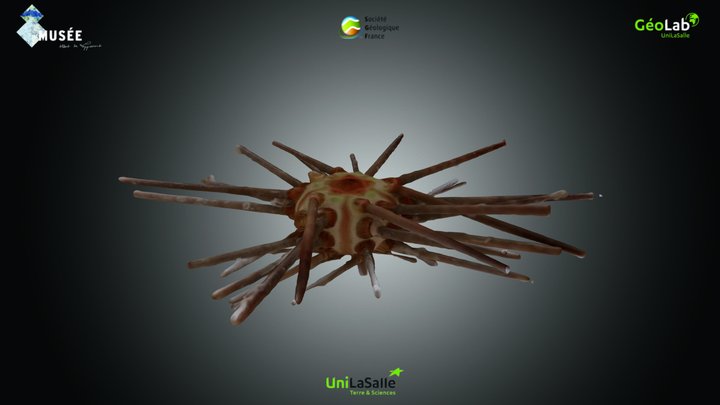
3D model
- Source
- Sketchfab
- Licence
- CC Attribution-NonCommercial-ShareAlike
- Commercial use
- the licence does not allow it
Smithsonian Open Access was not reached for this taxon, so this list is what the others held rather than everything there is.
The description on this site
- Source
- Wikipedia, “Cidaris”
- Licence
- CC BY-SA 4.0
This is what the site found, which is not the same as what exists.
Keep going
What may have been alongside itCidaridae through timeFormations of the Late TriassicThe world it lived on
Occurrence data from the Paleobiology Database, CC BY 4.0. Leske 1778