Effigia okeeffeae
Effigia is an extinct genus of shuvosaurid known from the Late Triassic of New Mexico, south-western USA. With a bipedal stance, long neck, and a toothless beaked skull, Effigia and other shuvosaurids bore a resemblance to the ornithomimid dinosaurs of the Cretaceous Period. However, shuvosaurids were not dinosaurs, but were instead a specialized family of poposauroid pseudosuchians, meaning that their closest living relatives are crocodilians.

Neil Pezzoni · CC BY 4.0 · via Wikipedia/Commons. May be a photograph of a specimen, or an artist’s reconstruction — an interpretation of a skeleton, since colour and soft tissue are almost never preserved.
On record
Recorded, not inferred- Sits inside
- EffigiaPBDB
- Diet
- carnivorePBDB, for Pseudosuchia
- Motility
- actively mobilePBDB, for Osteichthyes
- Environment
- terrestrialPBDB, for Diapsida
Time the record covers
At most 4.3 million years on record.
The one occurrence read is dated to somewhere between 205.7 Mya and 201.4 Mya, which is a dating window rather than a span.
1 occurrence of Effigia okeeffeae on record, most of them in the Late Triassic. Bar height is expected occurrences, not a count: each fossil is spread across the span it is dated to, so a tall narrow bar means tight dating and a low wide one means loose.
When
1 occurrences- Late Triassic100%
These are dates about fossils, not the animal: the record can only begin after it arose and end before it died out, so either end may reach further. Shares are expected occurrences: a fossil dated to a span is counted partly in each period it straddles. More on what this infers.
Found in
1 formation
Loading coastlines…
The named rock units Effigia okeeffeae has been recovered from, largest first. Drawn where the rock is now, not where it formed.
Effigia okeeffeae and its relatives
Late TriassicWhere Effigia okeeffeae and its relatives were recorded in the Late Triassic.
Found in the same rock
19 taxa- Archosauriformes1 site
- Avicranium renestoi1 site
- Chinlea sorenseni1 site
- Coelophysis bauri1 site
- Crocodylomorpha1 site
- Daemonosaurus chauliodus1 site
- Darwinula1 site
- Drepanosauridae1 site
- Drepanosaurus1 site
- Eucoelophysis1 site
- Hesperosuchus agilis1 site
- Lasalichthys stewarti1 site
- Ptychotherates bucculentus1 site
- Redondasaurus bermani1 site
- Redondasaurus gregorii1 site
- Reptilia1 site
- Shipingia1 site
- Vancleavea campi1 site
- Whitakersaurus bermani1 site
The Paleobiology Database records 1 site for Effigia okeeffeae, and this reads all of them. The number is how many of those sites it was catalogued from too.
This is not a list of everything alive at the time. It is only what has come out of the same ground as this animal and been written down.
Entered from
1 referenceEach of the 1 occurrence read was entered from one of these publications, ordered by how many each accounts for. This is not a search for papers mentioning the name. Each entry links to doi.org. Relayed as the Paleobiology Database holds them, not checked against what they resolve to.
Media and terms
Media content1
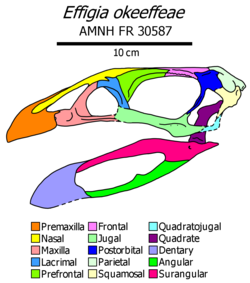
Picture of Effigia okeeffeae
- Source
- Wikipedia/Commons
- Credit
- Neil Pezzoni
- Licence
- CC BY 4.0
- Commercial use
- the licence allows it
No 3D scan of Effigia okeeffeae was found in Sketchfab.
Smithsonian Open Access and MorphoSource were not reached for this taxon, so this list is what the others held rather than everything there is.
The description on this site
- Source
- Wikipedia, “Effigia”
- Licence
- CC BY-SA 4.0
This is what the site found, which is not the same as what exists.
Keep going
What may have been alongside itEffigia through timeFormations of the Late TriassicThe world it lived on
Occurrence data from the Paleobiology Database, CC BY 4.0. Nesbitt and Norell 2006