Eomyidae
Eomyidae is a family of extinct rodents from North America and Eurasia related to modern day pocket gophers and kangaroo rats. They are known from the Middle Eocene to the Late Miocene in North America and from the Late Eocene to the Pleistocene in Eurasia. Eomyids were generally small, but occasionally large, and tended to be squirrel-like in form and habits. The family includes the earliest known gliding rodent, Eomys quercyi.

Nobu Tamura · CC BY 3.0 · via Wikipedia/Commons. May be a photograph of a specimen, or an artist’s reconstruction — an interpretation of a skeleton, since colour and soft tissue are almost never preserved.
On record
Recorded, not inferred- Sits inside
- GeomyoideaPBDB
- Diet
- herbivorePBDB, for Rodentia
- Life habit
- ground dwellingPBDB, for Rodentia
- Motility
- actively mobilePBDB, for Osteichthyes
- Environment
- terrestrialPBDB, for Eutheria
Time the record covers
At least 37 million years on record.
The record covers at least 39.7 Mya to 2.58 Mya. No occurrence read is dated outside 45.9 Mya to 774 ka.
726 occurrences of Eomyidae on record, most of them in the Eocene. Bar height is expected occurrences, not a count: each fossil is spread across the span it is dated to, so a tall narrow bar means tight dating and a low wide one means loose.
When
726 occurrences- Eocene34%
- Oligocene33%
- Miocene30%
- Pliocene2%
- Pleistoceneunder 1%
These are dates about fossils, not the animal: the record can only begin after it arose and end before it died out, so either end may reach further. Shares are expected occurrences: a fossil dated to a span is counted partly in each period it straddles. More on what this infers.
Found in
90 formations
- Chadron Formation · White River Group58
- Friars Formation · La Jolla Group48
- Brule Formation · White River Group47
- Cypress Hills Formation28
- White River Formation28
- Hsanda Gol Formation16
Loading coastlines…
The named rock units Eomyidae has been recovered from, largest first. Drawn where the rock is now, not where it formed. 66 further formations hold fewer occurrences each and are not listed. 265 occurrences have no formation on record, which is common for older literature.
Eomyidae and its relatives
EoceneWhere Eomyidae and its relatives were recorded in the Eocene.
Found in the same rock
2,115 taxa- Metanoiamys agorus47 sites
- Sciuravus powayensis36 sites
- Hesperocyon gregarius35 sites
- Paradjidaumo trilophus34 sites
- Brontotheriidae33 sites
- Patriolestes novaceki32 sites
- Herpetotherium knighti31 sites
- Microparamys minutus28 sites
- Uintasorex montezumicus27 sites
- Adjidaumo minutus25 sites
- Crypholestes vaughni25 sites
- Herpetotherium fugax25 sites
- Merycoidodontidae25 sites
- Chiroptera24 sites
- Centetodon aztecus21 sites
- Leptictidae21 sites
- Palaeolagus haydeni21 sites
- Ischyromys20 sites
- Palaeolagus temnodon20 sites
- Peradectes20 sites
- Didelphidae19 sites
- Megalagus turgidus19 sites
- Peradectes californicus19 sites
- Soricidae19 sites
The Paleobiology Database records 454 sites for Eomyidae, and this reads 240 of them. The number is how many of those sites it was catalogued from too. The 24 sharing the most are listed.
This is not a list of everything alive at the time. It is only what has come out of the same ground as this animal and been written down.
Entered from
211 references- Synonymies and reidentifications of North American fossil mammals61
- Kleinsäugerstratigraphie in der miozänen Hörnlischüttung (Ostschweiz); (Biostratigraphy of small mammals in the Hörnlischüttung of Miocene age (East Switzerland))33
- Correlation of the early Oligocene (Chadronian) in northwestern Nebraska30
- New data about the diversity of Early Oligocene eomyids (Mammalia, Rodentia) in Western Europe27
- Geomyoid rodents (Mammalia) from the Orellan (middle Oligocene) of Nebraska,23
- A New Genus of Eomyid Rodent (Mammalia) from the Eocene (Uintan-Duchesnean) of Southern California22
- Beiträge zur Biostratigraphie der Unteren Süßwasser-Molasse Süddeutschlands - Rodentia und Lagomorpha (Mammalia) aus den Fundstellen der Ulmer Gegend.22
- The eomyid rodents (Mammalia) from the Oligocene and Miocene of the Valley of Lakes (Central Mongolia)21
- Magnetostratigraphy and biostratigraphy of the Eocene-Oligocene transition, southwestern Montana15
- New specimens of Metanoiamys, Pauromys, and Simimys (Rodentia: Myomorpha) from the Uintan (middle Eocene) of San Diego County, California, and comments on the relationships of selected Paleogene Myomorpha13
- Decouvertes de faunes de micromammiferes dans les Pyrenees-Orientales (France) de l'Oligocene superieur au Miocene superieur; especes nouvelles et reflexion sur l'etalonnage des echelles continentale et marine. [New upper Oligocene to upper Miocene faunas of micromammals found in the Pyrenees-Orientales (France); new species of rodents and remarks about the calibration of marine and continental biochronological scales.]13
- Eocene-Oligocene faunas of the Cypress Hills Formation, Saskatchewan11
Each of the 726 occurrences read was entered from one of these publications, ordered by how many each accounts for. This is not a search for papers mentioning the name. 199 further references are not listed. Entries link to doi.org where the Paleobiology Database holds an identifier, and to its own record where it does not. Relayed as the Paleobiology Database holds them, not checked against what they resolve to.
Media and terms
Media content2
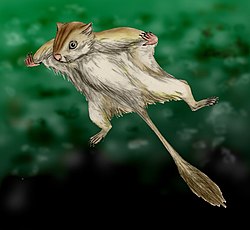
Picture of Eomyidae
- Source
- Wikipedia/Commons
- Credit
- Nobu Tamura
- Licence
- CC BY 3.0
- Commercial use
- the licence allows it
CT scan
- Source
- MorphoSource
- Licence
- not stated by the source
- Commercial use
- cannot be read from the licence given — check the record
- Specimen
- Eomyidae indet. · UF:VP:305361
The description on this site
- Source
- Wikipedia, “Eomyidae”
- Licence
- CC BY-SA 4.0
This is what the site found, which is not the same as what exists.
Keep going
What may have been alongside itGeomyoidea through timeFormations of the EoceneThe world it lived on
Occurrence data from the Paleobiology Database, CC BY 4.0. Winge 1887