Ephemeroptera
Mayflies are aquatic insects belonging to the order Ephemeroptera. This order is part of an ancient group of insects termed the Palaeoptera, which also contains dragonflies and damselflies. Over 3,000 species of mayfly are known worldwide, grouped into over 400 genera in 42 families.

Richard Bartz , Munich aka Makro Freak Image:MFB.jpg · CC BY-SA 2.5 · via Wikipedia/Commons. May be a photograph of a specimen, or an artist’s reconstruction — an interpretation of a skeleton, since colour and soft tissue are almost never preserved.
On record
Recorded, not inferred- Also called
- mayflyPBDB
- Sits inside
- HeptabranchiaPBDB
- Motility
- actively mobilePBDB, for Arthropoda
- Environment
- terrestrialPBDB, for Insecta
Time the record covers
At least 296 million years on record.
The record covers at least 300.3 Mya to 3.6 Mya. No occurrence read is dated outside 307.4 Mya to 2.58 Mya.
460 occurrences of Ephemeroptera on record, most of them in the Early Cretaceous. The Paleobiology Database records this as a living group, and the chart stops with its fossils rather than at the present. Bar height is expected occurrences, not a count: each fossil is spread across the span it is dated to, so a tall narrow bar means tight dating and a low wide one means loose.
When
460 occurrences- Carboniferousunder 1%
- Permianunder 1%
- Middle Triassic2%
- Late Triassicunder 1%
- Early Jurassic4%
- Middle Jurassic3%
- Late Jurassic14%
- Early Cretaceous36%
- Late Cretaceous9%
- Paleoceneunder 1%
- Eocene23%
- Oligoceneunder 1%
- Miocene6%
- Plioceneunder 1%
These are dates about fossils, not the animal: the record can only begin after it arose and end before it died out, so either end may reach further. Shares are expected occurrences: a fossil dated to a span is counted partly in each period it straddles. More on what this infers.
Found in
85 formations
- Crato Formation · Santana Group57
- Turga Formation22
- Yixian Formation · Jehol Group14
- Glushkovo Formation14
- Florissant Formation12
- Cheremkhovskaya Formation12
Loading coastlines…
The named rock units Ephemeroptera has been recovered from, largest first. Drawn where the rock is now, not where it formed. 61 further formations hold fewer occurrences each and are not listed. 153 occurrences have no formation on record, which is common for older literature.
Ephemeroptera and its relatives
Early CretaceousWhere Ephemeroptera and its relatives were recorded in the Early Cretaceous.
Found in the same rock
7,108 taxa- Ephemeropsis trisetalis37 sites
- Mesobaetis sibirica18 sites
- Ephemeropsis15 sites
- Orthoptera12 sites
- Proameletus caudatus11 sites
- Insecta10 sites
- Stygeonectes jurassicus10 sites
- Coleoptera9 sites
- Araneae8 sites
- Aeschnogomphus intermedius7 sites
- Chresmoda obscura7 sites
- Cymatophlebia longialata7 sites
- Diptera7 sites
- Hexagenites cellulosus7 sites
- Odonata7 sites
- Blattodea6 sites
- Bolbonyx ludibriosus6 sites
- Coptoclava longipoda6 sites
- Dicranomyia (Dicranomyia) lobata6 sites
- Ditomoptera dubia6 sites
- Elateridae6 sites
- Forcipomyia (Forcipomyia)6 sites
- Gesomyrmex hoernesi6 sites
- Isophlebia aspasia6 sites
The Paleobiology Database records 265 sites for Ephemeroptera, and this reads 240 of them. Of that, one read hit the database's own return limit, so every count below is a floor rather than a total. The number is how many of those sites it was catalogued from too. The 24 sharing the most are listed.
This is not a list of everything alive at the time. It is only what has come out of the same ground as this animal and been written down.
Entered from
178 references- Mayflies. Ephemerida, in Pozdne-Mezozoyskie Nasekomye Vostochnogo Zabaykal'ya46
- Jurskie podenki (Ephemerida-Ephemeroptera) yuzhnoy Sibiri i zapadnoy Mongolii29
- Deuxième contribution à la connaissance des Éphéméroptères de l'ambre oligocène de la Baltique26
- Martill et al., 200718
- Insects from the Santana Formation, Lower Cretaceous of Brazil. Chapter 2: Ephemeroptera15
- New mayflies from the upper Mesozoic Transbaikalian locality Chernovskie Kopi (Insecta: Ephemerida = Ephemeroptera)12
- New Mayflies (Insecta, Ephemeroptera) from the Santana Formation (Lower Cretaceous), Araripe Basin, Northeastern Brazil8
- The Tertiary Insects of North America8
- Die im Bernstein befindlichen Neuropteren der Vorwelt8
- Revision of fossil Metretopodidae (Insecta, Ephemeroptera) in Baltic amber – Part 4: Description of two new species of Siphloplecton Clemens, 1915, with notes on the new S. jaegeri species group and with key to fossil male adults of Siphloplecton7
- Revision of fossil Metretopodidae (Insecta: Ephemeroptera) in Baltic amber – Part 1: Type specimens of hitherto described fossil species of Siphloplecton Clemens, 1915 and Metretopus Eaton, 1901; with description of four new fossil species of Siphloplecton7
- New mayflies (Insecta: Ephemerida = Ephemeroptera) from the Upper Mesozoic locality of Khasurty, western Transbaikalia6
Each of the 460 occurrences read was entered from one of these publications, ordered by how many each accounts for. This is not a search for papers mentioning the name. 166 further references are not listed. Entries link to doi.org where the Paleobiology Database holds an identifier, and to its own record where it does not. Relayed as the Paleobiology Database holds them, not checked against what they resolve to.
Media and terms
Media content1
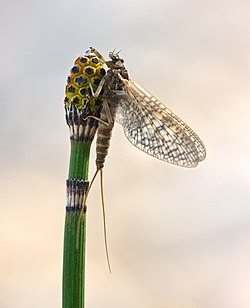
Picture of Ephemeroptera
- Source
- Wikipedia/Commons
- Credit
- Richard Bartz , Munich aka Makro Freak Image:MFB.jpg
- Licence
- CC BY-SA 2.5
- Commercial use
- the licence allows it
No 3D scan was found. Smithsonian Open Access, MorphoSource and Sketchfab were all searched.
The description on this site
- Source
- Wikipedia, “Mayfly”
- Licence
- CC BY-SA 4.0
This is what the site found, which is not the same as what exists.
Keep going
What may have been alongside itHeptabranchia through timeFormations of the Early CretaceousThe world it lived on
Occurrence data from the Paleobiology Database, CC BY 4.0. Hyatt and Arms 1890