Epihippus
Epihippus is an extinct genus of the modern horse family Equidae that lived in the Eocene, from 46 to 38 million years ago.

Internet Archive Book Images · No restrictions · via Wikipedia/Commons. May be a photograph of a specimen, or an artist’s reconstruction — an interpretation of a skeleton, since colour and soft tissue are almost never preserved.
On record
Recorded, not inferred- Sits inside
- EquidaePBDB
- Diet
- browserPBDB, for Equidae
- Life habit
- ground dwellingPBDB, for Equidae
- Motility
- actively mobilePBDB, for Osteichthyes
- Environment
- terrestrialPBDB, for Eutheria
Time the record covers
At most 12 million years on record.
Every occurrence read is dated to somewhere between 48.07 Mya and 37 Mya, and nothing in the dating separates them, so that window is what the record shows rather than a span.
46 occurrences of Epihippus on record, most of them in the Eocene. Bar height is expected occurrences, not a count: each fossil is spread across the span it is dated to, so a tall narrow bar means tight dating and a low wide one means loose.
When
46 occurrences- Eocene100%
These are dates about fossils, not the animal: the record can only begin after it arose and end before it died out, so either end may reach further. Shares are expected occurrences: a fossil dated to a span is counted partly in each period it straddles. More on what this infers.
Found in
14 formations
- Uinta Formation16
- Tepee Trail Formation7
- Wagon Bed ("Tepee Trail") Formation5
- Colmena Tuff Formation3
- Washakie Formation3
- Wiggins Formation3
Loading coastlines…
The named rock units Epihippus has been recovered from, largest first. Drawn where the rock is now, not where it formed.
Epihippus and its relatives
EoceneWhere Epihippus and its relatives were recorded in the Eocene.
Found in the same rock
428 taxa- Hyopsodus uintensis10 sites
- Protoreodon pumilus10 sites
- Protoreodon petersoni9 sites
- Amynodon advenus8 sites
- Protoreodon8 sites
- Amynodon7 sites
- Colodon woodi7 sites
- Herpetotherium knighti7 sites
- Isectolophus annectens7 sites
- Mytonolagus petersoni7 sites
- Ourayia uintensis7 sites
- Uintaparamys7 sites
- Heteraletes leotanus6 sites
- Microparamys dubius6 sites
- Tapocyon robustus6 sites
- Triplopus obliquidens6 sites
- Brontotheriidae5 sites
- Bunomeryx montanus5 sites
- Diplobunops matthewi5 sites
- Harpagolestes uintensis5 sites
- Herpetotherium innominatum5 sites
- Leptoreodon5 sites
- Leptotragulus medius5 sites
- Macrotarsius siegerti5 sites
The Paleobiology Database records 41 sites for Epihippus, and this reads all of them. The number is how many of those sites it was catalogued from too. The 24 sharing the most are listed.
This is not a list of everything alive at the time. It is only what has come out of the same ground as this animal and been written down.
Entered from
18 references- Synonymies and reidentifications of North American fossil mammals13
- Stratigraphic Distribution of Upper Middle Eocene Fossil Vertebrate Localities in the Eastern Uinta Basin, Utah, With Comments on Uintan Biostratigraphy5
- Geometric morphometrics and anatomical network analyses reveal ecospace partitioning among geoemydid turtles from the Uinta Formation, Utah4
- Paleontology and Geology of the Badwater Creek Area, Central Wyoming. Part 19. Perissodactyla4
- Comparison of populations of Mesophippus from Trans-Pecos Texas and the Big Badlands, South Dakota3
- The Eocene Vertebrates of the Uinta Basin, Utah3
- New records of Epihippus (Equidae) and a rhinocerotoid perissodactyl from the middle Eocene Santiago Formation of southern California2
- Magnetic stratigraphy and biostratigraphy of the middle Eocene Uinta Formation, Uinta Basin, Utah2
- Paleontology and Correlation of the Eocene Tepee Trail and Wiggins Formations in the North Fork of Owl Creek Area, Southeastern Absaroka Range, Hot Springs County, Wyoming2
- Mammalian fauna of the Middle Eoene Kishenehn Formation, Middle Fork of the Flathead River, Montana1
- Mammals from the earliest Uintan (middle Eocene) Turtle Bluff Member, Bridger Formation, southwestern Wyoming, USA, Part 2: Apatotheria, Lipotyphla, Carnivoramorpha, Condylartha, Dinocerata, Perissodactyla and Artiodactyla1
- Palaeoecology of a primate-friendly, middle Eocene community from Laredo, Texas and a review of stratigraphic occurrences of Paleogene land mammals across the Gulf Coastal Plain, USA1
Each of the 46 occurrences read was entered from one of these publications, ordered by how many each accounts for. This is not a search for papers mentioning the name. 5 further references are not listed. Entries link to doi.org where the Paleobiology Database holds an identifier, and to its own record where it does not. Relayed as the Paleobiology Database holds them, not checked against what they resolve to.
Media and terms
Media content3

Picture of Epihippus
- Source
- Wikipedia/Commons
- Credit
- Internet Archive Book Images
- Licence
- No restrictions
- Commercial use
- cannot be read from the licence given — check the record
CT scan
- Source
- MorphoSource
- Licence
- In Copyright
- Commercial use
- cannot be read from the licence given — check the record
- Specimen
- Epihippus gracilis · fmnh:pm:55311
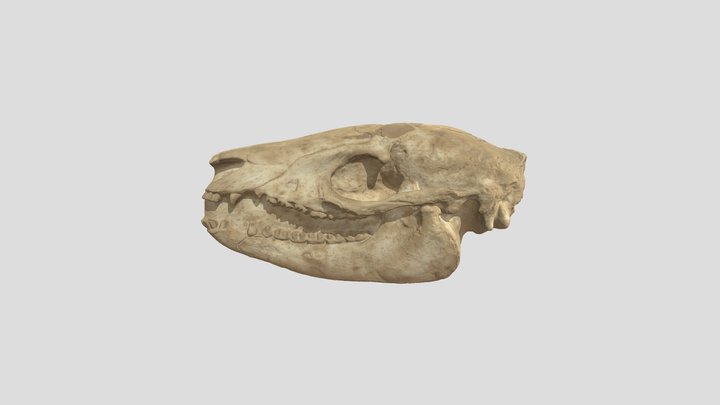
3D model
- Source
- Sketchfab
- Credit
- UIPaleoRepository
- Licence
- CC Attribution
- Commercial use
- cannot be read from the licence given — check the record
The description on this site
- Source
- Wikipedia, “Epihippus”
- Licence
- CC BY-SA 4.0
This is what the site found, which is not the same as what exists.
Keep going
What may have been alongside itEquidae through timeFormations of the EoceneThe world it lived on
Occurrence data from the Paleobiology Database, CC BY 4.0. Marsh 1878