Equini
Equini is the only living tribe of the subfamily Equinae, which has lived worldwide since the Hemingfordian stage of the Middle Miocene. It is considered to be a monophyletic clade.

Claudia Feh · CC BY-SA 4.0 · via Wikipedia/Commons. May be a photograph of a specimen, or an artist’s reconstruction — an interpretation of a skeleton, since colour and soft tissue are almost never preserved.
On record
Recorded, not inferred- Also called
- horsePBDB
- Sits inside
- EquinaePBDB
- Diet
- grazer, browserPBDB, for Equinae
- Life habit
- ground dwellingPBDB, for Equinae
- Motility
- actively mobilePBDB, for Osteichthyes
- Environment
- terrestrialPBDB, for Eutheria
Time the record covers
At least 23 million years on record.
The record covers at least 23.04 Mya to 11.7 ka. No occurrence read is dated outside 27.3 Mya to 0 Mya.
2,752 occurrences of Equini on record, most of them in the Pleistocene. The Paleobiology Database records this as a living group. Bar height is expected occurrences, not a count: each fossil is spread across the span it is dated to, so a tall narrow bar means tight dating and a low wide one means loose.
When
2,752 occurrences- Oligoceneunder 1%
- Miocene26%
- Pliocene11%
- Pleistocene61%
- Holocene2%
These are dates about fossils, not the animal: the record can only begin after it arose and end before it died out, so either end may reach further. Shares are expected occurrences: a fossil dated to a span is counted partly in each period it straddles. More on what this infers.
Found in
255 formations
- Koobi Fora Formation · Omo Group75
- Ash Hollow Formation · Ogallala Group71
- Palm Spring Formation71
- "unnamed sandstone" Formation62
- Valentine Formation · Ogallala Group61
- Shungura Formation · Omo Group43
Loading coastlines…
The named rock units Equini has been recovered from, largest first. Drawn where the rock is now, not where it formed. 231 further formations hold fewer occurrences each and are not listed. 1,472 occurrences have no formation on record, which is common for older literature.
Equini and its relatives
PleistoceneWhere Equini and its relatives were recorded in the Pleistocene.
Found in the same rock
968 taxa- Hippotherium56 sites
- Camelidae49 sites
- Teleoceras47 sites
- Gomphotheriidae40 sites
- Mylagaulidae38 sites
- Hipparionini37 sites
- Pseudhipparion gratum35 sites
- Teleoceras major35 sites
- Calippus martini31 sites
- Pliohippus pernix31 sites
- Epicyon saevus29 sites
- Epicyon haydeni28 sites
- Tayassuinae28 sites
- Procamelus grandis27 sites
- Aelurodon taxoides26 sites
- Archaeolaginae26 sites
- Aphelops megalodus25 sites
- Cosoryx furcatus25 sites
- Neohipparion eurystyle25 sites
- Calippus23 sites
- Gomphotherium23 sites
- Calippus placidus21 sites
- Calippus regulus21 sites
- Nannippus20 sites
The Paleobiology Database records at least 1,546 sites for Equini, and this reads 240 of them. The number is how many of those sites it was catalogued from too. The 24 sharing the most are listed.
This is not a list of everything alive at the time. It is only what has come out of the same ground as this animal and been written down.
Entered from
863 references- Synonymies and reidentifications of North American fossil mammals225
- Family Equidae74
- Biostratigraphy of Blancan and Irvingtonian mammals in the Fish Creek-Vallecito Creek section, southern California, and a review of the Blancan-Irvingtonian boundary72
- Phylogenetic Interrelationships and Evolution of North American Late Equidae61
- Calippus and Protohippus (Mammalia, Perissodactyla, Equidae) from the Miocene (Barstovian-early Hemphillian) of the Gulf Coastal Plain49
- Vertebrate biostratigraphy of the Ogallala Group in Nebraska44
- A review of the biostratigraphy of Pliocene and Pleistocene sediments in the Elsinore Fault Zone, Riverside County, California43
- Paleontology and nonmarine stratigraphy of the Cuyama Valley badlands, California; Part 1, Geology, faunal interpretations, and systematic descriptions of Chiroptera, Insectivora, and Rodentia35
- Cormohipparion and Hipparion (Mammalia, Perissodactyla, Equidae) from the Late Neogene of Florida33
- A catalogue of late Quaternary Vertebrates from California: Part Two, Mammals30
- The Early-Late Hemphillian (Hh2) Faunal Assemblage From Juchipila Basin, State of Zacatecas, Mexico, and Its Biochronologic Correlation with Other Hemphillian Faunas in Central Mexico22
- Mittelpleistozane Saugetierfaunen aus Mitteleuropa - der Versuch einer biostratigraphischen Zuordnung21
Each of the 2,752 occurrences read was entered from one of these publications, ordered by how many each accounts for. This is not a search for papers mentioning the name. 851 further references are not listed. Entries link to doi.org where the Paleobiology Database holds an identifier, and to its own record where it does not. Relayed as the Paleobiology Database holds them, not checked against what they resolve to.
Media and terms
Media content1
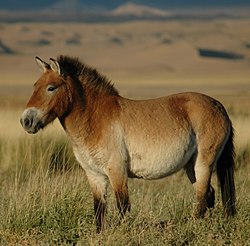
Picture of Equini
- Source
- Wikipedia/Commons
- Credit
- Claudia Feh
- Licence
- CC BY-SA 4.0
- Commercial use
- the licence allows it
No 3D scan was found. Smithsonian Open Access, MorphoSource and Sketchfab were all searched.
The description on this site
- Source
- Wikipedia, “Equini”
- Licence
- CC BY-SA 4.0
This is what the site found, which is not the same as what exists.
Keep going
Everything alive alongside itEquinae through timeFormations of the PleistoceneThe world it lived on
Occurrence data from the Paleobiology Database, CC BY 4.0. Quinn 1955