Eucryphia
Eucryphia is a small genus of trees and large shrubs native to the south temperate regions of South America and coastal eastern Australia, predominantly Tasmania. Some common names include leatherwood in Australia, and Ulmo, Nirre or Guindo santo in Argentina and Chile. Sometimes placed in a family of their own, the Eucryphiaceae, they are placed by more recent classifications in the Cunoniaceae. There are seven species, two in South America and five in Australia, and several named hybrids.

Cristian Ordenes · CC BY 2.0 · via Wikipedia/Commons. May be a photograph of a specimen, or an artist’s reconstruction — an interpretation of a skeleton, since colour and soft tissue are almost never preserved.
On record
Recorded, not inferred- Sits inside
- CunoniaceaePBDB
- Diet
- "photoautotroph"PBDB, for Angiospermae
Time the record covers
At least 55 million years on record.
The record covers at least 56 Mya to 129 ka. No occurrence read is dated outside 59.24 Mya to 11.7 ka.
17 occurrences of Eucryphia on record, most of them in the Pleistocene. The Paleobiology Database records this as a living group. Bar height is expected occurrences, not a count: each fossil is spread across the span it is dated to, so a tall narrow bar means tight dating and a low wide one means loose.
When
17 occurrences- Paleocene6%
- Eocene16%
- Oligocene34%
- Miocene2%
- Pleistocene41%
These are dates about fossils, not the animal: the record can only begin after it arose and end before it died out, so either end may reach further. Shares are expected occurrences: a fossil dated to a span is counted partly in each period it straddles. More on what this infers.
Found in
1 formation
Loading coastlines…
The named rock units Eucryphia has been recovered from, largest first. Drawn where the rock is now, not where it formed. 16 occurrences have no formation on record, which is common for older literature.
Eucryphia and its relatives
PleistoceneWhere Eucryphia and its relatives were recorded in the Pleistocene.
Found in the same rock
344 taxa- Agastachys4 sites
- Cenarrhenes4 sites
- Hakea3 sites
- Lomatia3 sites
- Araucaria2 sites
- Athrotaxis mesibovii2 sites
- Banksia kingii2 sites
- Coprosma2 sites
- Dacrycarpus linifolius2 sites
- Dicksonia2 sites
- Gephyrapollenites2 sites
- Nothofagidites2 sites
- Nothofagus2 sites
- Orites2 sites
- Phyllocladidites mawsonii2 sites
- Podocarpidites2 sites
- Podocarpus2 sites
- Proteacidites2 sites
- Symplocos2 sites
- Telopea2 sites
- Tricolpites2 sites
- Acacia1 site
- Acacia bulbosa1 site
- Acmopyle engelhardti1 site
The Paleobiology Database records 13 sites for Eucryphia, and this reads all of them. The number is how many of those sites it was catalogued from too. The 24 sharing the most are listed.
This is not a list of everything alive at the time. It is only what has come out of the same ground as this animal and been written down.
Entered from
4 references- Eucryphia (Cunoniaceae) Reproductive and Leaf Macrofossils from Australian Cainozoic Sediments11
- Leaves of Eucryphia (Eucryphiaceae) from tertiary sediments in south-eastern Australia4
- A fossil flora from rafted Plio Pleistocene mudstones at Regatta Point, Tasmania1
- Tertiary flora from the Rio Pichileufu, Argentina1
Each of the 17 occurrences read was entered from one of these publications, ordered by how many each accounts for. This is not a search for papers mentioning the name. Each entry links to doi.org. Relayed as the Paleobiology Database holds them, not checked against what they resolve to.
Media and terms
Media content1
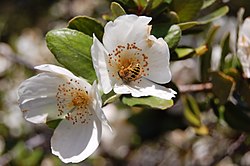
Picture of Eucryphia
- Source
- Wikipedia/Commons
- Credit
- Cristian Ordenes
- Licence
- CC BY 2.0
- Commercial use
- the licence allows it
No 3D scan of Eucryphia was found in Sketchfab.
Smithsonian Open Access and MorphoSource were not reached for this taxon, so this list is what the others held rather than everything there is.
The description on this site
- Source
- Wikipedia, “Eucryphia”
- Licence
- CC BY-SA 4.0
This is what the site found, which is not the same as what exists.
Keep going
What may have been alongside itCunoniaceae through timeFormations of the PleistoceneThe world it lived on
Occurrence data from the Paleobiology Database, CC BY 4.0. Cavanilles 1798