Euorthisina
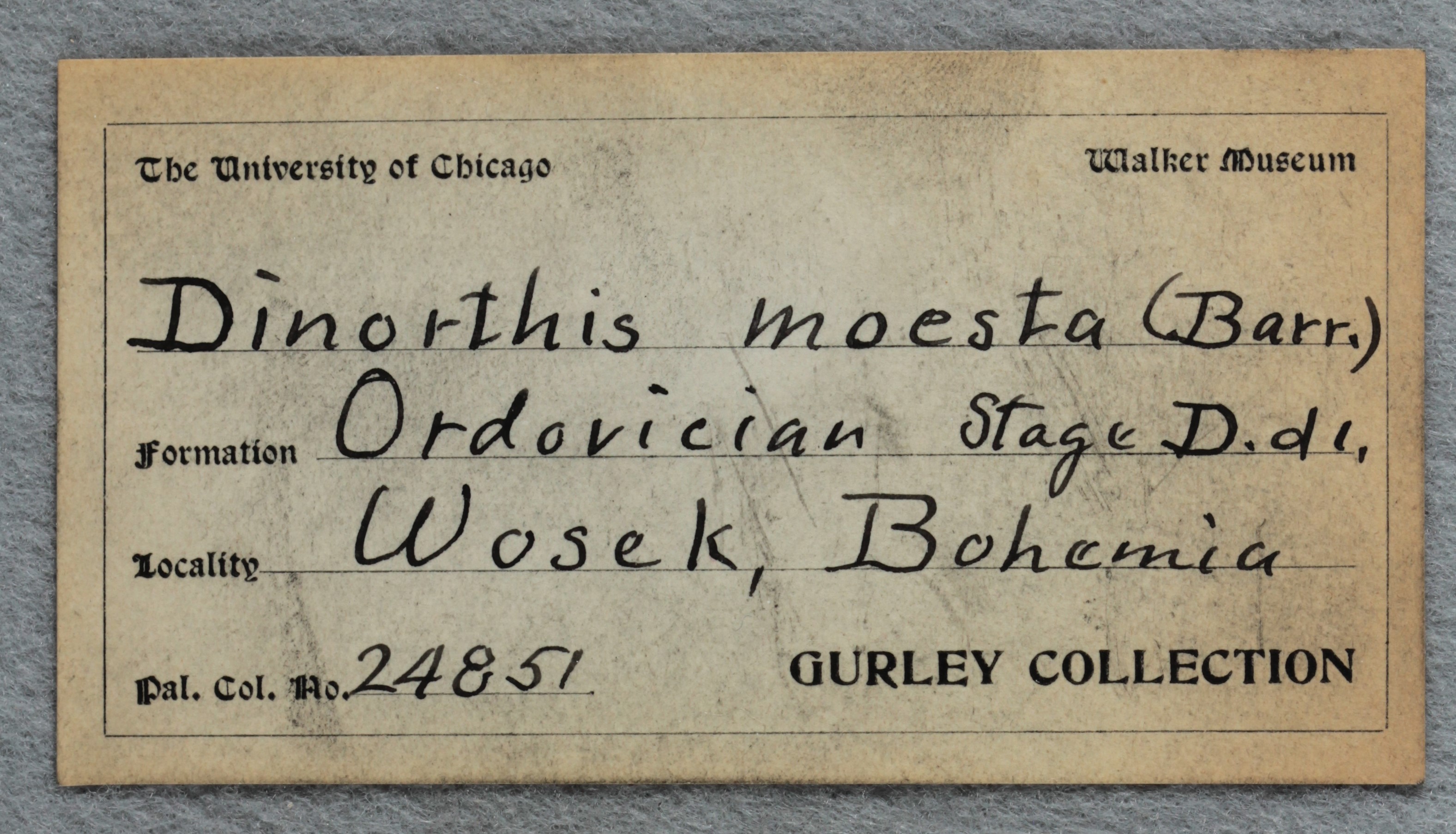
via iDigBio · via iDigBio. May be a photograph of a specimen, or an artist’s reconstruction — an interpretation of a skeleton, since colour and soft tissue are almost never preserved.
On record
Recorded, not inferred- Sits inside
- EuorthisinidaePBDB
- Diet
- suspension feederPBDB, for Orthida
- Life habit
- epifaunalPBDB, for Orthida
- Motility
- stationary, attachedPBDB, for Orthida
- Vision
- blindPBDB, for Rhynchonellata
- Environment
- marinePBDB, for Lophophorata
Time the record covers
At least 9.1 million years on record.
The record covers at least 477.1 Mya to 468 Mya. No occurrence read is dated outside 486.4 Mya to 458.2 Mya.
41 occurrences of Euorthisina on record, most of them in the Ordovician. Bar height is expected occurrences, not a count: each fossil is spread across the span it is dated to, so a tall narrow bar means tight dating and a low wide one means loose.
When
41 occurrences- Ordovician100%
These are dates about fossils, not the animal: the record can only begin after it arose and end before it died out, so either end may reach further. Shares are expected occurrences: a fossil dated to a span is counted partly in each period it straddles. More on what this infers.
Found in
11 formations
- Dawan Formation20
- Mytton Flags Formation5
- Tachilla Formation4
- Zhitai Formation3
- San José Formation3
- Mytton Flags and Tankerville Formation1
Loading coastlines…
The named rock units Euorthisina has been recovered from, largest first. Drawn where the rock is now, not where it formed.
Euorthisina and its relatives
OrdovicianWhere Euorthisina and its relatives were recorded in the Ordovician.
Found in the same rock
265 taxa- Protoskenidioides12 sites
- Nereidella11 sites
- Sinorthis11 sites
- Palaeoglossa9 sites
- Yangtzeella (Yangtzeella) poloi9 sites
- Nothorthis perplexa8 sites
- Tritoechia8 sites
- Baltoniodus7 sites
- Ormathops7 sites
- Paralenorthis serica7 sites
- Scolopodus7 sites
- Yangtzeella7 sites
- Didymograptus6 sites
- Leptella grandis6 sites
- Mimella6 sites
- Nocturnellia6 sites
- Pauxillites6 sites
- Protopanderodus6 sites
- Punctolira6 sites
- Colpocoryphe5 sites
- Eodiorthelasma5 sites
- Geragnostus5 sites
- Lepidorthis typicalis5 sites
- Megalaspides5 sites
The Paleobiology Database records 38 sites for Euorthisina, and this reads all of them. The number is how many of those sites it was catalogued from too. The 24 sharing the most are listed.
This is not a list of everything alive at the time. It is only what has come out of the same ground as this animal and been written down.
Entered from
14 references- Brachiopod diversification during the Early–Mid Ordovician: an example from the Dawan Formation, Yichang area, central China10
- The global stratotype section and point for the base of the Middle Ordovician Series and the Third Stage (Dapingian)6
- Ordovician Brachiopoda from the Shelve District, Shropshire5
- Biostratigraphy of the Yangtze Gorge Area. Part (2) Early Paleozoic Era4
- Brachiopods from the uppermost Lower Ordovician of Peru and their palaeogeographical significance3
- Stratigraphic Summary of the Southwestern Region of China3
- El Ordovícico Medio del Anti-Atlas marroquí: paleobiodiversidad, actualización bioestratigráfica y correlación2
- Ordovician Tergomya and Gastropoda (Mollusca) of the Anti-Atlas (Morocco)2
- New Upper Cambrian-Tremadoc rhynchonelliformean brachiopods from northwestern Argentina: evolutionary trends and early diversification of plectorthoideans in the Andean Gondwana1
- Chlupáč et al., 19981
- Les mollusques bivalves et rostroconches Ordoviciens de l’Anti-Atlas marocain: Intérêt paléogéographique de leur inventaire1
- Estudio bioestratigráfico del Ordovicico en el sinclinal del Valle (Provincia de Sevilla, so. de España)1
Each of the 41 occurrences read was entered from one of these publications, ordered by how many each accounts for. This is not a search for papers mentioning the name. 2 further references are not listed. Entries link to doi.org where the Paleobiology Database holds an identifier, and to its own record where it does not. Relayed as the Paleobiology Database holds them, not checked against what they resolve to.
Media and terms
Media content1
Picture of Euorthisina
- Source
- iDigBio
- Credit
- via iDigBio
- Licence
- not stated by the source
- Commercial use
- cannot be read from the licence given — check the record
No 3D scan was found. Smithsonian Open Access, MorphoSource and Sketchfab were all searched.
This is what the site found, which is not the same as what exists.
Keep going
What may have been alongside itEuorthisinidae through timeFormations of the OrdovicianThe world it lived on
Occurrence data from the Paleobiology Database, CC BY 4.0.