Flabellum pavoninum
Flabellum pavoninum is a species of deep sea coral belonging to the family Flabellidae. It is found in the western Indo-Pacific Ocean at depths varying from 73 to 665 m. They are sometimes known as dentures of the sea because of the perceived resemblance of the corallum (skeleton) to a set of dentures.

René Lesson · Public Domain · via Wikipedia/Commons. May be a photograph of a specimen, or an artist’s reconstruction — an interpretation of a skeleton, since colour and soft tissue are almost never preserved.
On record
Recorded, not inferred- Sits inside
- FlabellumPBDB
- Diet
- suspension feederPBDB, for Flabellum
- Life habit
- epifaunalPBDB, for Flabellum
- Motility
- stationaryPBDB, for Flabellum
- Vision
- blindPBDB, for Anthozoa
- Environment
- marinePBDB, for Flabellidae
Time the record covers
At least 37 million years on record.
The record covers at least 37.71 Mya to 129 ka. No occurrence read is dated outside 48.07 Mya to 0 Mya.
25 occurrences of Flabellum pavoninum on record, most of them in the Miocene. The Paleobiology Database records this as a living group. Bar height is expected occurrences, not a count: each fossil is spread across the span it is dated to, so a tall narrow bar means tight dating and a low wide one means loose.
When
25 occurrences- Eocene4%
- Oligocene12%
- Miocene59%
- Pliocene13%
- Pleistocene12%
These are dates about fossils, not the animal: the record can only begin after it arose and end before it died out, so either end may reach further. Shares are expected occurrences: a fossil dated to a span is counted partly in each period it straddles. More on what this infers.
Found in
8 formations
- Grand Bay Formation3
- Torehina Formation2
- Pucangan Formation1
- Ihungia Formation1
- Tonohama Formation1
- Ota Formation1
Loading coastlines…
The named rock units Flabellum pavoninum has been recovered from, largest first. Drawn where the rock is now, not where it formed. 14 occurrences have no formation on record, which is common for older literature.
Flabellum pavoninum and its relatives
MioceneWhere Flabellum pavoninum and its relatives were recorded in the Miocene.
Found in the same rock
341 taxa- Amalda (Baryspira)3 sites
- Chlamys3 sites
- Conus3 sites
- Dentalium3 sites
- Ficus carriacouensis3 sites
- Glycymeris3 sites
- Oliva delata3 sites
- Acanthocyathus grayi2 sites
- Amphistegina2 sites
- Antillophyllia constricta2 sites
- Balanus amphitrite2 sites
- Bufonaria elegans2 sites
- Bursa rugosa2 sites
- Calliostoma2 sites
- Caryophyllia2 sites
- Cibicides2 sites
- Cladocora2 sites
- Conus consobrinus2 sites
- Conus imitator2 sites
- Crassatella2 sites
- Cucullaea worthingtoni2 sites
- Cymatophos glareosus2 sites
- Dosinia (Raina) sodalis2 sites
- Fissidentalium2 sites
The Paleobiology Database records 12 sites for Flabellum pavoninum, and this reads all of them. The number is how many of those sites it was catalogued from too. The 24 sharing the most are listed.
This is not a list of everything alive at the time. It is only what has come out of the same ground as this animal and been written down.
Entered from
12 references- Lower Miocene corals from the Waitakere Ranges, North Auckland, New Zealand5
- Fossil and recent simple corals from Japan5
- Fossil mollusks from Carriacou, West Indies3
- Die Tertiärschichten auf Java. Nach den Entdecjungen von Fr. Junghuhn3
- Oligocene paleontology and palaeoecology of Waitete Bay, Northern Coromandel Peninsula2
- Stratigraphy, paleontology, and tectonics of Lower Miocene rocks in the Waipatiki/Mangatuna area, southern Hawke's Bay, New Zealand1
- Magyarorszagi Oligocen korallok [Oligocene corals from Hungary]1
- A Miocene marine fauna from Zululand1
- Corals from the Putjangan beds (Lower Pleistocene) of Java1
- Fossil and recent Flabellum from Japan1
- Corals from an elevated marl of Talaud (East Indies)1
- Jungtertiäre Korallen von Nias, Java und Borneo, nebst einer Übersicht über die aus dem Känozoikum des indischen Archipels bekannten Arten1
Each of the 25 occurrences read was entered from one of these publications, ordered by how many each accounts for. This is not a search for papers mentioning the name. Entries link to doi.org where the Paleobiology Database holds an identifier, and to its own record where it does not. Relayed as the Paleobiology Database holds them, not checked against what they resolve to.
Media and terms
Media content1
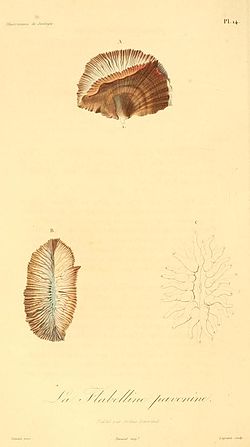
Picture of Flabellum pavoninum
- Source
- Wikipedia/Commons
- Credit
- René Lesson
- Licence
- Public Domain
- Commercial use
- the licence allows it
No 3D scan of Flabellum pavoninum was found in Sketchfab.
Smithsonian Open Access and MorphoSource were not reached for this taxon, so this list is what the others held rather than everything there is.
The description on this site
- Licence
- CC BY-SA 4.0
This is what the site found, which is not the same as what exists.
Keep going
What may have been alongside itFlabellum through timeFormations of the MioceneThe world it lived on
Occurrence data from the Paleobiology Database, CC BY 4.0. Lesson 1831