Galatheoidea
The Galatheoidea are a superfamily of decapod crustaceans comprising the porcelain crabs and some squat lobsters. Squat lobsters within the three families of the superfamily Chirostyloidea are not closely related to the squat lobsters within the Galatheoidea. The fossil record of the superfamily extends back to the Middle Jurassic genus Palaeomunidopsis.

Nhobgood · CC BY-SA 3.0 · via Wikipedia/Commons. May be a photograph of a specimen, or an artist’s reconstruction — an interpretation of a skeleton, since colour and soft tissue are almost never preserved.
On record
Recorded, not inferred- Sits inside
- AnomuraPBDB
- Diet
- carnivorePBDB, for Decapoda
- Life habit
- epifaunalPBDB, for Decapoda
- Motility
- actively mobilePBDB, for Malacostraca
- Vision
- well-developedPBDB, for Malacostraca
Time the record covers
At least 154 million years on record.
The record covers at least 154.8 Mya to 11.7 ka. No occurrence read is dated outside 201.4 Mya to 0 Mya.
347 occurrences of Galatheoidea on record, most of them in the Eocene. The Paleobiology Database records this as a living group. Bar height is expected occurrences, not a count: each fossil is spread across the span it is dated to, so a tall narrow bar means tight dating and a low wide one means loose.
When
347 occurrences- Early Jurassicunder 1%
- Middle Jurassicunder 1%
- Late Jurassic22%
- Early Cretaceous11%
- Late Cretaceous9%
- Paleocene5%
- Eocene25%
- Oligocene6%
- Miocene14%
- Pliocene2%
- Pleistocene1%
- Holocene5%
These are dates about fossils, not the animal: the record can only begin after it arose and end before it died out, so either end may reach further. Shares are expected occurrences: a fossil dated to a span is counted partly in each period it straddles. More on what this infers.
Found in
54 formations
- Ernstbrunn Formation45
- Eguino Formation16
- Pierre Shale Formation · Montana Group8
- Castelgomberto Formation6
- Basilika Formation5
- Calcareniti di Castelgomberto Formation4
Loading coastlines…
The named rock units Galatheoidea has been recovered from, largest first. Drawn where the rock is now, not where it formed. 30 further formations hold fewer occurrences each and are not listed. 193 occurrences have no formation on record, which is common for older literature.
Galatheoidea and its relatives
EoceneWhere Galatheoidea and its relatives were recorded in the Eocene.
Found in the same rock
1,620 taxa- Galathea weinfurteri12 sites
- Daira speciosa10 sites
- Xantho moldavicus10 sites
- Paratetralia convexa9 sites
- Eomunidopsis cobbani8 sites
- Galenopsis similis8 sites
- Lessinigalathea regalis8 sites
- Pilumnus mediterraneus8 sites
- Chlorodiella mediterranea7 sites
- Etisus arduinoi7 sites
- Lobogalenopsis quadrilobata7 sites
- Palaeomunida defecta7 sites
- Prochlorodius ellipticus7 sites
- Actaeites lobatus6 sites
- Cyamocarcinus angustifrons6 sites
- Kromtitis koberiformis6 sites
- Laevicarcinus lioyi6 sites
- Petrolisthes lineatus6 sites
- Pisa oroszyi6 sites
- Porites6 sites
- Callianassa5 sites
- Carpilius petreus5 sites
- Conus5 sites
- Daira sicula5 sites
The Paleobiology Database records 128 sites for Galatheoidea, and this reads all of them. The number is how many of those sites it was catalogued from too. The 24 sharing the most are listed.
This is not a list of everything alive at the time. It is only what has come out of the same ground as this animal and been written down.
Entered from
93 references- I crostacei associati a coralli nell’Eocene inferiore dell’area di Bolca (Verona e Vicenza, Italia nordorientale)26
- New families Paragalatheidae and Catillogalatheidae (Decapoda: Anomura: Galatheoidea) from the Mesozoic, restriction of the genus Paragalathea, and establishment of 6 new genera and 20 new species26
- Nine new genera and 24 new species of the Munidosidae (Decapoda: Anomura: Galatheoidea) from the Jurassic Ernstbrunn Limestone of Austria, and notes on fossil numidopsid classification24
- Galatheid, chirostylid and porcellanid decapods (Crustacea, Decapoda, Anomura) from the Eocene and Oligocene of Vicenza (N Italy)19
- Notes on North American Crustacea17
- La fauna di crostacei associati a coralli dell'Eocene Superiore di Campolongo di Val Liona (Monti Berici, Vicenz, Italia nordorientale)16
- Peak diversity of Cretaceous galatheoids (Crustacea, Decapoda) from northern Spain14
- Decapod crustacea of the Badenian12
- Contributo ai crostacei decapodi dell’Eocene inferiore dei Monti Lessini orientali (Italia nordorientale)11
- Systematics of 12 Jurassic, Cretaceous, and Paleogene squat lobster taxa (Galatheoidea)9
- New report of the coral-associated decapods from the “Formazione di Castelgomberto” (early Oligocene) (Vicenza, NE Italy)8
- A new crab, Eomunidopsis cobbani n. sp. (Crustacea, Decapoda), from the Pierre Shale (Early Maastrichtian) of Colorado8
Each of the 347 occurrences read was entered from one of these publications, ordered by how many each accounts for. This is not a search for papers mentioning the name. 81 further references are not listed. Entries link to doi.org where the Paleobiology Database holds an identifier, and to its own record where it does not. Relayed as the Paleobiology Database holds them, not checked against what they resolve to.
Media and terms
Media content1
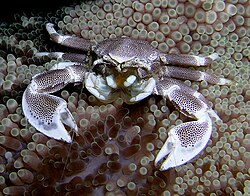
Picture of Galatheoidea
- Source
- Wikipedia/Commons
- Credit
- Nhobgood
- Licence
- CC BY-SA 3.0
- Commercial use
- the licence allows it
No 3D scan of Galatheoidea was found in Sketchfab.
Smithsonian Open Access and MorphoSource were not reached for this taxon, so this list is what the others held rather than everything there is.
The description on this site
- Licence
- CC BY-SA 4.0
This is what the site found, which is not the same as what exists.
Keep going
What may have been alongside itAnomura through timeFormations of the EoceneThe world it lived on
Occurrence data from the Paleobiology Database, CC BY 4.0. Samouelle 1819