Gavialis
Gavialis is a genus of crocodilians that includes the living gharial Gavialis gangeticus and one known extinct species, Gavialis bengawanicus. G. gangeticus comes from the Indian subcontinent, while G. bengawanicus is known from Java. Gavialis likely first appeared in the Indian Subcontinent in the Pliocene and dispersed into the Malay Archipelago through a path called the Siva–Malayan route in the Quaternary. Remains attributed to Gavialis have also been found on Sulawesi and Woodlark Island east of the Wallace Line, suggesting a prehistoric lineage of Gavialis was able to traverse marine environments and reach places possibly as far as western Oceania.

Bo Link from Knoxville, TN, USA · CC BY 2.0 · via Wikipedia/Commons. May be a photograph of a specimen, or an artist’s reconstruction — an interpretation of a skeleton, since colour and soft tissue are almost never preserved.
On record
Recorded, not inferred- Also called
- gharialPBDB
- Sits inside
- GavialidaePBDB
- Diet
- carnivorePBDB, for Crocodylia
- Motility
- actively mobilePBDB, for Osteichthyes
- Environment
- marinePBDB, for Mesoeucrocodylia
Time the record covers
At least 15 million years on record.
The record covers at least 15.98 Mya to 129 ka. No occurrence read is dated outside 20.45 Mya to 0 Mya.
44 occurrences of Gavialis on record, most of them in the Miocene. The Paleobiology Database records this as a living group. Bar height is expected occurrences, not a count: each fossil is spread across the span it is dated to, so a tall narrow bar means tight dating and a low wide one means loose.
When
44 occurrences- Miocene41%
- Pliocene19%
- Pleistocene40%
- Holoceneunder 1%
These are dates about fossils, not the animal: the record can only begin after it arose and end before it died out, so either end may reach further. Shares are expected occurrences: a fossil dated to a span is counted partly in each period it straddles. More on what this infers.
Found in
12 formations
- Pinjor Formation · Siwalik Group6
- Dhok Pathan Formation3
- Irrawaddy Formation3
- Pinjor Formation · Siwalik Group3
- Piram Conglomerate Formation2
- Babladanga Formation1
Loading coastlines…
The named rock units Gavialis has been recovered from, largest first. Drawn where the rock is now, not where it formed. 20 occurrences have no formation on record, which is common for older literature.
Gavialis and its relatives
MioceneWhere Gavialis and its relatives were recorded in the Miocene.
Found in the same rock
346 taxa- Crocodylus siamensis6 sites
- Crocodylus5 sites
- Batagur4 sites
- Brachypotherium4 sites
- Trionychidae4 sites
- Amphicyon giganteus3 sites
- Bubalus3 sites
- Cervus3 sites
- Elephas3 sites
- Muntiacus muntjak3 sites
- Rhinoceros sondaicus3 sites
- Sus3 sites
- Trionychinae3 sites
- Trionyx3 sites
- Aceratherium2 sites
- Acrochordus dehmi2 sites
- Amphimoschus ponteleviensis2 sites
- Anchitherium aurelianense2 sites
- Aureliachoerus aurelianensis2 sites
- Axis axis2 sites
- Batagurinae2 sites
- Bos2 sites
- Bos (Bibos)2 sites
- Bos gaurus2 sites
The Paleobiology Database records 38 sites for Gavialis, and this reads all of them. The number is how many of those sites it was catalogued from too. The 24 sharing the most are listed.
This is not a list of everything alive at the time. It is only what has come out of the same ground as this animal and been written down.
Entered from
18 references- Fossil turtles and crocodiles from the Caenozoic of S-Asia11
- A revision of the Dubois crocodylians, Gavialis bengawanicus and Crocodylus ossifragus, from the Pleistocene Homo erectus beds of Java8
- The taxonomic content of the genus Gavialis from the Siwalik Hills of India and Pakistan4
- Taxonomic overview of Neogene crocodylians in Myanmar3
- Miocene vertebrates from the Siwalik Group, Western Nepal3
- Fossil Gavials from North India3
- Le site paléontologique du Grand Morier (Pont-Boutard, Indre-et-Loire, France): contexte géologique et détail biostratigraphique des formations cénozoïques à partir des assemblages de vertébrés fossiles1
- Gavialis from the Pleistocene of Thailand and its relevance for drainage connections from India to Java1
- Neogene reptiles of northeastern Thailand and their paleogeographical significance1
- A new gavialid from the Early Miocene of south-eastern Pakistan (Preliminary Report)1
- Les vertébrés du Miocène moyen de Contres (Loir-et-Cher, France)1
- The Late Neogene elephantoid-bearing faunas of Indonesia and their palaeozoogeographic implications. A study of the terrestrial faunal succession of Sulawesi, Flores and Java, including evidence for early hominid dispersal east of Wallace's Line1
Each of the 44 occurrences read was entered from one of these publications, ordered by how many each accounts for. This is not a search for papers mentioning the name. 6 further references are not listed. Entries link to doi.org where the Paleobiology Database holds an identifier, and to its own record where it does not. Relayed as the Paleobiology Database holds them, not checked against what they resolve to.
Media and terms
Media content3
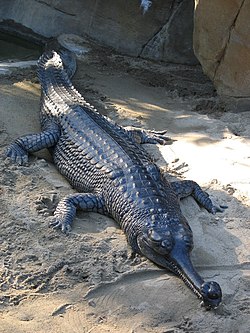
Picture of Gavialis
- Source
- Wikipedia/Commons
- Credit
- Bo Link from Knoxville, TN, USA
- Licence
- CC BY 2.0
- Commercial use
- the licence allows it
CT scan
- Source
- MorphoSource
- Licence
- not stated by the source
- Commercial use
- cannot be read from the licence given — check the record
- Specimen
- Gavialis gangeticus · UF:Herp:118998
3D model
- Source
- Sketchfab
- Credit
- Dr. Eugenia Gold
- Licence
- CC Attribution
- Commercial use
- cannot be read from the licence given — check the record
Smithsonian Open Access was not reached for this taxon, so this list is what the others held rather than everything there is.
The description on this site
- Source
- Wikipedia, “Gavialis”
- Licence
- CC BY-SA 4.0
This is what the site found, which is not the same as what exists.
Keep going
What may have been alongside itGavialidae through timeFormations of the MioceneThe world it lived on
Occurrence data from the Paleobiology Database, CC BY 4.0. Oppel 1811