Geochelone
Geochelone, from Ancient Greek γῆ (gê), meaning "earth", and χελώνη (khelṓnē), meaning "turtle", is a genus of tortoises.

en:User:Cburnett · CC BY-SA 3.0 · via Wikipedia/Commons. May be a photograph of a specimen, or an artist’s reconstruction — an interpretation of a skeleton, since colour and soft tissue are almost never preserved.
On record
Recorded, not inferred- Sits inside
- TestudininaePBDB
- Diet
- herbivore, herbivorePBDB, for Testudinidae
- Life habit
- ground dwellingPBDB, for Testudinidae
- Motility
- actively mobilePBDB, for Osteichthyes
- Environment
- terrestrialPBDB, for Testudinidae
Time the record covers
At least 51 million years on record.
The record covers at least 51.1 Mya to 11.7 ka. No occurrence read is dated outside 66 Mya to 0 Mya.
160 occurrences of Geochelone on record, most of them in the Pleistocene. The Paleobiology Database records this as a living group. Bar height is expected occurrences, not a count: each fossil is spread across the span it is dated to, so a tall narrow bar means tight dating and a low wide one means loose.
When
160 occurrencesThese are dates about fossils, not the animal: the record can only begin after it arose and end before it died out, so either end may reach further. Shares are expected occurrences: a fossil dated to a span is counted partly in each period it straddles. More on what this infers.
Found in
49 formations
- Koobi Fora Formation21
- Vogel River Series Formation6
- Baynunah Formation5
- Wood Mountain Formation4
- Dam Formation3
- "unnamed sandstone" Formation3
Loading coastlines…
The named rock units Geochelone has been recovered from, largest first. Drawn where the rock is now, not where it formed. 25 further formations hold fewer occurrences each and are not listed. 65 occurrences have no formation on record, which is common for older literature.
Geochelone and its relatives
PleistoceneWhere Geochelone and its relatives were recorded in the Pleistocene.
Found in the same rock
2,326 taxa- Trionyx38 sites
- Crocodylus27 sites
- Euthecodon brumpti24 sites
- Crocodylus niloticus23 sites
- Polypterus21 sites
- Clarias19 sites
- Lates19 sites
- Protopterus19 sites
- Trionychidae17 sites
- Ceratotherium16 sites
- Rhinocerotidae15 sites
- Theropithecus oswaldi15 sites
- Aves14 sites
- Equus14 sites
- Hominidae14 sites
- Gazella13 sites
- Hipparion13 sites
- Testudo12 sites
- Loxodonta exoptata11 sites
- Rana11 sites
- Alcelaphini10 sites
- Amphicyonidae10 sites
- Crocuta crocuta10 sites
- Thamnophis10 sites
The Paleobiology Database records 158 sites for Geochelone, and this reads all of them. The number is how many of those sites it was catalogued from too. The 24 sharing the most are listed.
This is not a list of everything alive at the time. It is only what has come out of the same ground as this animal and been written down.
Entered from
88 references- Koobi Fora Research Project The Fossil Ungulates: Proboscidea, Perissodactyla, Suidae11
- The Late Neogene elephantoid-bearing faunas of Indonesia and their palaeozoogeographic implications. A study of the terrestrial faunal succession of Sulawesi, Flores and Java, including evidence for early hominid dispersal east of Wallace's Line7
- Laetoli: a Pliocene Site in Northern Tanzania6
- The Hottell Ranch rhino quarries (basal Ogallala: medial Barstovian), Banner County, Nebraska. Part I: Geologic setting, faunal lists, lower vertebrates6
- Stratigraphy and mammal faunas of the Brackwassermolasse in the surroundings of Ulm (Southwest Germany)5
- Chelonia from the Late Miocene Baynunah Formation, Emirate of Abu Dhabi, United Arab Emirates: palaeogeographic implications5
- Extinct large Colobines from the Plio-Pleistocene of Africa5
- Holocene Vertebrate Fossils from Isla Floreana, Galapagos4
- Zur Stellung der Wirbeltierfauna des Geiseltals, insbesondere der Mammalier, im europäischen Mitteleozän (Position of the European Middle Eocene vertebrate fauna of the Geisel Valley, with special focus on mammals)4
- Contribution a l'etude des Cheloniens. Cheloniens continentaux due Cretace et du Tertiare de France4
- Lothagam: the dawn of humanity in eastern Africa3
- The first australopithecine 2500 kilometres west of the Rift Valley (Chad)3
Each of the 160 occurrences read was entered from one of these publications, ordered by how many each accounts for. This is not a search for papers mentioning the name. 76 further references are not listed. Entries link to doi.org where the Paleobiology Database holds an identifier, and to its own record where it does not. Relayed as the Paleobiology Database holds them, not checked against what they resolve to.
Media and terms
Media content3

Picture of Geochelone
- Source
- Wikipedia/Commons
- Credit
- en:User:Cburnett
- Licence
- CC BY-SA 3.0
- Commercial use
- the licence allows it
Structured light scan
- Source
- MorphoSource
- Licence
- In Copyright
- Commercial use
- cannot be read from the licence given — check the record
- Specimen
- Geochelone elegans · zmuc:rept:R2560
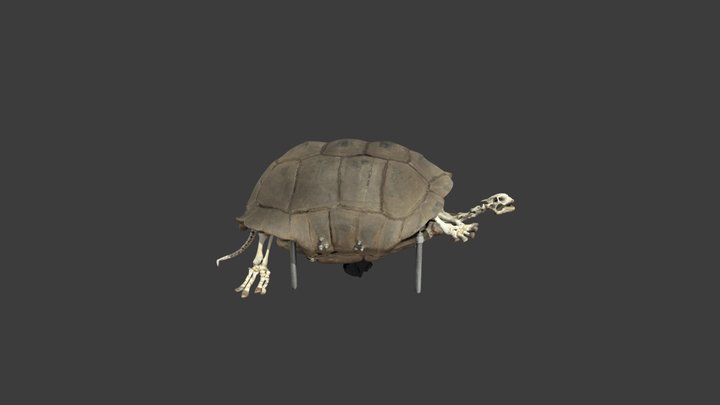
3D model
- Source
- Sketchfab
- Licence
- CC0 Public Domain
- Commercial use
- the licence allows it
The description on this site
- Source
- Wikipedia, “Geochelone”
- Licence
- CC BY-SA 4.0
This is what the site found, which is not the same as what exists.
Keep going
What may have been alongside itTestudininae through timeFormations of the PleistoceneThe world it lived on
Occurrence data from the Paleobiology Database, CC BY 4.0. Fitzinger 1835