Gliridae
A dormouse is a rodent of the family Gliridae. Dormice are nocturnal animals found in Africa, Asia, and Europe. They are named for their long dormant hibernation period of six months or longer. There are nine genera and 28 living species of dormice, with half of living species belonging to the African genus Graphiurus.

H. Osadnik · CC BY-SA 3.0 · via Wikipedia/Commons. May be a photograph of a specimen, or an artist’s reconstruction — an interpretation of a skeleton, since colour and soft tissue are almost never preserved.
On record
Recorded, not inferred- Also called
- dormousePBDB
- Sits inside
- SciuromorphaPBDB
- Diet
- herbivorePBDB, for Rodentia
- Life habit
- ground dwellingPBDB, for Rodentia
- Motility
- actively mobilePBDB, for Osteichthyes
- Environment
- terrestrialPBDB, for Eutheria
Time the record covers
At least 48 million years on record.
The record covers at least 48.07 Mya to 11.7 ka. No occurrence read is dated outside 56 Mya to 0 Mya.
1,269 occurrences of Gliridae on record, most of them in the Miocene. The Paleobiology Database records this as a living group. Bar height is expected occurrences, not a count: each fossil is spread across the span it is dated to, so a tall narrow bar means tight dating and a low wide one means loose.
When
1,269 occurrencesThese are dates about fossils, not the animal: the record can only begin after it arose and end before it died out, so either end may reach further. Shares are expected occurrences: a fossil dated to a span is counted partly in each period it straddles. More on what this infers.
Found in
75 formations
- Lower Freshwater Molasse Formation · Molasse Group25
- Villarrosano Formation25
- Alfambra Formation24
- facies à Congeria Formation24
- Upper Freshwater Molasse Formation · Molasse Group12
- Lower Headon Beds Formation10
Loading coastlines…
The named rock units Gliridae has been recovered from, largest first. Drawn where the rock is now, not where it formed. 51 further formations hold fewer occurrences each and are not listed. 960 occurrences have no formation on record, which is common for older literature.
Gliridae and its relatives
MioceneWhere Gliridae and its relatives were recorded in the Miocene.
Found in the same rock
1,713 taxa- Mimomys53 sites
- Apodemus51 sites
- Microtus45 sites
- Apodemus sylvaticus38 sites
- Pliomys36 sites
- Crocidura32 sites
- Allocricetus31 sites
- Eliomys30 sites
- Heteroxerus30 sites
- Equus29 sites
- Myodes29 sites
- Soricidae26 sites
- Chiroptera24 sites
- Lepus24 sites
- Sciurus24 sites
- Beremendia fissidens23 sites
- Prolagus23 sites
- Cervus22 sites
- Cricetus cricetus22 sites
- Microtus arvalis22 sites
- Ophisaurus22 sites
- Castillomys crusafonti21 sites
- Glis glis20 sites
- Ursus20 sites
The Paleobiology Database records 604 sites for Gliridae, and this reads 240 of them. The number is how many of those sites it was catalogued from too. The 24 sharing the most are listed.
This is not a list of everything alive at the time. It is only what has come out of the same ground as this animal and been written down.
Entered from
291 references- Kleinsäugerstratigraphie in der miozänen Hörnlischüttung (Ostschweiz); (Biostratigraphy of small mammals in the Hörnlischüttung of Miocene age (East Switzerland))109
- Decouvertes de faunes de micromammiferes dans les Pyrenees-Orientales (France) de l'Oligocene superieur au Miocene superieur; especes nouvelles et reflexion sur l'etalonnage des echelles continentale et marine. [New upper Oligocene to upper Miocene faunas of micromammals found in the Pyrenees-Orientales (France); new species of rodents and remarks about the calibration of marine and continental biochronological scales.]61
- Gliridae (Rodentia, Mammalia) from the Eocene and Oligocene of the Sierra Palomera (Teruel, Spain)37
- Gliridae (Mammalia, Rodentia) de l’Oligocène européen: origine de trois genres miocènes37
- Beiträge zur Biostratigraphie der Unteren Süßwasser-Molasse Süddeutschlands - Rodentia und Lagomorpha (Mammalia) aus den Fundstellen der Ulmer Gegend.37
- Neue Ergebnisse zur Stratigraphie der mittleren Serie der Oberen Süßwassermolasse Bayerns (New results on the stratigraphy of the middle series of upper Freshwater Molasse, Bavaria)31
- Late Messinian mollusks and vertebrates from Moncucco Torinese, north-western Italy. Paleoecological and paleoclimatological implications24
- Overview of the geology of the Levač basin and the fossil mammal and the fossil plants localities in the Sibnica area (Central Serbia)23
- Rodent faunas of the Mio-Pliocene continental sediments of the Teruel-Alfambra region, Spain22
- Vertebrates from the Early Miocene lignite deposits of the opencast mine Oberdorf (Western Styrian Basin, Austria): 6. Rodentia 1 (Mammalia)19
- Diversité, datation et paléoenvironnement de la faune de mammifères oligocène de Cavalé (Quercy, SO France) : contribution de l’analyse morphométrique des Theridomyinae (Mammalia, Rodentia)18
- The Gliridae from the Upper Eocene of Sossís, Roc de Santa and Claverol (Lleida, Spain)18
Each of the 1,269 occurrences read was entered from one of these publications, ordered by how many each accounts for. This is not a search for papers mentioning the name. 279 further references are not listed. Entries link to doi.org where the Paleobiology Database holds an identifier, and to its own record where it does not. Relayed as the Paleobiology Database holds them, not checked against what they resolve to.
Media and terms
Media content1
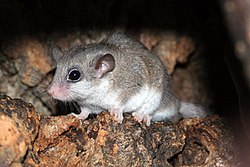
Picture of Gliridae
- Source
- Wikipedia/Commons
- Credit
- H. Osadnik
- Licence
- CC BY-SA 3.0
- Commercial use
- the licence allows it
No 3D scan of Gliridae was found in Sketchfab.
Smithsonian Open Access and MorphoSource were not reached for this taxon, so this list is what the others held rather than everything there is.
The description on this site
- Source
- Wikipedia, “Dormouse”
- Licence
- CC BY-SA 4.0
This is what the site found, which is not the same as what exists.
Keep going
What may have been alongside itSciuromorpha through timeFormations of the MioceneThe world it lived on
Occurrence data from the Paleobiology Database, CC BY 4.0. Muirhead 1819