Apodemus sylvaticus
The wood mouse is a murid rodent native to Europe and northwestern Africa. It is closely related to the yellow-necked mouse but differs in that it has no band of yellow fur around the neck, has slightly smaller ears, and is usually slightly smaller overall: around 90 mm (3.54 in) in length and 23 g in weight. It is found across most of Europe and is a very common and widespread species, is commensal with people and is sometimes considered a pest. Other common names are long-tailed field mouse, field mouse, common field mouse, and European wood mouse. This species is a known potential carrier of the Dobrava sequence of hantavirus which affects humans and may pose serious risks to human health.

Christian Fischer · CC BY-SA 4.0 · via Wikipedia/Commons. May be a photograph of a specimen, or an artist’s reconstruction — an interpretation of a skeleton, since colour and soft tissue are almost never preserved.
On record
Recorded, not inferred- Also called
- wood mousePBDB
- Sits inside
- ApodemusPBDB
- Diet
- herbivore, insectivorePBDB, for Muridae
- Life habit
- ground dwellingPBDB, for Muridae
- Motility
- actively mobilePBDB, for Osteichthyes
- Environment
- terrestrialPBDB, for Eutheria
Time the record covers
At least 2.5 million years on record.
The record covers at least 2.58 Mya to 11.7 ka. No occurrence read is dated outside 5.333 Mya to 0 Mya.
106 occurrences of Apodemus sylvaticus on record, most of them in the Pleistocene. The Paleobiology Database records this as a living group. Bar height is expected occurrences, not a count: each fossil is spread across the span it is dated to, so a tall narrow bar means tight dating and a low wide one means loose.
When
106 occurrences- Pliocene6%
- Pleistocene92%
- Holocene3%
These are dates about fossils, not the animal: the record can only begin after it arose and end before it died out, so either end may reach further. Shares are expected occurrences: a fossil dated to a span is counted partly in each period it straddles. More on what this infers.
Found in
4 formations
Loading coastlines…
The named rock units Apodemus sylvaticus has been recovered from, largest first. Drawn where the rock is now, not where it formed. 101 occurrences have no formation on record, which is common for older literature.
Apodemus sylvaticus and its relatives
PleistoceneWhere Apodemus sylvaticus and its relatives were recorded in the Pleistocene.
Found in the same rock
705 taxa- Microtus60 sites
- Mimomys58 sites
- Myodes51 sites
- Pliomys51 sites
- Allocricetus36 sites
- Cricetus cricetus35 sites
- Beremendia fissidens33 sites
- Lepus32 sites
- Microtus arvalis29 sites
- Sorex minutus29 sites
- Crocidura25 sites
- Arvicola24 sites
- Equus23 sites
- Sorex runtonensis22 sites
- Chiroptera21 sites
- Talpa fossilis21 sites
- Sorex20 sites
- Talpa europaea20 sites
- Allophaiomys pliocaenicus19 sites
- Canis lupus19 sites
- Lagurus19 sites
- Ochotona19 sites
- Spalax18 sites
- Citellus17 sites
The Paleobiology Database records 105 sites for Apodemus sylvaticus, and this reads all of them. The number is how many of those sites it was catalogued from too. The 24 sharing the most are listed.
This is not a list of everything alive at the time. It is only what has come out of the same ground as this animal and been written down.
Entered from
40 references- Pleistocene vertebrate faunas of Hungary14
- Biochronology of the Pleistocene deposits at Betfia (Bihor, Romania)12
- I giacimenti Quaternari di vertebrati fossili nell'Italia Nord-Orientale11
- Principaux gisements paleontologiques Francais du Pleistocene Moyen: Essai de classification9
- The Villafranchian mammalian faunas and biochronology of Greece8
- Mittelpleistozane Saugetierfaunen aus Mitteleuropa - der Versuch einer biostratigraphischen Zuordnung5
- The vertebrate fauna from the interglacial deposits at Sugworth near Oxford5
- Les rongeurs de l'Aven I des Abimes de la Fage a Noailles (Correze)5
- New microstratigraphic horizons in the vertebrate chronology of the Hungarian Pleistocene3
- The micromammals of the Quaternary deposits from Cave A, Loutra Almopias (Pella, Northern Greece): Stratigraphy-Taphonomy-Paleoenvironment2
- Le gisement Pleistocene moyen et superieur d'Artenac (Saint-Mary, Charent): premier bilan interdisciplinaire2
- Early Middle Pleistocene mammalian faunas from Karlich (Kaerlich) and Miesenheim I and their biostratigraphical implications2
Each of the 106 occurrences read was entered from one of these publications, ordered by how many each accounts for. This is not a search for papers mentioning the name. 28 further references are not listed. Entries link to doi.org where the Paleobiology Database holds an identifier, and to its own record where it does not. Relayed as the Paleobiology Database holds them, not checked against what they resolve to.
Media and terms
Media content2

Picture of Apodemus sylvaticus
- Source
- Wikipedia/Commons
- Credit
- Christian Fischer
- Licence
- CC BY-SA 4.0
- Commercial use
- the licence allows it
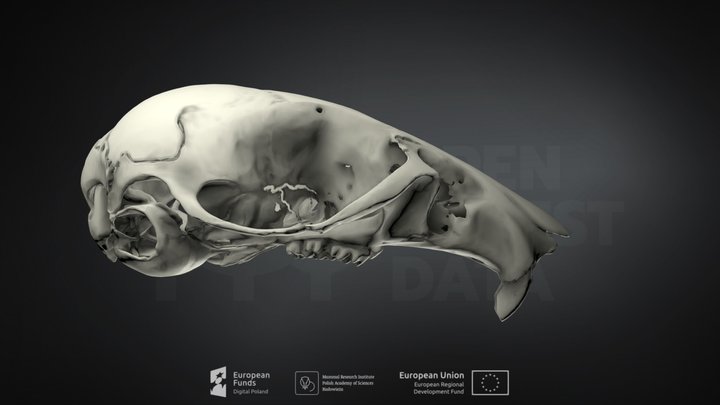
3D model
- Source
- Sketchfab
- Licence
- CC Attribution
- Commercial use
- cannot be read from the licence given — check the record
Smithsonian Open Access and MorphoSource were not reached for this taxon, so this list is what the others held rather than everything there is.
The description on this site
- Source
- Wikipedia, “Wood mouse”
- Licence
- CC BY-SA 4.0
This is what the site found, which is not the same as what exists.
Keep going
What may have been alongside itApodemus through timeFormations of the PleistoceneThe world it lived on
Occurrence data from the Paleobiology Database, CC BY 4.0. (Linnaeus 1758)