Glycymerita banosensis
via iDigBio · CC BY · via iDigBio. May be a photograph of a specimen, or an artist’s reconstruction — an interpretation of a skeleton, since colour and soft tissue are almost never preserved.
On record
Recorded, not inferred- Sits inside
- GlycymeritaPBDB
- Diet
- suspension feederPBDB, for Glycymerididae
- Life habit
- semi-infaunalPBDB, for Glycymerididae
- Motility
- facultatively mobilePBDB, for Glycymerididae
- Vision
- blindPBDB, for Bivalvia
- Environment
- coastal,inner shelf,outer shelf,oceanicPBDB, for Glycymerididae
Time the record covers
At most 18 million years on record.
Every occurrence read is dated to somewhere between 83.6 Mya and 66 Mya, and nothing in the dating separates them, so that window is what the record shows rather than a span.
14 occurrences of Glycymerita banosensis on record, most of them in the Late Cretaceous. Bar height is expected occurrences, not a count: each fossil is spread across the span it is dated to, so a tall narrow bar means tight dating and a low wide one means loose.
When
14 occurrences- Late Cretaceous100%
These are dates about fossils, not the animal: the record can only begin after it arose and end before it died out, so either end may reach further. Shares are expected occurrences: a fossil dated to a span is counted partly in each period it straddles. More on what this infers.
Found in
6 formations
- Moreno Formation · Great Valley Group9
- Pigeon Point Formation1
- Panoche Formation · Great Valley Group1
- Merced Formation1
- Rosario Formation1
- El Piojo Formation1
Loading coastlines…
The named rock units Glycymerita banosensis has been recovered from, largest first. Drawn where the rock is now, not where it formed.
Glycymerita banosensis and its relatives
Late CretaceousWhere Glycymerita banosensis and its relatives were recorded in the Late Cretaceous.
Found in the same rock
62 taxa- Calva (Calva) varians3 sites
- Callistalox fragilis2 sites
- Cymbophora2 sites
- Cymbophora triangulata2 sites
- Gyrodes (Sohlella) expansus2 sites
- Loxo quintense2 sites
- Opis (Hesperopis) triangulata2 sites
- Ostrea2 sites
- Perissitys stantoni2 sites
- Septifer2 sites
- Tylostoma garzana2 sites
- Anchura gibbera1 site
- Baculites rex1 site
- Biplica miniplicata1 site
- Bulbificopsis garza1 site
- Bullamirifica ainiktos1 site
- Calva (Calva) peninsularis1 site
- Calva (Egelicalva) bowersiana1 site
- Calva (Egelicalva) nitida1 site
- Cataceramus balticus1 site
- Clisocolus dubius1 site
- Crassatella1 site
- Crassatella mercedensis1 site
- Crustacea1 site
The Paleobiology Database records 14 sites for Glycymerita banosensis, and this reads all of them. The number is how many of those sites it was catalogued from too. The 24 sharing the most are listed.
This is not a list of everything alive at the time. It is only what has come out of the same ground as this animal and been written down.
Entered from
6 references- Map and checklists of Jurassic and Cretaceous macrofossil localities within the San Jose 1:100,000 Quadrangle, California, and discussion of paleontological results7
- Upper Cretaceous of the Pacific Coast3
- Northeast Pacific Upper Cretaceous and Paleocene Glycymeridid Bivalves1
- New information on Late Cretaceous, Paleocene, and Eocene neritid gastropods from the North American Pacific slope1
- Checklist of Mesozoic macrofossil localities in the Santa Cruz Mountains and vicinity1
- Mollusks of Latest Cretaceous and Paleocene Age, Lake Nacimiento, California1
Each of the 14 occurrences read was entered from one of these publications, ordered by how many each accounts for. This is not a search for papers mentioning the name. Entries link to doi.org where the Paleobiology Database holds an identifier, and to its own record where it does not. Relayed as the Paleobiology Database holds them, not checked against what they resolve to.
Media and terms
Media content2
Picture of Glycymerita banosensis
- Source
- iDigBio
- Credit
- via iDigBio
- Licence
- CC BY
- Commercial use
- the licence allows it
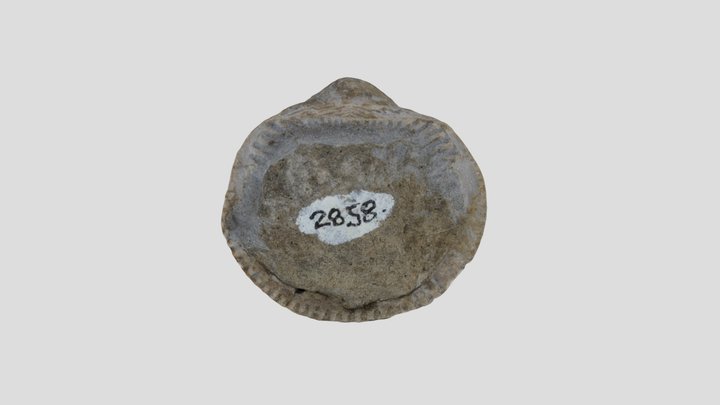
3D model
- Source
- Sketchfab
- Licence
- CC Attribution-NonCommercial
- Commercial use
- the licence does not allow it
Smithsonian Open Access and MorphoSource were not reached for this taxon, so this list is what the others held rather than everything there is.
This is what the site found, which is not the same as what exists.
Keep going
What may have been alongside itGlycymerita through timeFormations of the Late CretaceousThe world it lived on
Occurrence data from the Paleobiology Database, CC BY 4.0. (Anderson 1958)