Gogia
Gogia is a genus of primitive eocrinoid blastozoan from the early to middle Cambrian.

Kevmin · CC BY-SA 3.0 · via Wikipedia/Commons. May be a photograph of a specimen, or an artist’s reconstruction — an interpretation of a skeleton, since colour and soft tissue are almost never preserved.
On record
Recorded, not inferred- Sits inside
- EocrinidaePBDB
- Diet
- suspension feederPBDB
- Life habit
- intermediate-level epifaunalPBDB
- Motility
- stationary, attachedPBDB
- Vision
- blindPBDB, for Eocrinoidea
- Environment
- marinePBDB, for Echinodermata
Time the record covers
At least 12 million years on record.
The record covers at least 509.7 Mya to 497 Mya. No occurrence read is dated outside 515.3 Mya to 486.85 Mya.
36 occurrences of Gogia on record, most of them in the Cambrian. Bar height is expected occurrences, not a count: each fossil is spread across the span it is dated to, so a tall narrow bar means tight dating and a low wide one means loose.
When
36 occurrences- Cambrian100%
These are dates about fossils, not the animal: the record can only begin after it arose and end before it died out, so either end may reach further. Shares are expected occurrences: a fossil dated to a span is counted partly in each period it straddles. More on what this infers.
Found in
18 formations
- Langston Formation5
- Wheeler Shale Formation5
- Stephen Formation4
- Murero Formation · Mesones Group4
- Chisholm Shale Formation2
- Lead Bell Shale Formation2
Loading coastlines…
The named rock units Gogia has been recovered from, largest first. Drawn where the rock is now, not where it formed.
Gogia and its relatives
CambrianWhere Gogia and its relatives were recorded in the Cambrian.
Found in the same rock
390 taxa- Lingulella8 sites
- Hyolithes7 sites
- Micromitra6 sites
- Paradoxides (Eccaparadoxides)6 sites
- Bathyuriscus5 sites
- Chancelloria5 sites
- Elrathia5 sites
- Gyrocystis platessa5 sites
- Kootenia5 sites
- Peronopsis5 sites
- Acrothele subsidua4 sites
- Ceratocystis4 sites
- Dictyonina4 sites
- Ehmaniella4 sites
- Marpolia spissa4 sites
- Modocia4 sites
- Naraoia compacta4 sites
- Nisusia4 sites
- Oryctocephalus4 sites
- Protospongia4 sites
- Zacanthoides4 sites
- Zacanthoides idahoensis4 sites
- Acadagnostus acadica3 sites
- Acrothele3 sites
The Paleobiology Database records 33 sites for Gogia, and this reads all of them. The number is how many of those sites it was catalogued from too. The 24 sharing the most are listed.
This is not a list of everything alive at the time. It is only what has come out of the same ground as this animal and been written down.
Entered from
21 references- Morphology and evolution of blastozoan echinoderms11
- The diverse radiodont fauna from the Marjum Formation of Utah, USA (Cambrian: Drumian)2
- First report of Gogia (Eocrinoidea, Echinodermata) from the Early-Middle Cambrian of Sonora (Mexico), with biostratigraphical and palaeoecological comments2
- Middle Cambrian gogiid echinoderms from Northeast Spain: Taxonomy, palaeoecology, and palaeogeographic implications2
- Paleoecology of the Greater Phyllopod Bed community, Burgess Shale2
- Révision biostratigraphique du Cambrien moyen du versant méridional de la Montagne Noire (Languedoc, France)2
- Additional Middle Cambrian trilobites from the Wheeler Shale of Utah2
- Redescription of the Cambrian edrioasteroid Sprinkleoglobus spencensis n. comb. (Wen et al., 2019) from the Spence Shale (Utah, USA)1
- Morphology and phylogenetic interpretation of a new Cambrian edrioasteroid (Echinodermata) from Spain1
- The oldest isorophid edrioasteroid (Echinodermata) and the evolution of attachment strategies in Cambrian edrioasteroids1
- New eocrinoids from the Burgess Shale, southern British Columbia, Canada, and the Spence Shale, northern Utah, USA1
- Totiglobus, an unusual new edrioasteroid from the Middle Cambrian of Nevada1
Each of the 36 occurrences read was entered from one of these publications, ordered by how many each accounts for. This is not a search for papers mentioning the name. 8 further references are not listed. Entries link to doi.org where the Paleobiology Database holds an identifier, and to its own record where it does not. Relayed as the Paleobiology Database holds them, not checked against what they resolve to.
Media and terms
Media content3

Picture of Gogia
- Source
- Wikipedia/Commons
- Credit
- Kevmin
- Licence
- CC BY-SA 3.0
- Commercial use
- the licence allows it
Structured light scan
- Source
- MorphoSource
- Licence
- not stated by the source
- Commercial use
- cannot be read from the licence given — check the record
- Specimen
- Gogia sp. · KU:KUMIP:561411
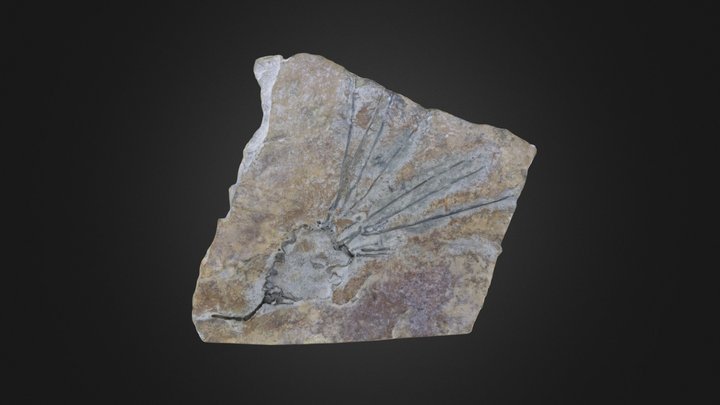
3D model
- Source
- Sketchfab
- Licence
- CC0 Public Domain
- Commercial use
- the licence allows it
Smithsonian Open Access was not reached for this taxon, so this list is what the others held rather than everything there is.
The description on this site
- Source
- Wikipedia, “Gogia”
- Licence
- CC BY-SA 4.0
This is what the site found, which is not the same as what exists.
Keep going
What may have been alongside itEocrinidae through timeFormations of the CambrianThe world it lived on
Occurrence data from the Paleobiology Database, CC BY 4.0. Walcott 1917