Graphiurus
The African dormice are dormice that live throughout sub-Saharan Africa in a variety of habitats. They are very agile climbers and have bushy tails. They primarily eat invertebrates, with other components of their diet including small vertebrates, fruit, nuts and eggs. They represent the most diverse living genus of dormice, making up half of all living species.

H. Osadnik · CC BY-SA 3.0 · via Wikipedia/Commons. May be a photograph of a specimen, or an artist’s reconstruction — an interpretation of a skeleton, since colour and soft tissue are almost never preserved.
On record
Recorded, not inferred- Sits inside
- GliridaePBDB
- Diet
- herbivorePBDB, for Rodentia
- Life habit
- ground dwellingPBDB, for Rodentia
- Motility
- actively mobilePBDB, for Osteichthyes
- Environment
- terrestrialPBDB, for Eutheria
Time the record covers
At least 233 million years on record.
The record covers at least 233.6 Mya to 11.7 ka. No occurrence read is dated outside 237 Mya to 0 Mya.
13 occurrences of Graphiurus on record, most of them in the Pliocene. The Paleobiology Database records this as a living group. Bar height is expected occurrences, not a count: each fossil is spread across the span it is dated to, so a tall narrow bar means tight dating and a low wide one means loose.
When
13 occurrences- Late Triassic8%
- Miocene3%
- Pliocene32%
- Pleistocene26%
- Holocene31%
These are dates about fossils, not the animal: the record can only begin after it arose and end before it died out, so either end may reach further. Shares are expected occurrences: a fossil dated to a span is counted partly in each period it straddles. More on what this infers.
Found in
4 formations
Loading coastlines…
The named rock units Graphiurus has been recovered from, largest first. Drawn where the rock is now, not where it formed. 6 occurrences have no formation on record, which is common for older literature.
Graphiurus and its relatives
PlioceneWhere Graphiurus and its relatives were recorded in the Pliocene.
Found in the same rock
327 taxa- Dendromus10 sites
- Epimys (Aethomys)9 sites
- Mus9 sites
- Dasymys8 sites
- Otomys8 sites
- Praomys8 sites
- Mystromys7 sites
- Rhabdomys7 sites
- Steatomys7 sites
- Elephantulus6 sites
- Eptesicus6 sites
- Tatera6 sites
- Cryptomys hottentotus5 sites
- Elephantulus brachyrhynchus5 sites
- Lemniscomys5 sites
- Malacothrix5 sites
- Myosorex5 sites
- Phacochoerus aethiopicus5 sites
- Rhinolophus5 sites
- Suncus varilla5 sites
- Acomys4 sites
- Alcelaphus buselaphus4 sites
- Crocidura4 sites
- Cryptomys4 sites
The Paleobiology Database records 12 sites for Graphiurus, and this reads all of them. The number is how many of those sites it was catalogued from too. The 24 sharing the most are listed.
This is not a list of everything alive at the time. It is only what has come out of the same ground as this animal and been written down.
Entered from
11 references- Plio-Pleistocene fossil mammalian microfauna of southern Africa: a preliminary report including descriptions of two new fossil muroid genera (Mammalia: Rodentia)2
- The Structure and Dynamics of a West African Savanna2
- The Makapansgat australopithecine environment1
- Evolution and sedimentary character of lake deltas fed by ephemeral rivers in the Turkana Basin, southern Kenya1
- Structure of Nylsrley Savanna1
- The Hunters of the Hunted? An Introduction to African Cave Taphonomy1
- The Mammalian Fauna from the Middle and Later Stone Age (Later Pleistocene) Levels of Border Cave, Natal Province, South Africa1
- The Pliocene fossil occurences in 'E' Quarry, Langebaanweg, South Africa1
- The Prehistory of Eastern Zambia1
- Some evidence of chronology and paleoecology of Sterkfontein, Swartkrans, and Kromdraai from the fossil Bovidae1
- Die Fische der bituminösen Schiefer von Raibl in Kärnthen1
Each of the 13 occurrences read was entered from one of these publications, ordered by how many each accounts for. This is not a search for papers mentioning the name. Entries link to doi.org where the Paleobiology Database holds an identifier, and to its own record where it does not. Relayed as the Paleobiology Database holds them, not checked against what they resolve to.
Media and terms
Media content2
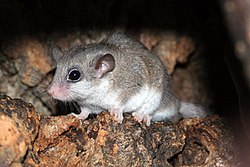
Picture of Graphiurus
- Source
- Wikipedia/Commons
- Credit
- H. Osadnik
- Licence
- CC BY-SA 3.0
- Commercial use
- the licence allows it
CT scan
- Source
- MorphoSource
- Credit
- AMNH Mammal Collections
- Licence
- not stated by the source
- Commercial use
- cannot be read from the licence given — check the record
- Specimen
- Graphiurus platyops · amnh:mammals:88170
Smithsonian Open Access was not reached for this taxon, so this list is what the others held rather than everything there is.
The description on this site
- Source
- Wikipedia, “Graphiurus”
- Licence
- CC BY-SA 4.0
This is what the site found, which is not the same as what exists.
Keep going
What may have been alongside itGliridae through timeFormations of the PlioceneThe world it lived on
Occurrence data from the Paleobiology Database, CC BY 4.0. Smuts 1832