Haddonia
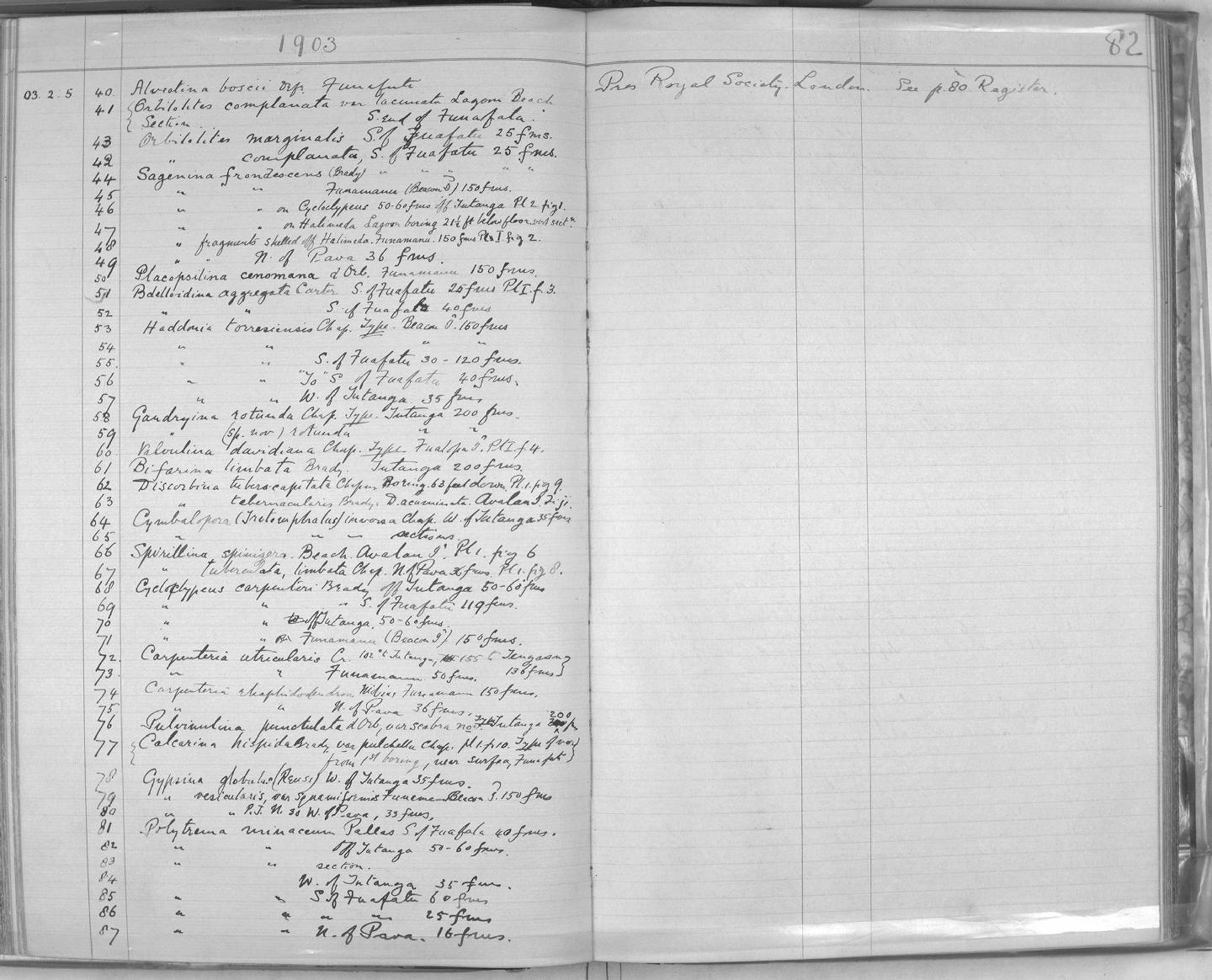
via GBIF · CC0 · via GBIF. May be a photograph of a specimen, or an artist’s reconstruction — an interpretation of a skeleton, since colour and soft tissue are almost never preserved.
On record
Recorded, not inferred- Sits inside
- LituolidaePBDB
- Diet
- omnivorePBDB, for Foraminifera
- Life habit
- semi-infaunalPBDB, for Foraminifera
- Motility
- stationaryPBDB, for Foraminifera
Time the record covers
At least 137 million years on record.
The record covers at least 143.1 Mya to 5.333 Mya. No occurrence read is dated outside 145.06 Mya to 3.6 Mya.
79 occurrences of Haddonia on record, most of them in the Paleocene. The Paleobiology Database records this as a living group, and the chart stops with its fossils rather than at the present. Bar height is expected occurrences, not a count: each fossil is spread across the span it is dated to, so a tall narrow bar means tight dating and a low wide one means loose.
When
79 occurrences- Late Jurassic1%
- Late Cretaceous10%
- Paleocene57%
- Eocene19%
- Oligocene6%
- Miocene3%
- Pliocene4%
These are dates about fossils, not the animal: the record can only begin after it arose and end before it died out, so either end may reach further. Shares are expected occurrences: a fossil dated to a span is counted partly in each period it straddles. More on what this infers.
Found in
25 formations
- Nago Limestone Formation5
- Trstelj Formation · Kras Group3
- Kambuhel Formation3
- Kambuhel Limestone Formation3
- Rasov Formation3
- Biely Potok Formation3
Loading coastlines…
The named rock units Haddonia has been recovered from, largest first. Drawn where the rock is now, not where it formed. One further formation holds fewer occurrences and is not listed. 35 occurrences have no formation on record, which is common for older literature.
Haddonia and its relatives
PaleoceneWhere Haddonia and its relatives were recorded in the Paleocene.
Found in the same rock
438 taxa- Polystrata alba28 sites
- Sporolithon26 sites
- Elianella elegans20 sites
- Bryozoa14 sites
- Miliolida14 sites
- Acicularia13 sites
- Discocyclina12 sites
- Placopsilina11 sites
- Planorbulina cretae11 sites
- Bivalvia10 sites
- Lithothamnion10 sites
- Miscellanea10 sites
- Quinqueloculina10 sites
- Textulariida10 sites
- Mesophyllum9 sites
- Discocyclina seunesi8 sites
- Gypsina8 sites
- Miniacina8 sites
- Planorbulina8 sites
- Archaeolithothamnium7 sites
- Cymopolia7 sites
- Distichoplax biserialis7 sites
- Nubecularia7 sites
- Nummulites7 sites
The Paleobiology Database records 59 sites for Haddonia, and this reads all of them. The number is how many of those sites it was catalogued from too. The 24 sharing the most are listed.
This is not a list of everything alive at the time. It is only what has come out of the same ground as this animal and been written down.
Entered from
29 references- Palaeocene reef complex of the Western Carpathians14
- Depositional History of a Paleogene Carbonate Ramp (Western Cephalonia, Ionian Islands, Greece)8
- Palaeoecological significance of coral−encrusting foraminiferan associations: A case−study from the Upper Eocene of northern Italy5
- Faziesverteilung und Fossilvergesellschaftungen im karbonatischen Flachwassser-Milieu der alpinen Oberkreide (Gosau-Formation) [Facies and fossils from the Upper Cretaceous carbonate shallow water deposits of the Eastern Alps (Gosau Formation)]5
- Evolution of shallow benthic communities during the Late Paleocene-earliest Eocene transition in the Northern Tethys (SW Slovenia)4
- Coralline red algal limestones of the late Eocene alpine Foreland Basin in Upper Austria: Component analysis, facies and palecology4
- Samuel et al., 19724
- Contribution to the knowledge of the Palaeogene reef-complexes of the Myjava-Hricov-Haligovka Zone (West Carpathians)4
- An occurrence of Paleocene reefal limestone in the Zwieselalm Formation of Gosau (Upper Austria)3
- Pieninia oblonga- Skeletal parts or endoparasites of Keratosa sponges?3
- Middle Miocene carbonate facies with rhodoliths from the NW Transylvanian Basin (Vălenii Șomcutei Cave, Romania)2
- Coralline red algal assemblage from the Middle Pliocene shallow-water temperate carbonates of the Monte Cetona (Northern Apennines, Italy)2
Each of the 79 occurrences read was entered from one of these publications, ordered by how many each accounts for. This is not a search for papers mentioning the name. 17 further references are not listed. Entries link to doi.org where the Paleobiology Database holds an identifier, and to its own record where it does not. Relayed as the Paleobiology Database holds them, not checked against what they resolve to.
Media and terms
Media content1
Picture of Haddonia
- Source
- GBIF
- Credit
- via GBIF
- Licence
- CC0
- Commercial use
- the licence allows it
No 3D scan of Haddonia was found in MorphoSource and Sketchfab.
Smithsonian Open Access was not reached for this taxon, so this list is what the others held rather than everything there is.
This is what the site found, which is not the same as what exists.
Keep going
What may have been alongside itLituolidae through timeFormations of the PaleoceneThe world it lived on
Occurrence data from the Paleobiology Database, CC BY 4.0.