Hallucigenia
Hallucigenia is a genus of lobopodian known from Cambrian-aged fossils in Burgess Shale-type deposits in Canada and China, and from isolated spines around the world. The generic name reflects the type species' unusual appearance and eccentric history of study; when it was erected as a genus, H. sparsa was reconstructed as an enigmatic animal upside down and back to front. Lobopodians are a grade of Paleozoic panarthropods from which the velvet worms, water bears, and arthropods arose.

Han Zeng · CC0 · via Wikipedia/Commons. May be a photograph of a specimen, or an artist’s reconstruction — an interpretation of a skeleton, since colour and soft tissue are almost never preserved.
On record
Recorded, not inferred- Sits inside
- HallucigeniidaePBDB
- Diet
- grazerPBDB
- Life habit
- epifaunalPBDB
- Motility
- actively mobilePBDB
- Vision
- limitedPBDB
Time the record covers
At least 6.3 million years on record.
The record covers at least 516 Mya to 509.7 Mya. No occurrence read is dated outside 538.8 Mya to 505.3 Mya.
26 occurrences of Hallucigenia on record, most of them in the Cambrian. Bar height is expected occurrences, not a count: each fossil is spread across the span it is dated to, so a tall narrow bar means tight dating and a low wide one means loose.
When
26 occurrences- Cambrian100%
These are dates about fossils, not the animal: the record can only begin after it arose and end before it died out, so either end may reach further. Shares are expected occurrences: a fossil dated to a span is counted partly in each period it straddles. More on what this infers.
Found in
6 formations
- Burgess Shale Formation · Chancellor Group15
- Yuanshan Formation4
- Yu'anshan Formation2
- Hongjingshao Formation2
- Wulongqing Formation2
- Balang Formation1
Loading coastlines…
The named rock units Hallucigenia has been recovered from, largest first. Drawn where the rock is now, not where it formed.
Hallucigenia and its relatives
CambrianWhere Hallucigenia and its relatives were recorded in the Cambrian.
Found in the same rock
409 taxa- Hazelia14 sites
- Selkirkia13 sites
- Lingulella12 sites
- Acrothyra11 sites
- Burgessia11 sites
- Canadaspis perfecta11 sites
- Diraphora11 sites
- Ehmaniella burgessensis11 sites
- Haplophrentis carinatus11 sites
- Hurdia11 sites
- Liangshanella11 sites
- Marrella splendens11 sites
- Morania11 sites
- Ottoia prolifica11 sites
- Pectocaris11 sites
- Pentagnostus praecurrens11 sites
- Scenella amii11 sites
- Selkirkia columbia11 sites
- Sidneyia11 sites
- Trilobita11 sites
- Waptia fieldensis11 sites
- Wiwaxia corrugata11 sites
- Yohoia11 sites
- Dictyophycus gracilis10 sites
The Paleobiology Database records 20 sites for Hallucigenia, and this reads all of them. The number is how many of those sites it was catalogued from too. The 24 sharing the most are listed.
This is not a list of everything alive at the time. It is only what has come out of the same ground as this animal and been written down.
Entered from
9 references- Paleoecology of the Greater Phyllopod Bed community, Burgess Shale14
- Community palaeoecology of the early Cambrian Maotianshan Shale biota: Ecological dominance of priapulid worms3
- A Chengjiang-type fossil assemblage from the Hongjingshao Formation (Cambrian Stage 3) at Chenggong, Kunming, Yunnan2
- A new species of Hallucigenia from the Cambrian Stage 4 Wulongqing Formation of Yunnan (South China) and the structure of sclerites in lobopodians2
- A Cambrian soft-bodied biota after the first Phanerozoic mass extinction1
- Paleocommunity analysis of the Burgess Shale Tulip Beds, Mount Stephen, British Columbia: Comparison with the Walcott Quarry and implications for community variation in the Burgess Shale1
- Diversity and species abundance patterns of the early Cambrian (Series 2, Stage 3) Chengjiang Biota from China1
- Spatial variation in the diversity and composition of the Lower Cambrian (Series 2, Stage 3) Chengjiang Biota, Southwest China1
- Early Cambrian Chengjiang fauna in eastern Yunnan, CHina1
Each of the 26 occurrences read was entered from one of these publications, ordered by how many each accounts for. This is not a search for papers mentioning the name. Entries link to doi.org where the Paleobiology Database holds an identifier, and to its own record where it does not. Relayed as the Paleobiology Database holds them, not checked against what they resolve to.
Media and terms
Media content2
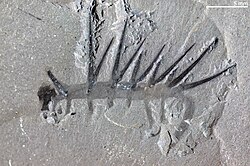
Picture of Hallucigenia
- Source
- Wikipedia/Commons
- Credit
- Han Zeng
- Licence
- CC0
- Commercial use
- the licence allows it
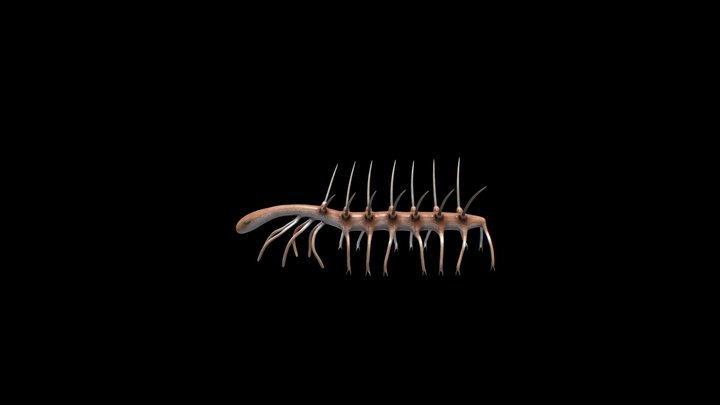
3D model
- Source
- Sketchfab
- Credit
- huykhoi2407
- Licence
- CC Attribution
- Commercial use
- cannot be read from the licence given — check the record
Smithsonian Open Access was not reached for this taxon, so this list is what the others held rather than everything there is.
The description on this site
- Licence
- CC BY-SA 4.0
This is what the site found, which is not the same as what exists.
Keep going
What may have been alongside itHallucigeniidae through timeFormations of the CambrianThe world it lived on
Occurrence data from the Paleobiology Database, CC BY 4.0. Conway Morris 1977