Haurania
Haurania is a genus of elongated, finely agglutinated benthic foraminifera included in the Spirocyclinidae. The test is free, starting with a brief planispiral coil followed by a straight uncoiled stage. The exterior is imperforate, the interior divided by radial septula or beams, perpendicular to the septa and outer wall. The aperture is cribrate, a series of openings on the terminal face.
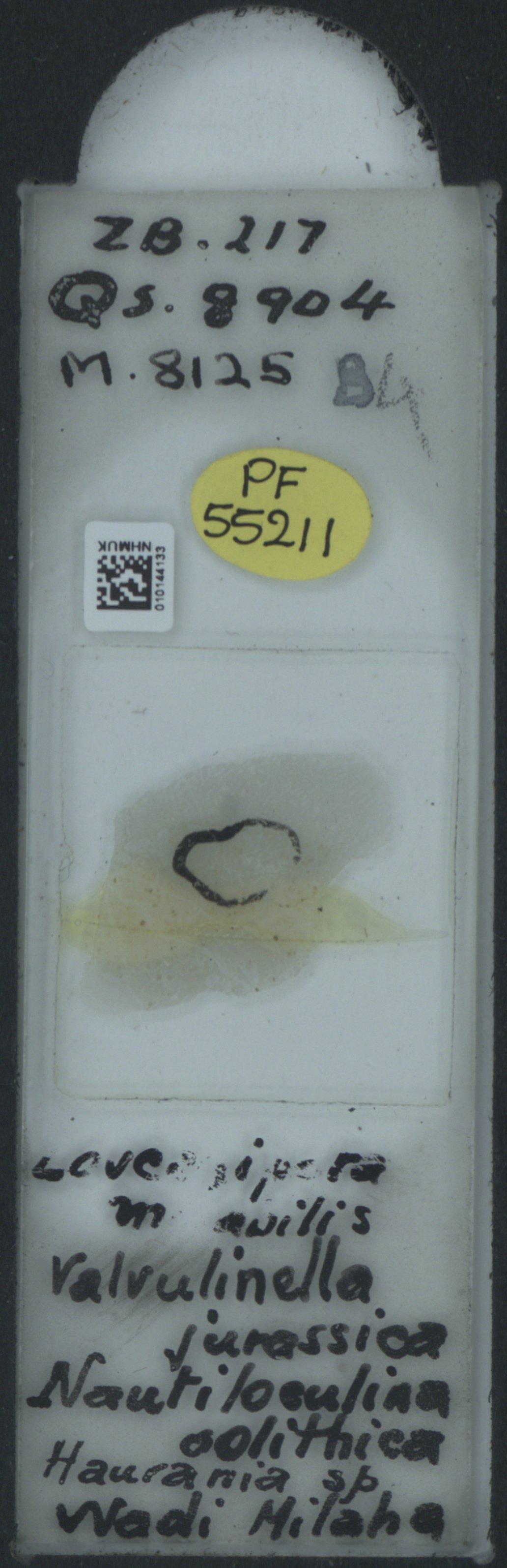
via iDigBio · CC BY · via iDigBio. May be a photograph of a specimen, or an artist’s reconstruction — an interpretation of a skeleton, since colour and soft tissue are almost never preserved.
On record
Recorded, not inferred- Sits inside
- SpirocyclinidaePBDB
- Diet
- omnivorePBDB, for Foraminifera
- Life habit
- semi-infaunalPBDB, for Foraminifera
- Motility
- stationaryPBDB, for Foraminifera
Time the record covers
At least 38 million years on record.
The record covers at least 192.9 Mya to 154.8 Mya. No occurrence read is dated outside 201.4 Mya to 143.1 Mya.
22 occurrences of Haurania on record, most of them in the Early Jurassic. Bar height is expected occurrences, not a count: each fossil is spread across the span it is dated to, so a tall narrow bar means tight dating and a low wide one means loose.
When
22 occurrencesThese are dates about fossils, not the animal: the record can only begin after it arose and end before it died out, so either end may reach further. Shares are expected occurrences: a fossil dated to a span is counted partly in each period it straddles. More on what this infers.
Found in
4 formations
- Calcari Grigi Formation6
- Dhruma Formation · Shaqra Group6
- Jebel Rihat Formation2
- Xiron Formation1
Loading coastlines…
The named rock units Haurania has been recovered from, largest first. Drawn where the rock is now, not where it formed. 7 occurrences have no formation on record, which is common for older literature.
Haurania and its relatives
Early JurassicWhere Haurania and its relatives were recorded in the Early Jurassic.
Found in the same rock
96 taxa- Trocholina9 sites
- Nerinea6 sites
- Orbitopsella6 sites
- Frondicularia5 sites
- Involutina5 sites
- Lituosepta5 sites
- Mayncina5 sites
- Nautiloculina5 sites
- Echinodermata4 sites
- Thaumatoporella parvovesiculifera4 sites
- Gervilleioperna3 sites
- Lithiotis problematica3 sites
- Opisoma3 sites
- Palaeodasycladus mediterraneus3 sites
- Pholadomya3 sites
- Cayeuxia2 sites
- Cochlearites2 sites
- Lithioperna2 sites
- Megalodon2 sites
- Milleporidium2 sites
- Mytiloperna2 sites
- Oppelismilia2 sites
- Pachyrisma2 sites
- Pecten2 sites
The Paleobiology Database records 13 sites for Haurania, and this reads all of them. The number is how many of those sites it was catalogued from too. The 24 sharing the most are listed.
This is not a list of everything alive at the time. It is only what has come out of the same ground as this animal and been written down.
Entered from
5 references- Dissecting "Lithiotis" Bivalves: Implications for the Early Jurassic Reef Eclipse10
- Le Jurassique D`Arabie Centrale6
- Lower Jurassic carbonate succession between Predole and Mlačevo, Central Slovenia4
- Platform margin and oceanic sedimentation in a divergent and convergent plate setting (Jurassic, Pelagonian Zone, NE Evvoia, Greece)1
- Lower Jurassic beds with bivalves in south Slovenia (Spodnjejurske plasti s školjkami v južni Sloveniji)1
Each of the 22 occurrences read was entered from one of these publications, ordered by how many each accounts for. This is not a search for papers mentioning the name. Entries link to doi.org where the Paleobiology Database holds an identifier, and to its own record where it does not. Relayed as the Paleobiology Database holds them, not checked against what they resolve to.
Media and terms
Media content1
Picture of Haurania
- Source
- iDigBio
- Credit
- via iDigBio
- Licence
- CC BY
- Commercial use
- the licence allows it
No 3D scan was found. Smithsonian Open Access, MorphoSource and Sketchfab were all searched.
The description on this site
- Source
- Wikipedia, “Haurania”
- Licence
- CC BY-SA 4.0
This is what the site found, which is not the same as what exists.
Keep going
What may have been alongside itSpirocyclinidae through timeFormations of the Early JurassicThe world it lived on
Occurrence data from the Paleobiology Database, CC BY 4.0.