Helioporidae
Heliopora is a genus of cnidarians in the family Helioporidae. The genus consists of reef building corals, and is ancient and highly conserved. The species Heliopora coerulea is also known as "blue coral".

User:Haplochromis · Public Domain · via Wikipedia/Commons. May be a photograph of a specimen, or an artist’s reconstruction — an interpretation of a skeleton, since colour and soft tissue are almost never preserved.
On record
Recorded, not inferred- Sits inside
- HelioporaceaPBDB
- Diet
- suspension feederPBDB, for Helioporacea
- Life habit
- epifaunalPBDB, for Helioporacea
- Motility
- stationary, attachedPBDB, for Helioporacea
- Vision
- blindPBDB, for Anthozoa
- Environment
- marinePBDB, for Helioporacea
Time the record covers
At least 100 million years on record.
The record covers at least 121.4 Mya to 20.45 Mya. No occurrence read is dated outside 125.77 Mya to 5.333 Mya.
56 occurrences of Helioporidae on record, most of them in the Early Cretaceous. Bar height is expected occurrences, not a count: each fossil is spread across the span it is dated to, so a tall narrow bar means tight dating and a low wide one means loose.
When
56 occurrences- Early Cretaceous32%
- Late Cretaceous20%
- Paleocene4%
- Eocene21%
- Oligocene14%
- Miocene9%
These are dates about fossils, not the animal: the record can only begin after it arose and end before it died out, so either end may reach further. Shares are expected occurrences: a fossil dated to a span is counted partly in each period it straddles. More on what this infers.
Found in
16 formations
- Salcedo Formation4
- Moshi Sandstone Formation · Miyako Group4
- Streiteck Formation · Lower Gosau Group3
- Hiraiga Sandstone Formation · Miyako Group3
- Moneague Formation · White Limestone Group2
- Benassal Formation2
Loading coastlines…
The named rock units Helioporidae has been recovered from, largest first. Drawn where the rock is now, not where it formed. 27 occurrences have no formation on record, which is common for older literature.
Helioporidae and its relatives
Early CretaceousWhere Helioporidae and its relatives were recorded in the Early Cretaceous.
Found in the same rock
669 taxa- Parapolytremacis bellardii9 sites
- Porites8 sites
- Pseudopolytremacis spinoseptata8 sites
- Alveopora rudis6 sites
- Antiguastrea6 sites
- Astreopora meneghiniana6 sites
- Astreopora tecta6 sites
- Astrocoenia lobatorotundata6 sites
- Microsolena major6 sites
- Variabilifavia confertissima6 sites
- Actinacis rollei5 sites
- Dimorphastrea5 sites
- Heterocoenia5 sites
- Montastraea5 sites
- Pavona5 sites
- Pleurocora arachnoides5 sites
- Porites nummulitica5 sites
- Acropora4 sites
- Acropora haidingeri4 sites
- Actinacis martiniana4 sites
- Alveopora4 sites
- Astrocoenia laminosa4 sites
- Columnocoenia ksiazkiewiczi4 sites
- Favia subdenticulata4 sites
The Paleobiology Database records 31 sites for Helioporidae, and this reads all of them. The number is how many of those sites it was catalogued from too. The 24 sharing the most are listed.
This is not a list of everything alive at the time. It is only what has come out of the same ground as this animal and been written down.
Entered from
29 references- Mesozoic hexacorals from Japan7
- Systematische und paläoökologische Untersuchungen an oligozänen Korallen der Umgebung von San Luca (Provinz Vicenza, Norditalien) [Systematic and paleoecologic studies of Oligocene corals from San Luca area (Vicenza, northern Italy)]5
- A Bükkhegyseg Eocen Koralljai [Eocene corals from the Bükk Mountains]5
- Coraux du Barrémien du Sud de la France (Ardèche et Drôme)3
- Coral-rudist bioconstructions in the Upper Cretaceous Haidach section (Northern Calcaerous Alps, Austria)3
- Research on fossil corals from Java3
- Low-light and nutrient-rich coral assemblages in an Upper Aptian carbonate platform of the southern Maestrat Basin (Iberian Chain, eastern Spain)2
- Reef corals of the White Limestone Group of Jamaica2
- Die Korallen der sächsischen Oberkreide - eine Zwischenbilanz und Bemerkungen zu Korallenfaunen des Cenomans [Upper Cretaceous corals from Saxony (Germany) - interim results and notes on Cenomanian coral faunas]2
- La faune corallienne du mont Kassenberg a Mülheim-sur-la-Ruhr (Bassin cretace de Westphalie, nord-ouest de l'Allemagne), 2. Paleontologie [The coral fauna of Mount Kassenberg in Mühlheim-an-der-Ruhr (Cretaceous Basin of Westphalia, NW Germany), 2. Paleontology]2
- Paleoecologie des Madreporaires du Cretace superieur dans le Srednogorie de l'Ouest (Bulgarie occidentale) (Paleoecology of Upper Cretaceous scleractinians from the Western Sredna Gora (Western Bulgaria)]2
- Hexacorallia et octocorallia du Paleogene des Carpates externes [Paleogene corals of the Outer Carpathians]2
Each of the 56 occurrences read was entered from one of these publications, ordered by how many each accounts for. This is not a search for papers mentioning the name. 17 further references are not listed. Entries link to doi.org where the Paleobiology Database holds an identifier, and to its own record where it does not. Relayed as the Paleobiology Database holds them, not checked against what they resolve to.
Media and terms
Media content1
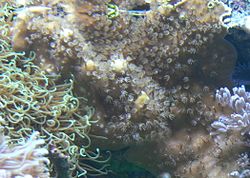
Picture of Helioporidae
- Source
- Wikipedia/Commons
- Credit
- User:Haplochromis
- Licence
- Public Domain
- Commercial use
- the licence allows it
No 3D scan of Helioporidae was found in MorphoSource and Sketchfab.
Smithsonian Open Access was not reached for this taxon, so this list is what the others held rather than everything there is.
The description on this site
- Source
- Wikipedia, “Heliopora”
- Licence
- CC BY-SA 4.0
This is what the site found, which is not the same as what exists.
Keep going
What may have been alongside itHelioporacea through timeFormations of the Early CretaceousThe world it lived on
Occurrence data from the Paleobiology Database, CC BY 4.0. Moseley 1876