Heteroceras
Heteroceras is a genus of Lower Cretaceous heteromorph ammonites belonging to the ancyloceratoidean family, Heteroceratidae.

via iDigBio · CC BY-SA · via iDigBio. May be a photograph of a specimen, or an artist’s reconstruction — an interpretation of a skeleton, since colour and soft tissue are almost never preserved.
On record
Recorded, not inferred- Sits inside
- HeteroceratidaePBDB
- Diet
- carnivorePBDB, for Ammonoidea
- Life habit
- nektonicPBDB, for Ammonoidea
- Motility
- fast-movingPBDB, for Ammonoidea
- Vision
- well-developedPBDB, for Cephalopoda
- Environment
- marinePBDB, for Cephalopoda
Time the record covers
At least 37 million years on record.
The record covers at least 121.4 Mya to 83.6 Mya. No occurrence read is dated outside 125.77 Mya to 72.2 Mya.
62 occurrences of Heteroceras on record, most of them in the Early Cretaceous. Bar height is expected occurrences, not a count: each fossil is spread across the span it is dated to, so a tall narrow bar means tight dating and a low wide one means loose.
When
62 occurrencesThese are dates about fossils, not the animal: the record can only begin after it arose and end before it died out, so either end may reach further. Shares are expected occurrences: a fossil dated to a span is counted partly in each period it straddles. More on what this infers.
Found in
9 formations
- Sarcheshmah Formation15
- Ishido Formation3
- Maiolica Formation3
- Rio Mayer Formation · Pueyrredon Group2
- Pierre Shale Formation · Montana Group2
- Makatini Formation1
Loading coastlines…
The named rock units Heteroceras has been recovered from, largest first. Drawn where the rock is now, not where it formed. 33 occurrences have no formation on record, which is common for older literature.
Heteroceras and its relatives
Early CretaceousWhere Heteroceras and its relatives were recorded in the Early Cretaceous.
Found in the same rock
115 taxa- Martelites12 sites
- Pseudohaploceras matheroni12 sites
- Desmoceras difficile5 sites
- Barremitites strettostoma3 sites
- Anahamulina subcylindrica2 sites
- Ancyloceras2 sites
- Giovaraites massiliae2 sites
- Holcodiscus2 sites
- Imerites2 sites
- Macroscaphites yvani2 sites
- Paraimerites2 sites
- Phyllopachyceras infundibulum2 sites
- Procheloniceras2 sites
- Pulchellia2 sites
- Silesites seranonis2 sites
- Aconeceras1 site
- Aconeceras nisum1 site
- Acrioceras tabarelli1 site
- Anahamulina1 site
- Ancyloceras (Audouliceras) fallauxi1 site
- Anisomyon1 site
- Aporrhais biangulata1 site
- Aptychus1 site
- Astarte1 site
The Paleobiology Database records 48 sites for Heteroceras, and this reads all of them. The number is how many of those sites it was catalogued from too. The 24 sharing the most are listed.
This is not a list of everything alive at the time. It is only what has come out of the same ground as this animal and been written down.
Entered from
17 references- Biostratigraphic events at the Barremian/Aptian boundary in the Betic Cordillera, southern Spain22
- Ammonite families Phylloceratidae, Gaudryceratidae, Oppeliidae and Desmoceratidae from Kopet Dagh Basin NE of Iran; palaeobiogeographical and palaeoecological application15
- New Heteroceratidae (Ammonoidea) from the late Barremian deepening succession of Marseille (Bouches-du-Rhône, France)4
- Upper Barremian Heteroceratinae (Cephalopoda, Ammonoidea) from Patagonia and Zululand, with comments on the systematics of the subfamily3
- Le Crétacé inférieur de l'arc subalpin de Castellane entre l'Asse et le Var: Stratigraphy et Sédimentologie3
- Nuova fauna ad ammoniti del Barremiano superiore Lombardo [A new Upper Barremian ammonite fauna from Lombardy]3
- The first mesozoic chondrophorine (medusoid hydrozoan) from the Lower Cretaceous of Japan2
- The first report of late Valanginian-early Aptian (Early Cretaceous) ammonites and chemostratigraphy of Eastern Anatolian, Olur‐Erzurum, Türkiye1
- Lower Cretaceous (Hauterivian-Albian) ammonite biostratigraphy in the Maestrat Basin (E Spain)1
- Ammonites (Phylloceratina, Lytoceratina and Ancyloceratina) and organic-walled dinoflagellate cysts from the Late Barremian in Boljetin, eastern Serbia1
- [III. Paleontological study of the Yamanaka Group]1
- Notes on some rare Barremian/Aptian ancyloceratids from the Silesian Unit (Outer Western Carpathians, Czech Republic)1
Each of the 62 occurrences read was entered from one of these publications, ordered by how many each accounts for. This is not a search for papers mentioning the name. 5 further references are not listed. Entries link to doi.org where the Paleobiology Database holds an identifier, and to its own record where it does not. Relayed as the Paleobiology Database holds them, not checked against what they resolve to.
Media and terms
Media content2
Picture of Heteroceras
- Source
- iDigBio
- Credit
- via iDigBio
- Licence
- CC BY-SA
- Commercial use
- the licence allows it
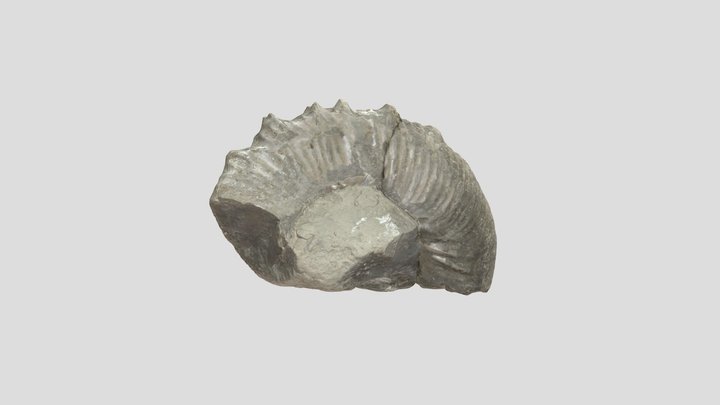
3D model
- Source
- Sketchfab
- Credit
- UIPaleoRepository
- Licence
- CC Attribution
- Commercial use
- cannot be read from the licence given — check the record
Smithsonian Open Access was not reached for this taxon, so this list is what the others held rather than everything there is.
The description on this site
- Source
- Wikipedia, “Heteroceras”
- Licence
- CC BY-SA 4.0
This is what the site found, which is not the same as what exists.
Keep going
What may have been alongside itHeteroceratidae through timeFormations of the Early CretaceousThe world it lived on
Occurrence data from the Paleobiology Database, CC BY 4.0. d'Orbigny 1849