Interatheriinae
Interatheriinae is an extinct subfamily of interatheriids that consisted of notoungulates dating from the Early Eocene to the Early Pliocene. The subfamily includes the genera Archaeophylus, Argyrohyrax, Boleatherium, Brucemacfaddenia, Caenophilus, Choichephilum, Cochilius, Eopachyrucos, Federicoanaya, Interatherium, Juchuysillu, Miocochilius, Neoicochilus, Patriarchus, Proargyrohyrax, Progaleopithecus, Protypotherium, and Santiagorothia. They were small to medium sized interatheres, and when compared to the other subfamily, Notopithecinae, interatheriines are found to occupy an advanced, derived position in the family.

Momotarou2012 · CC BY-SA 3.0 · via Wikipedia/Commons. May be a photograph of a specimen, or an artist’s reconstruction — an interpretation of a skeleton, since colour and soft tissue are almost never preserved.
On record
Recorded, not inferred- Sits inside
- InteratheriidaePBDB
- Diet
- herbivorePBDB, for Notoungulata
- Life habit
- scansorialPBDB, for Eutheria
- Motility
- actively mobilePBDB, for Osteichthyes
- Environment
- terrestrialPBDB, for Eutheria
Time the record covers
At least 34 million years on record.
The record covers at least 42 Mya to 7.246 Mya. No occurrence read is dated outside 56 Mya to 3.6 Mya.
47 occurrences of Interatheriinae on record, most of them in the Oligocene. Bar height is expected occurrences, not a count: each fossil is spread across the span it is dated to, so a tall narrow bar means tight dating and a low wide one means loose.
When
47 occurrencesThese are dates about fossils, not the animal: the record can only begin after it arose and end before it died out, so either end may reach further. Shares are expected occurrences: a fossil dated to a span is counted partly in each period it straddles. More on what this infers.
Found in
16 formations
- Sarmiento Formation9
- Cura-Mallín Formation3
- Nazareno Formation3
- Cerro Boleadoras Formation · Río Zeballos Group3
- Fray Bentos Formation2
- Salla Formation2
Loading coastlines…
The named rock units Interatheriinae has been recovered from, largest first. Drawn where the rock is now, not where it formed. 15 occurrences have no formation on record, which is common for older literature.
Interatheriinae and its relatives
OligoceneWhere Interatheriinae and its relatives were recorded in the Oligocene.
Found in the same rock
493 taxa- Santiagorothia chiliensis8 sites
- Eopachyrucos pliciformis7 sites
- Barrancatatus rigidus5 sites
- Archaeotypotherium propheticus4 sites
- Caviomorpha4 sites
- Dasypodidae4 sites
- Eomorphippus obscurus4 sites
- Meteutatus4 sites
- Parutaetus chilensis4 sites
- Protarchaeohyrax gracilis4 sites
- Pseudhyrax strangulatus4 sites
- Archaeohyrax patagonicus3 sites
- Astrapotheriidae3 sites
- Borhyaenidae3 sites
- Glyptatelinae3 sites
- Juchuysillu arenalesensis3 sites
- Litopterna3 sites
- Meteutatus lagenaformis3 sites
- Peltephilus3 sites
- Phorusrhacidae3 sites
- Proargyrolagus bolivianus3 sites
- Prohegetotherium3 sites
- Prohegetotherium schiaffinoi3 sites
- Pseudhyrax eutrachytheroides3 sites
The Paleobiology Database records 27 sites for Interatheriinae, and this reads all of them. The number is how many of those sites it was catalogued from too. The 24 sharing the most are listed.
This is not a list of everything alive at the time. It is only what has come out of the same ground as this animal and been written down.
Entered from
16 references- New interatheriines (Interatheriidae, Notoungulata) from the Paleogene of Central Chile and Southern Argentina9
- Rodent-like notoungulates (Typotheria) from Gran Barranca, Chubut Province, Argentina: phylogeny and systematics7
- New interatheres (Mammalia, Notoungulata) from the late Oligocene Salla Beds of Bolivia6
- A new typothere notoungulate (Mammalia: Interatheriidae), from the Miocene Nazareno Formation of Southern Bolivia4
- A new Interatheriinae (Mammalia, Notoungulata) from the Cerro Boleadoras Formation (Santa Cruz, Argentina) and the evolution of the tarsus within the lineage during the Miocene3
- A 60-million-year Cenozoic history of western Amazonian ecosystems in Contamana, eastern Peru3
- Chronologic implications of new Miocene mammals from the Cura-Mallín and Trapa Trapa formations, Laguna del Laja area, south Central Chile3
- The Egidio Feruglio's collection in the Museum of Geology and Palaeontology of the University of Padova: its importance to the knowledge of Cenozoic mammals from South America2
- Nueva asociación de mamíferos del Paleógeno en el este de la Patagonia (provincia de Chubut, Argentina): implicancias biocronológicas y paleobiogeográficas2
- A new species of Eopachyrucos (Mammalia, Notoungulata, Interatheriidae) from the Late Oligocene of Uruguay2
- New craniodental material of the typotherian notoungulates from the upper Oligocene of Mendoza, central-western Argentina and their taxonomical importance1
- Youngest Interatheriinae (Mammalia, Notoungulata) from lower Pliocene Tunuyán Formation (Mendoza, Argentina)1
Each of the 47 occurrences read was entered from one of these publications, ordered by how many each accounts for. This is not a search for papers mentioning the name. 4 further references are not listed. Entries link to doi.org where the Paleobiology Database holds an identifier, and to its own record where it does not. Relayed as the Paleobiology Database holds them, not checked against what they resolve to.
Media and terms
Media content1
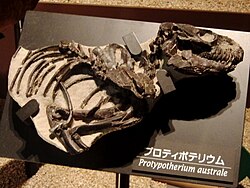
Picture of Interatheriinae
- Source
- Wikipedia/Commons
- Credit
- Momotarou2012
- Licence
- CC BY-SA 3.0
- Commercial use
- the licence allows it
No 3D scan of Interatheriinae was found in Sketchfab.
Smithsonian Open Access and MorphoSource were not reached for this taxon, so this list is what the others held rather than everything there is.
The description on this site
- Licence
- CC BY-SA 4.0
This is what the site found, which is not the same as what exists.
Keep going
What may have been alongside itInteratheriidae through timeFormations of the OligoceneThe world it lived on
Occurrence data from the Paleobiology Database, CC BY 4.0. Simpson 1945