Isastrea bernardiana

Jean.claude · CC BY-SA 4.0 · via Wikidata/Commons. May be a photograph of a specimen, or an artist’s reconstruction — an interpretation of a skeleton, since colour and soft tissue are almost never preserved.
On record
Recorded, not inferred- Sits inside
- IsastreaPBDB
- Diet
- photosymbiotic, suspension feederPBDB, for Montlivaltiidae
- Life habit
- colonial, clonalPBDB, for Montlivaltiidae
- Motility
- stationary, attachedPBDB, for Faviina
- Vision
- blindPBDB, for Anthozoa
- Environment
- marinePBDB, for Scleractinia
Time the record covers
At least 22 million years on record.
The record covers at least 184.2 Mya to 161.5 Mya. No occurrence read is dated outside 192.9 Mya to 154.8 Mya.
65 occurrences of Isastrea bernardiana on record, most of them in the Middle Jurassic. Bar height is expected occurrences, not a count: each fossil is spread across the span it is dated to, so a tall narrow bar means tight dating and a low wide one means loose.
When
65 occurrencesThese are dates about fossils, not the animal: the record can only begin after it arose and end before it died out, so either end may reach further. Shares are expected occurrences: a fossil dated to a span is counted partly in each period it straddles. More on what this infers.
Found in
8 formations
- Calcaire à polypier de Frotey Formation8
- Vršatec Limestone Formation4
- Parvadeh Formation2
- Calcaire d’Audun-le-Tiche Formation1
- Hojedk Formation1
- Hanifa Formation · Shaqra Group1
Loading coastlines…
The named rock units Isastrea bernardiana has been recovered from, largest first. Drawn where the rock is now, not where it formed. 46 occurrences have no formation on record, which is common for older literature.
Isastrea bernardiana and its relatives
Middle JurassicWhere Isastrea bernardiana and its relatives were recorded in the Middle Jurassic.
Found in the same rock
70 taxa- Thamnasteria mettensis49 sites
- Periseris elegantula45 sites
- Cladophyllia babeana17 sites
- Complexastrea zolleriana13 sites
- Dendraraea dendroidea12 sites
- Stephanastrea simonneliana10 sites
- Microsolena major6 sites
- Thecosmilia6 sites
- Isastrea tenuistriata3 sites
- Isastrea explanulata2 sites
- Isastrea salinensis2 sites
- Thamnasteria2 sites
- Thamnasteria terquemi2 sites
- Actinaraea1 site
- Actinostreon1 site
- Afrocytheridea1 site
- Arcomytilus laitmairensis1 site
- Atelophyllia clermontei1 site
- Aulacopygus caudatus1 site
- Brachiopoda1 site
- Bryozoa1 site
- Caenocidaris1 site
- Chlamys1 site
- Cidaroida1 site
The Paleobiology Database records 56 sites for Isastrea bernardiana, and this reads all of them. The number is how many of those sites it was catalogued from too. The 24 sharing the most are listed.
This is not a list of everything alive at the time. It is only what has come out of the same ground as this animal and been written down.
Entered from
11 references- Coraux constructeurs du Bajocien inférieur de France. 1ère Partie40
- Growth models of Bajocian coral-microbialite reefs of Chargey-les-Port (eastern France): palaeoenvironmental interpretations8
- Coral assemblages and environments from Bajocian reefs in the Western Carpathians4
- Jurassic corals of east-central Iran3
- Pliensbachian corals from the Western Tethys2
- Jurassic corals from the Shemshak Formation of the Alborz Mountains, Iran2
- Korallenbänke im Dogger Gamma bei Thalmässing (Mfr.) [Coral banks in the Dogger Gamma near Thalmässing]2
- Jurassic corals from the Jaisalmer Basin, western Rajasthan, India1
- Coraux constructeurs du Bajocien inférieure de France. 2ème Partie1
- Le Jurassique D`Arabie Centrale1
- Bemerkungen zum fossilen Korallenriff Gisliflue-Homberg1
Each of the 65 occurrences read was entered from one of these publications, ordered by how many each accounts for. This is not a search for papers mentioning the name. Entries link to doi.org where the Paleobiology Database holds an identifier, and to its own record where it does not. Relayed as the Paleobiology Database holds them, not checked against what they resolve to.
Media and terms
Media content2
Picture of Isastrea bernardiana
- Source
- Wikidata/Commons
- Credit
- Jean.claude
- Licence
- CC BY-SA 4.0
- Commercial use
- the licence allows it
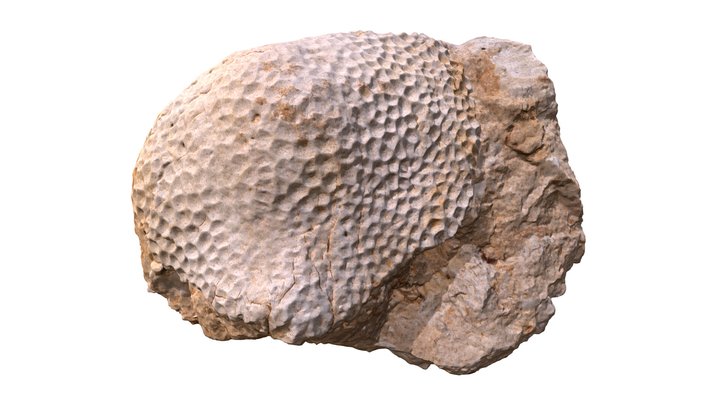
3D model
- Source
- Sketchfab
- Licence
- CC Attribution
- Commercial use
- cannot be read from the licence given — check the record
Smithsonian Open Access and MorphoSource were not reached for this taxon, so this list is what the others held rather than everything there is.
This is what the site found, which is not the same as what exists.
Keep going
What may have been alongside itIsastrea through timeFormations of the Middle JurassicThe world it lived on
Occurrence data from the Paleobiology Database, CC BY 4.0. (d'Orbigny 1850)