Isotelus
Isotelus is an extinct genus of large asaphid trilobites from the Middle and Late Ordovician period, fairly common in the northeastern United States into eastern Canada. Isotelus is the state fossil of Ohio, and through multiple specimens from the 1800s into the modern day has held the title of largest trilobite fossil in the world, reaching over 70 centimetres (28 in) long. Isotelus was carnivorous and a burrower which lived in warm shallow seas, feeding on worms and other soft-bodied animals on and below the substrate. As larvae, Isotelus was planktonic, drifting in the water column with a morphology very different from the adult. Their distinctive morphology with a large shovel-like head, prominent eyes, long genal spines, and their enormous size, makes Isotelus one of the most sought after trilobites in North America.

Chris Woodrich · CC BY-SA 4.0 · via Wikipedia/Commons. May be a photograph of a specimen, or an artist’s reconstruction — an interpretation of a skeleton, since colour and soft tissue are almost never preserved.
On record
Recorded, not inferred- Sits inside
- IsotelinaePBDB
- Diet
- carnivorePBDB, for Trilobita
- Life habit
- low-level epifaunalPBDB, for Asaphida
- Motility
- fast-movingPBDB, for Asaphida
- Vision
- well-developedPBDB, for Asaphidae
- Environment
- marinePBDB, for Trilobita
Time the record covers
At least 30 million years on record.
The record covers at least 471.3 Mya to 440.5 Mya. No occurrence read is dated outside 488.9 Mya to 432.9 Mya.
1,141 occurrences of Isotelus on record, most of them in the Ordovician. Bar height is expected occurrences, not a count: each fossil is spread across the span it is dated to, so a tall narrow bar means tight dating and a low wide one means loose.
When
1,141 occurrences- Cambrianunder 1%
- Ordovician100%
- Silurianunder 1%
These are dates about fossils, not the animal: the record can only begin after it arose and end before it died out, so either end may reach further. Shares are expected occurrences: a fossil dated to a span is counted partly in each period it straddles. More on what this infers.
Found in
154 formations
- Kope Formation187
- Waynesville Formation79
- Martinsburg Formation68
- Lexington Limestone Formation49
- Fairview Formation42
- Liberty Formation41
Loading coastlines…
The named rock units Isotelus has been recovered from, largest first. Drawn where the rock is now, not where it formed. 130 further formations hold fewer occurrences each and are not listed. 33 occurrences have no formation on record, which is common for older literature.
Isotelus and its relatives
OrdovicianWhere Isotelus and its relatives were recorded in the Ordovician.
Found in the same rock
1,422 taxa- Rafinesquina74 sites
- Strophomena57 sites
- Zygospira modesta49 sites
- Anazyga recurvirostra47 sites
- Sowerbyella44 sites
- Glyptorthis bellarugosa42 sites
- Lophospira41 sites
- Ambonychia40 sites
- Flexicalymene40 sites
- Hesperorthis tricenaria40 sites
- Paucicrura rogata38 sites
- Platystrophia37 sites
- Escharopora36 sites
- Hallopora35 sites
- Rafinesquina trentonensis35 sites
- Zygospira35 sites
- Leperditia32 sites
- Petrocrania32 sites
- Ctenodonta31 sites
- Tetradium31 sites
- Liospira30 sites
- Rhynchotrema30 sites
- Trepostomata30 sites
- Conularia29 sites
The Paleobiology Database records 952 sites for Isotelus, and this reads 240 of them. The number is how many of those sites it was catalogued from too. The 24 sharing the most are listed.
This is not a list of everything alive at the time. It is only what has come out of the same ground as this animal and been written down.
Entered from
124 references- Gradient ecology of a biotic invasion: biofacies of the type Cincinnatian Series (Upper Ordovician), Cincinnati, Ohio region, USA308
- Analysis of sample-level properties along a paleoenvironmental gradient: the behavior of evenness as a function of sample size123
- Community gradients in the Martinsburg Fm. (Ord.) southwestern Virginia72
- The Chazy Formation and its fauna67
- Ecological restructuring after extinction: the Late Ordovician (Mohawkian) of the eastern United States45
- Ecosystem structure and stability: middle Upper Ordovician of central Kentucky, USA35
- Palaeozoic geology of the Lake Simcoe Area, Ontario29
- Biostratigraphy of the Middle and Late Ordovician cephalopods of the Upper Mississippi Valley area27
- R. Titus unpublished collections26
- Biofacies Replacement in a Sequence Stratigraphic Framework: Middle and Upper Ordovician of the Nashville Dome, Tennessee, USA19
- Zonation of the Middle and Upper Ordovician strata in northwestern Georgia19
- Stratigraphy of the Lower Middle Ordovician of Tazewell County, Virginia18
Each of the 1,141 occurrences read was entered from one of these publications, ordered by how many each accounts for. This is not a search for papers mentioning the name. 112 further references are not listed. Entries link to doi.org where the Paleobiology Database holds an identifier, and to its own record where it does not. Relayed as the Paleobiology Database holds them, not checked against what they resolve to.
Media and terms
Media content2

Picture of Isotelus
- Source
- Wikipedia/Commons
- Credit
- Chris Woodrich
- Licence
- CC BY-SA 4.0
- Commercial use
- the licence allows it
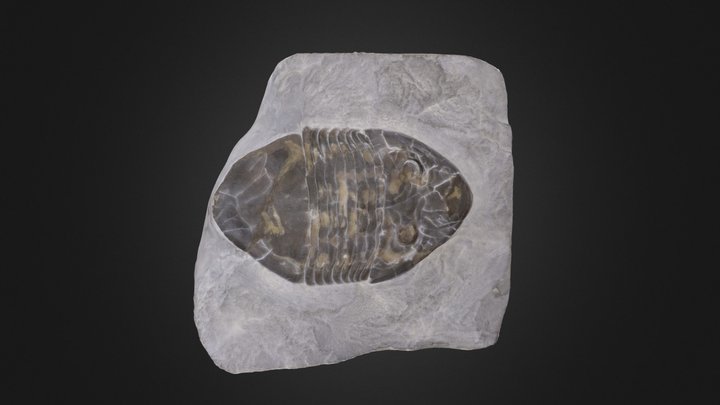
3D model
- Source
- Sketchfab
- Licence
- CC0 Public Domain
- Commercial use
- the licence allows it
This entry was cached before the site began recording what Smithsonian Open Access and MorphoSource did, so a search that failed cannot be told from one that found nothing.
The description on this site
- Source
- Wikipedia, “Isotelus”
- Licence
- CC BY-SA 4.0
This is what the site found, which is not the same as what exists.
Keep going
What may have been alongside itIsotelinae through timeFormations of the OrdovicianThe world it lived on
Occurrence data from the Paleobiology Database, CC BY 4.0. (Dekay 1824)