Latiaxis
Latiaxis is a genus of medium-sized sea snails, marine gastropod mollusks in the family Muricidae, subfamily Coralliophilinae, the coral snails or coral shells.

MerlinCharon · Public Domain · via Wikipedia/Commons. May be a photograph of a specimen, or an artist’s reconstruction — an interpretation of a skeleton, since colour and soft tissue are almost never preserved.
On record
Recorded, not inferred- Sits inside
- CoralliophilidaePBDB
- Diet
- carnivorePBDB, for Coralliophilidae
- Life habit
- epifaunalPBDB, for Coralliophilidae
- Motility
- actively mobilePBDB, for Coralliophilidae
- Vision
- limitedPBDB, for Gastropoda
Time the record covers
At least 72 million years on record.
The record covers at least 72.2 Mya to 129 ka. No occurrence read is dated outside 83.6 Mya to 11.7 ka.
19 occurrences of Latiaxis on record, most of them in the Late Cretaceous. The Paleobiology Database records this as a living group. Bar height is expected occurrences, not a count: each fossil is spread across the span it is dated to, so a tall narrow bar means tight dating and a low wide one means loose.
When
19 occurrences- Late Cretaceous42%
- Miocene16%
- Pliocene16%
- Pleistocene26%
These are dates about fossils, not the animal: the record can only begin after it arose and end before it died out, so either end may reach further. Shares are expected occurrences: a fossil dated to a span is counted partly in each period it straddles. More on what this infers.
Found in
7 formations
- Ripley Formation · Selma Group3
- Severn Formation2
- Corsicana Marl Formation1
- Dry Creek Sands Formation1
- Monte Giogo Formation1
- Nacatoch Sand Formation · Navarro Group1
Loading coastlines…
The named rock units Latiaxis has been recovered from, largest first. Drawn where the rock is now, not where it formed. 9 occurrences have no formation on record, which is common for older literature.
Latiaxis and its relatives
Late CretaceousWhere Latiaxis and its relatives were recorded in the Late Cretaceous.
Found in the same rock
958 taxa- Cymbophora7 sites
- Nuculana7 sites
- Acteon6 sites
- Anomia argentaria6 sites
- Cadulus6 sites
- Crassatella vadosa6 sites
- Cyprimeria6 sites
- Dentalium6 sites
- Linearis6 sites
- Morea marylandica6 sites
- Nemodon eufaulensis6 sites
- Turritella6 sites
- Anchura5 sites
- Corbula5 sites
- Eulima5 sites
- Euspira rectilabrum5 sites
- Exogyra (Exogyra) costata5 sites
- Fulgerca attenuata5 sites
- Ostrea5 sites
- Paladmete cancellaria5 sites
- Panopea5 sites
- Urceolabrum tuberculatum5 sites
- Acirsa4 sites
- Amuletum4 sites
The Paleobiology Database records 11 sites for Latiaxis, and this reads all of them. The number is how many of those sites it was catalogued from too. The 24 sharing the most are listed.
This is not a list of everything alive at the time. It is only what has come out of the same ground as this animal and been written down.
Entered from
10 references- Cenozoic fossil mollusks from Western Pacific Islands; Gastropods (Volutidae through Terebridae)4
- Resilience of marine invertebrate communities during the early Cenozoic hyperthermals3
- Marine mollusca from the "Ryukyu Limestone" of Kikai-Zima, Ryukyu Group3
- Upper Cretaceous (Maestrichtian) larger invertebrates from the Haustator bilira Assemblage Zone in the Atlantic Coastal Plain with further data for the East Gulf2
- Cenozoic fossil mollusks from Western Pacific Islands; Gastropods (Eratoidae through Harpidae)2
- Nuove specie di Gasteropodi del Piacenziano di rio Crevalese, Castell’Arquato (Piacenza, Italia)1
- Upper Cretaceous (Maestrichtian) larger invertebrate Fossils from the Haustator bilira Assemblage Zone in the west gulf Coastal Plain1
- Archeogastropoda, Mesogastropoda and stratigraphy of the Ripley, Owl Creek, and Prairie Bluff Formations1
- The molluscan fauna of the Pliocene strata underlying the Adelaide Plains. Part V - Gastropoda (Eratoidae to Scaphandridae)1
- The fauna of the Ripley formation on Coon creek, Tennessee1
Each of the 19 occurrences read was entered from one of these publications, ordered by how many each accounts for. This is not a search for papers mentioning the name. Entries link to doi.org where the Paleobiology Database holds an identifier, and to its own record where it does not. Relayed as the Paleobiology Database holds them, not checked against what they resolve to.
Media and terms
Media content2
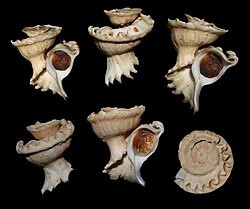
Picture of Latiaxis
- Source
- Wikipedia/Commons
- Credit
- MerlinCharon
- Licence
- Public Domain
- Commercial use
- the licence allows it
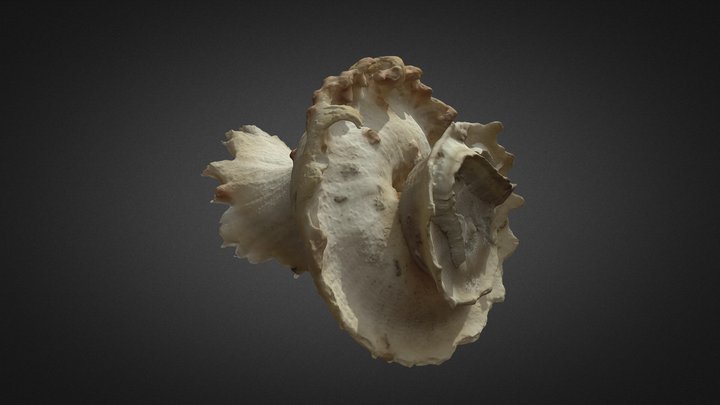
3D model
- Source
- Sketchfab
- Credit
- Giorgio Scioldo
- Licence
- CC Attribution
- Commercial use
- cannot be read from the licence given — check the record
Smithsonian Open Access was not reached for this taxon, so this list is what the others held rather than everything there is.
The description on this site
- Source
- Wikipedia, “Latiaxis”
- Licence
- CC BY-SA 4.0
This is what the site found, which is not the same as what exists.
Keep going
What may have been alongside itCoralliophilidae through timeFormations of the Late CretaceousThe world it lived on
Occurrence data from the Paleobiology Database, CC BY 4.0. Swainson 1840