Leopardus wiedii
The margay is a small wild cat native to Mexico, Central and South America. A solitary and nocturnal felid, it lives mainly in primary evergreen and deciduous forest.

Supreet Sahoo · CC BY-SA 4.0 · via Wikipedia/Commons. May be a photograph of a specimen, or an artist’s reconstruction — an interpretation of a skeleton, since colour and soft tissue are almost never preserved.
On record
Recorded, not inferred- Also called
- margayPBDB
- Sits inside
- LeopardusPBDB
- Diet
- carnivorePBDB, for Felidae
- Life habit
- arborealPBDB
- Motility
- actively mobilePBDB, for Osteichthyes
- Environment
- terrestrialPBDB, for Eutheria
- Mass
- 105 gWikidata
Time the record covers
At least 2 thousand years on record.
The record covers at least 14 ka to 11.7 ka. No occurrence read is dated outside 2.58 Mya to 0 Mya.
7 occurrences of Leopardus wiedii on record, most of them in the Pleistocene. The Paleobiology Database records this as a living group. Bar height is expected occurrences, not a count: each fossil is spread across the span it is dated to, so a tall narrow bar means tight dating and a low wide one means loose.
When
7 occurrences- Pleistocene82%
- Holocene18%
These are dates about fossils, not the animal: the record can only begin after it arose and end before it died out, so either end may reach further. Shares are expected occurrences: a fossil dated to a span is counted partly in each period it straddles. More on what this infers.
Found in
1 formation
Loading coastlines…
The named rock units Leopardus wiedii has been recovered from, largest first. Drawn where the rock is now, not where it formed. 6 occurrences have no formation on record, which is common for older literature.
Leopardus wiedii and its relatives
PleistoceneWhere Leopardus wiedii and its relatives were recorded in the Pleistocene.
Found in the same rock
130 taxa- Aenocyon dirus3 sites
- Odocoileus virginianus2 sites
- Procyon lotor2 sites
- Agkistrodon1 site
- Alligator mississippiensis1 site
- Alouatta palliatus1 site
- Ameiurus1 site
- Amia calva1 site
- Amphiuma1 site
- Aotus trivirgatus1 site
- Archosargus probatocephalus1 site
- Arctodus pristinus1 site
- Arctodus simus1 site
- Ardea herodias1 site
- Ateles geoffroyi1 site
- Bassaricyon gabbii1 site
- Bison antiquus1 site
- Bradypus variegatus1 site
- Branta canadensis1 site
- Bufo1 site
- Buteo1 site
- Buteo jamaicensis1 site
- Cabassous centralis1 site
- Caluromys1 site
The Paleobiology Database records 7 sites for Leopardus wiedii, and this reads all of them. The number is how many of those sites it was catalogued from too. The 24 sharing the most are listed.
This is not a list of everything alive at the time. It is only what has come out of the same ground as this animal and been written down.
Entered from
5 references- Late Quaternary Carnivora from the Balck Belt, Mississippi3
- Cenozoic vertebrate biostratigraphy of South Carolina, U.S.A. and additions to the fauna1
- Vertebrate Paleontology1
- Synonymies and reidentifications of North American fossil mammals1
- Barro Colorado Island and Tropical Biology1
Each of the 7 occurrences read was entered from one of these publications, ordered by how many each accounts for. This is not a search for papers mentioning the name. Entries link to doi.org where the Paleobiology Database holds an identifier, and to its own record where it does not. Relayed as the Paleobiology Database holds them, not checked against what they resolve to.
Media and terms
Media content3
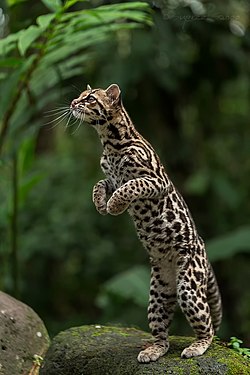
Picture of Leopardus wiedii
- Source
- Wikipedia/Commons
- Credit
- Supreet Sahoo
- Licence
- CC BY-SA 4.0
- Commercial use
- the licence allows it
CT scan
- Source
- MorphoSource
- Licence
- not stated by the source
- Commercial use
- cannot be read from the licence given — check the record
- Specimen
- Leopardus wiedii · mnhn:zm:1984-041
3D model
- Source
- Sketchfab
- Credit
- DouglasRibeiro2
- Licence
- CC Attribution-NonCommercial-NoDerivs
- Commercial use
- the licence does not allow it
The description on this site
- Source
- Wikipedia, “Margay”
- Licence
- CC BY-SA 4.0
This is what the site found, which is not the same as what exists.
Keep going
What may have been alongside itLeopardus through timeFormations of the PleistoceneThe world it lived on
Occurrence data from the Paleobiology Database, CC BY 4.0. (Schinz 1821)