Lirophora mariae
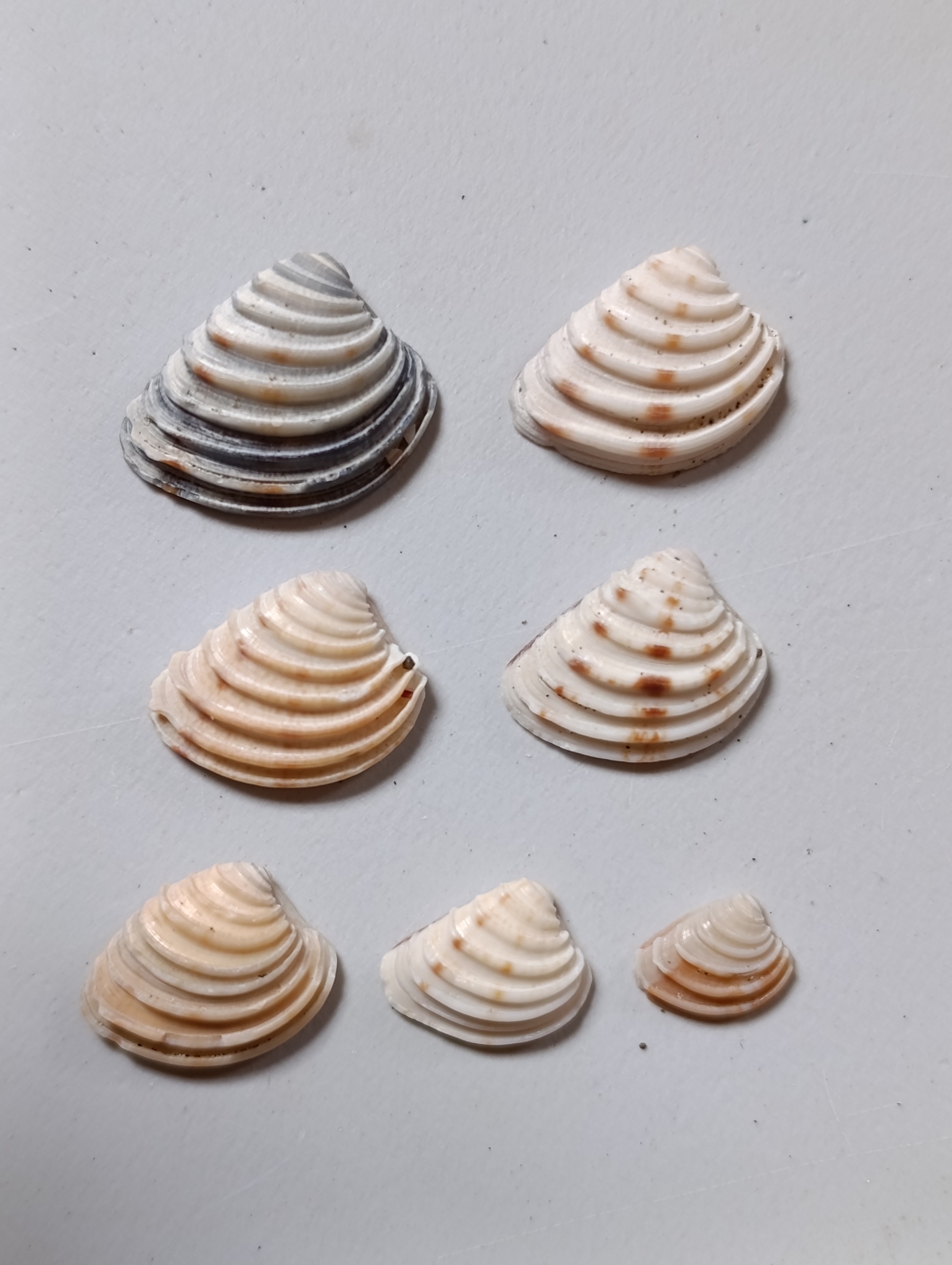
Juan Fernando Pesántez-Muñoz · CC BY-NC 4.0 · via GBIF. May be a photograph of a specimen, or an artist’s reconstruction — an interpretation of a skeleton, since colour and soft tissue are almost never preserved.
On record
Recorded, not inferred- Sits inside
- LirophoraPBDB
- Diet
- suspension feederPBDB, for Lirophora
- Life habit
- infaunalPBDB, for Lirophora
- Motility
- facultatively mobilePBDB, for Lirophora
- Vision
- blindPBDB, for Bivalvia
Time the record covers
At least 3.4 million years on record.
The record covers at least 3.6 Mya to 129 ka. No occurrence read is dated outside 5.333 Mya to 0 Mya.
13 occurrences of Lirophora mariae on record, most of them in the Pleistocene. The Paleobiology Database records this as a living group. Bar height is expected occurrences, not a count: each fossil is spread across the span it is dated to, so a tall narrow bar means tight dating and a low wide one means loose.
When
13 occurrences- Pliocene35%
- Pleistocene64%
- Holoceneunder 1%
These are dates about fossils, not the animal: the record can only begin after it arose and end before it died out, so either end may reach further. Shares are expected occurrences: a fossil dated to a span is counted partly in each period it straddles. More on what this infers.
Found in
8 formations
- Jama Formation3
- Canoa Formation3
- Charco Azul Formation1
- Armuelles Formation · Charco Azul Group1
- Onzole Formation · Daule Group1
- Montezuma Formation1
Loading coastlines…
The named rock units Lirophora mariae has been recovered from, largest first. Drawn where the rock is now, not where it formed. 1 occurrence has no formation on record, which is common for older literature.
Lirophora mariae and its relatives
PleistoceneWhere Lirophora mariae and its relatives were recorded in the Pleistocene.
Found in the same rock
289 taxa- Mexicardia procera4 sites
- Raeta undulata4 sites
- Anadara nux3 sites
- Anomia peruviana3 sites
- Argopecten ventricosus3 sites
- Calyptraea mamillaris3 sites
- Chionopsis amathusia3 sites
- Hybolophus gibbosus3 sites
- Polinices uber3 sites
- Tellina (Eurytellina) regia3 sites
- Turritella3 sites
- Anadara concinna2 sites
- Antillophos (Antillophos) veraguensis2 sites
- Architectonica nobilis2 sites
- Arcinella californica2 sites
- Barbatia illota2 sites
- Cancellaria urceolata2 sites
- Caryocorbula biradiata2 sites
- Caryocorbula marmorata2 sites
- Caryocorbula ovulata2 sites
- Columbella2 sites
- Conus2 sites
- Cosmioconcha modesta2 sites
- Crenella decussata2 sites
The Paleobiology Database records 5 sites for Lirophora mariae, and this reads all of them. The number is how many of those sites it was catalogued from too. The 24 sharing the most are listed.
This is not a list of everything alive at the time. It is only what has come out of the same ground as this animal and been written down.
Entered from
8 references- A Pliocene fauna from Western Ecuador4
- Sequence stratigraphy of the Punta Ballena Member of the Jama Formation (Early Pleistocene, Ecuador): insights from integrated sedimentologic, taphonomic and paleoecologic analysis of molluscan shell concentrations2
- Tertiary and Quaternary fossils from Burica Peninsula of Panama and Costa Rica2
- Unpublished taxonomic backbone for Eastern Pacific Invertebrate Communities of the Cenozoic (EPICC) Thematic Collections Network1
- Quaternary invertebrate fossil assemblages from coastal marine ecosystems of Bahia de Panama, Panama1
- Taphonomic and paleoecological analyses (mollusks and fishes) of the Súa Member condensed shelled, upper Onzole Formation (Early Pliocene, Ecuador)1
- Paleoecology and paleoenvironments of the Pleistocene deposits of Bahia la Choya (Gulf of California, Sonora, Mexico)1
- Geology and paleontology of the Santa Maria District California1
Each of the 13 occurrences read was entered from one of these publications, ordered by how many each accounts for. This is not a search for papers mentioning the name. Entries link to doi.org where the Paleobiology Database holds an identifier, and to its own record where it does not. Relayed as the Paleobiology Database holds them, not checked against what they resolve to.
Media and terms
Media content1
Picture of Lirophora mariae
- Source
- GBIF
- Credit
- Juan Fernando Pesántez-Muñoz
- Licence
- CC BY-NC 4.0
- Commercial use
- the licence does not allow it
No 3D scan of Lirophora mariae was found in Sketchfab.
Smithsonian Open Access and MorphoSource were not reached for this taxon, so this list is what the others held rather than everything there is.
This is what the site found, which is not the same as what exists.
Keep going
What may have been alongside itLirophora through timeFormations of the PleistoceneThe world it lived on
Occurrence data from the Paleobiology Database, CC BY 4.0. (d'Orbigny 1846)