Manorina melanocephala
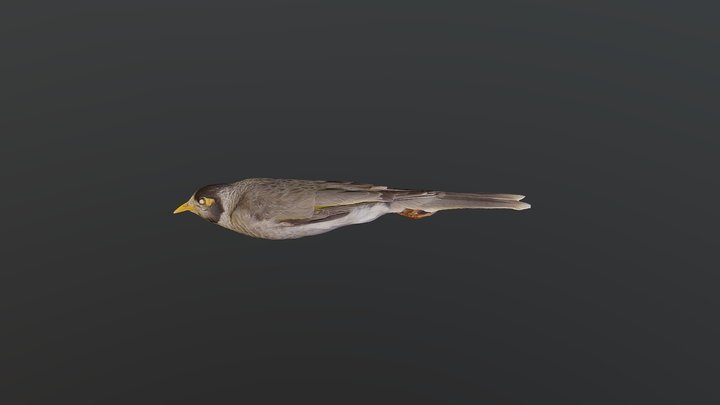
The noisy miner is a bird in the honeyeater family, Meliphagidae, and is endemic to eastern and southeastern Australia. This miner is a grey bird, with a black head, orange-yellow beak and feet, a distinctive yellow patch behind the eye, and white tips on the tail feathers. The Tasmanian subspecies has a more intense yellow panel in the wing, and a broader white tip to the tail. Males, females and juveniles are similar in appearance, though young birds are a brownish-grey. As the common name suggests, the noisy miner is a vocal species with a large range of songs, calls, scoldings and alarms, and almost constant vocalisations, particularly from young birds. One of four species in the genus Manorina, the noisy miner itself is divided into four subspecies. The separation of the Tasmanian M. m. leachi is of long standing, and the mainland birds were further split in 1999.

JJ Harrison ( https://www.jjharrison.com.au/ ) · CC BY-SA 3.0 · via Wikipedia/Commons. May be a photograph of a specimen, or an artist’s reconstruction — an interpretation of a skeleton, since colour and soft tissue are almost never preserved.
On record
Recorded, not inferred- Also called
- noisy minerPBDB
- Sits inside
- ManorinaPBDB
- Diet
- carnivorePBDB, for Coelurosauria
- Life habit
- ground dwelling, solitaryPBDB, for Theropoda
- Motility
- actively mobilePBDB, for Theropoda
- Environment
- terrestrialPBDB, for Theropoda
- Mass
- 57 gWikidata
Time the record covers
At most 118 thousand years on record.
The one occurrence read is dated to somewhere between 129 ka and 11.7 ka, which is a dating window rather than a span.
1 occurrence of Manorina melanocephala on record, most of them in the Pleistocene. The Paleobiology Database records this as a living group. Bar height is expected occurrences, not a count: each fossil is spread across the span it is dated to, so a tall narrow bar means tight dating and a low wide one means loose.
When
1 occurrences- Pleistocene100%
These are dates about fossils, not the animal: the record can only begin after it arose and end before it died out, so either end may reach further. Shares are expected occurrences: a fossil dated to a span is counted partly in each period it straddles. More on what this infers.
Manorina melanocephala and its relatives
PleistoceneWhere Manorina melanocephala and its relatives were recorded in the Pleistocene.
Found in the same rock
21 taxa- Accipitridae1 site
- Cacatua tenuirostris1 site
- Cacatuidae1 site
- Callocephalon fimbriatum1 site
- Calyptorhynchus banksii1 site
- Calyptorhynchus lathami1 site
- Centropus colossus1 site
- Corvus1 site
- Dacelo novaeguineae1 site
- Dasyornis broadbenti1 site
- Falco berigora1 site
- Hirundinidae1 site
- Metasthenurus newtonae1 site
- Orthonyx hypsilophus1 site
- Phaps1 site
- Phaps chalcoptera1 site
- Platycercus1 site
- Procoptodon gilli1 site
- Simosthenurus maddocki1 site
- Simosthenurus occidentalis1 site
- Tribonyx mortierii1 site
The Paleobiology Database records 1 site for Manorina melanocephala, and this reads all of them. The number is how many of those sites it was catalogued from too.
This is not a list of everything alive at the time. It is only what has come out of the same ground as this animal and been written down.
Entered from
1 referenceEach of the 1 occurrence read was entered from one of these publications, ordered by how many each accounts for. This is not a search for papers mentioning the name. Each entry links to doi.org. Relayed as the Paleobiology Database holds them, not checked against what they resolve to.
Media and terms
Media content2

Picture of Manorina melanocephala
- Source
- Wikipedia/Commons
- Credit
- JJ Harrison ( https://www.jjharrison.com.au/ )
- Licence
- CC BY-SA 3.0
- Commercial use
- the licence allows it
MorphoSource was not reached for this taxon, so this list is what the others held rather than everything there is.
The description on this site
- Source
- Wikipedia, “Noisy miner”
- Licence
- CC BY-SA 4.0
This is what the site found, which is not the same as what exists.
Keep going
What may have been alongside itManorina through timeFormations of the PleistoceneThe world it lived on
Occurrence data from the Paleobiology Database, CC BY 4.0. (Latham 1801)