Megalosauridae
Megalosauridae is a monophyletic family of carnivorous theropod dinosaurs within the group Megalosauroidea. Appearing in the Middle Jurassic, megalosaurids were among the first major radiation of large theropod dinosaurs. They were a relatively primitive group of basal tetanurans containing two main subfamilies, Megalosaurinae and Afrovenatorinae, along with the basal genus Eustreptospondylus, an unresolved taxon which differs from both subfamilies.

Etemenanki3 · CC BY-SA 4.0 · via Wikipedia/Commons. May be a photograph of a specimen, or an artist’s reconstruction — an interpretation of a skeleton, since colour and soft tissue are almost never preserved.
On record
Recorded, not inferred- Sits inside
- MegalosauroideaPBDB
- Diet
- carnivorePBDB, for Theropoda
- Life habit
- ground dwelling, solitaryPBDB, for Theropoda
- Motility
- actively mobilePBDB, for Theropoda
- Environment
- terrestrialPBDB, for Theropoda
Time the record covers
At least 129 million years on record.
The record covers at least 201.4 Mya to 72.2 Mya. No occurrence read is dated outside 205.7 Mya to 66 Mya.
134 occurrences of Megalosauridae on record, most of them in the Late Jurassic. Bar height is expected occurrences, not a count: each fossil is spread across the span it is dated to, so a tall narrow bar means tight dating and a low wide one means loose.
When
134 occurrences- Late Triassicunder 1%
- Early Jurassic1%
- Middle Jurassic31%
- Late Jurassic41%
- Early Cretaceous22%
- Late Cretaceous4%
These are dates about fossils, not the animal: the record can only begin after it arose and end before it died out, so either end may reach further. Shares are expected occurrences: a fossil dated to a span is counted partly in each period it straddles. More on what this infers.
Found in
46 formations
- Morrison Formation13
- Lourinhã Formation11
- Marnes de Dives Formation6
- Forest Marble Formation · Great Oolite Group4
- Tendaguru Formation4
- Cotswold Slate Formation4
Loading coastlines…
The named rock units Megalosauridae has been recovered from, largest first. Drawn where the rock is now, not where it formed. 22 further formations hold fewer occurrences each and are not listed. 37 occurrences have no formation on record, which is common for older literature.
Megalosauridae and its relatives
Late JurassicWhere Megalosauridae and its relatives were recorded in the Late Jurassic.
Found in the same rock
515 taxa- Megalosaurus47 sites
- Sauropoda15 sites
- Theropoda15 sites
- Torvosaurus14 sites
- Camarasaurus12 sites
- Lepidotes10 sites
- Megalosaurus bucklandii10 sites
- Ceratosaurus9 sites
- Goniopholis9 sites
- Allosaurus8 sites
- Ornithopoda8 sites
- Apatosaurus7 sites
- Dinosauria7 sites
- Diplodocus7 sites
- Multituberculata7 sites
- Stegosaurus7 sites
- Torvosaurus gurneyi7 sites
- Torvosaurus tanneri7 sites
- Bivalvia6 sites
- Iguanodon6 sites
- Iguanodontidae6 sites
- Mammalia6 sites
- Albanerpetontidae5 sites
- Ankylosauria5 sites
The Paleobiology Database records 127 sites for Megalosauridae, and this reads all of them. The number is how many of those sites it was catalogued from too. The 24 sharing the most are listed.
This is not a list of everything alive at the time. It is only what has come out of the same ground as this animal and been written down.
Entered from
80 references- Torvosaurus gurneyi n. sp., the largest terrestrial predator from Europe, and a proposed terminology of the maxilla anatomy in nonavian theropods7
- El Weald de Munilla (La Rioja) y sus icnitas de dinosaurios. (II) [The Wealden of Munilla (La Rioja) and its dinosaur footprints. (II)]7
- Lydekker, 18887
- El Weald de Igea (Cameros - La Rioja): sedimentologia, bioestratigrafia y paleoicnologia de grandes reptiles (Dinosaurios) [The Wealden of Igea (Cameros – La Rioja: sedimentology, biostratigraphy and paleoichnology of great reptiles (dinosaurs)]6
- The phylogeny of Tetanurae (Dinosauria: Theropoda)5
- Multivariate and cladistic analyses of isolated teeth reveal sympatry of theropod dinosaurs in the Late Jurassic of northern Germany4
- Les dinosaures de France [The dinosaurs of France]4
- A large sized megalosaurid (Theropoda, Tetanurae) from the late Jurassic of Uruguay and Tanzania3
- A new specimen of Torvoaurus tanneri originally collected by Elmer Riggs3
- Connely, 20023
- Benton and Spencer, 19953
- Edmarka rex, a new, gigantic theropod dinosaur from the middle Morrison Formation, Late Jurassic of the Como Bluff outcrop region3
Each of the 134 occurrences read was entered from one of these publications, ordered by how many each accounts for. This is not a search for papers mentioning the name. 68 further references are not listed. Entries link to doi.org where the Paleobiology Database holds an identifier, and to its own record where it does not. Relayed as the Paleobiology Database holds them, not checked against what they resolve to.
Media and terms
Media content1
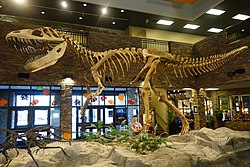
Picture of Megalosauridae
- Source
- Wikipedia/Commons
- Credit
- Etemenanki3
- Licence
- CC BY-SA 4.0
- Commercial use
- the licence allows it
No 3D scan of Megalosauridae was found in MorphoSource and Sketchfab.
Smithsonian Open Access was not reached for this taxon, so this list is what the others held rather than everything there is.
The description on this site
- Licence
- CC BY-SA 4.0
This is what the site found, which is not the same as what exists.
Keep going
What may have been alongside itMegalosauroidea through timeFormations of the Late JurassicThe world it lived on
Occurrence data from the Paleobiology Database, CC BY 4.0. (Fitzinger 1843)