Lepidotes
Lepidotes is an extinct genus of Mesozoic ray-finned fish. It has long been considered a wastebasket taxon, characterised by "general features, such as thick rhomboid scales and, for most of the species, by semi-tritorial or strongly tritorial dentition". with dozens of species assigned to it. Fossils attributed to Lepidotes have been found in Jurassic and Cretaceous rocks worldwide. It has been argued that Lepidotes should be restricted to species closely related to the type species L. gigas, which are only known from the Early Jurassic of Western and Central Europe, with most other species being not closely related, with other species transferred to new genera such as Scheenstia. Lepidotes belongs to Ginglymodi, a clade of fish whose only living representatives are the gars (Lepisosteidae). The type species L. gigas and close relatives are thought to be members of the family Lepidotidae, part of the order Lepisosteiformes within Ginglymodi, with other species occupying various other positions within Ginglymodi.

Ghedo · CC BY-SA 4.0 · via Wikipedia/Commons. May be a photograph of a specimen, or an artist’s reconstruction — an interpretation of a skeleton, since colour and soft tissue are almost never preserved.
On record
Recorded, not inferred- Sits inside
- SemionotidaePBDB
- Diet
- durophage, carnivorePBDB, for Semionotiformes
- Life habit
- nektonicPBDB, for Semionotiformes
- Motility
- actively mobilePBDB, for Semionotiformes
Time the record covers
At least 169 million years on record.
The record covers at least 241.464 Mya to 72.2 Mya. No occurrence read is dated outside 244.4 Mya to 66 Mya.
292 occurrences of Lepidotes on record, most of them in the Early Cretaceous. Bar height is expected occurrences, not a count: each fossil is spread across the span it is dated to, so a tall narrow bar means tight dating and a low wide one means loose.
When
292 occurrences- Middle Triassicunder 1%
- Late Triassic8%
- Early Jurassic6%
- Middle Jurassic11%
- Late Jurassic23%
- Early Cretaceous41%
- Late Cretaceous11%
These are dates about fossils, not the animal: the record can only begin after it arose and end before it died out, so either end may reach further. Shares are expected occurrences: a fossil dated to a span is counted partly in each period it straddles. More on what this infers.
Found in
119 formations
- Tendaguru Formation11
- Solnhofen Formation8
- Paluxy Formation · Trinity Group7
- La Huérguina Formation6
- Lourinhã Formation6
- Westbury Formation · Penarth Group6
Loading coastlines…
The named rock units Lepidotes has been recovered from, largest first. Drawn where the rock is now, not where it formed. 95 further formations hold fewer occurrences each and are not listed. 68 occurrences have no formation on record, which is common for older literature.
Lepidotes and its relatives
Early CretaceousWhere Lepidotes and its relatives were recorded in the Early Cretaceous.
Found in the same rock
2,013 taxa- Theropoda57 sites
- Hybodus37 sites
- Crocodylia36 sites
- Testudines30 sites
- Sauropoda27 sites
- Anura24 sites
- Mesoeucrocodylia23 sites
- Caturus21 sites
- Dinosauria20 sites
- Dromaeosauridae20 sites
- Pterosauria20 sites
- Actinopterygii18 sites
- Gastropoda18 sites
- Hybodontidae18 sites
- Teleostei18 sites
- Bivalvia17 sites
- Goniopholis17 sites
- Ornithopoda15 sites
- Pycnodontidae15 sites
- Pycnodontiformes15 sites
- Testudinata15 sites
- Bernissartia14 sites
- Hypsilophodontidae14 sites
- Squamata14 sites
The Paleobiology Database records 263 sites for Lepidotes, and this reads 240 of them. The number is how many of those sites it was catalogued from too. The 24 sharing the most are listed.
This is not a list of everything alive at the time. It is only what has come out of the same ground as this animal and been written down.
Entered from
167 references- Catalogue of the Fossil Fishes in the British Museum (Natural History), Part III27
- Selachians and actinopterygians from the Upper Jurassic of Tendaguru, Tanzania11
- Lower vertebrate faunas of the Trinity Division on north-central Texas7
- Monographie der fossilien Fische aus den Lithographischen Schiefern Bayerns7
- Étude derestes de poissons du Crétacé saharien [Study of fish remains from the Saharan Cretaceous]6
- A Fauna da Formação Brejo Santo, Neojurássico da Bacia do Araripe, Brasil: Interpretações Paleoambientais5
- Le Crétacé continental à vertébrés de la bordure sud du plateau de Tinhert: découvertes paléontologiques et considérations stratigraphiques [The continental Cretaceous vertebrates of the southern border of the Tinhert Plateau: paleontological discoveries and stratigraphic considerations]5
- Estado de las investigaciones sobre los vertebrados del Jurásico Superior y Cretácico Interior de Galve (Teruel) [State of the investigations into the vertebrates of the Upper Jurassic and Lower Cretaceous of Galve (Teruel)]5
- Mesozoic continental vertebrates of Tunisia5
- Fish remains from a temporary exposure of Hythe Beds (Aptian-Lower Cretaceous) near Godstone, Surrey5
- Sulla probabile esistenza del gen. Carcharodon nel Mare Titonico [On the probable existence of the gen. Carcharodon in the Tithonian Sea]4
- Microvertebrates of the Lourinhã Formation (Late Jurassic, Portugal)3
Each of the 292 occurrences read was entered from one of these publications, ordered by how many each accounts for. This is not a search for papers mentioning the name. 155 further references are not listed. Entries link to doi.org where the Paleobiology Database holds an identifier, and to its own record where it does not. Relayed as the Paleobiology Database holds them, not checked against what they resolve to.
Media and terms
Media content2
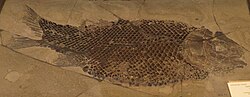
Picture of Lepidotes
- Source
- Wikipedia/Commons
- Credit
- Ghedo
- Licence
- CC BY-SA 4.0
- Commercial use
- the licence allows it
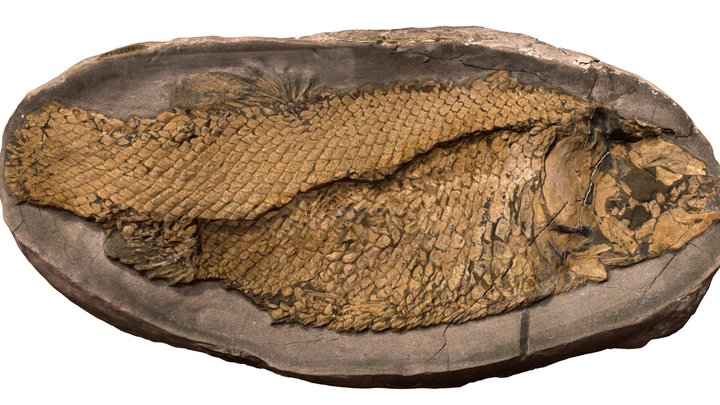
3D model
- Source
- Sketchfab
- Licence
- CC Attribution
- Commercial use
- cannot be read from the licence given — check the record
The description on this site
- Source
- Wikipedia, “Lepidotes”
- Licence
- CC BY-SA 4.0
This is what the site found, which is not the same as what exists.
Keep going
What may have been alongside itSemionotidae through timeFormations of the Early CretaceousThe world it lived on
Occurrence data from the Paleobiology Database, CC BY 4.0. Agassiz 1832