Melvius
Melvius is a genus of vidalamiin amiid ray-finned fish from the Late Cretaceous. The type species, Melvius thomasi, was described by Bryant in 1987 from Hell Creek Formation. A second species Melvius chauliodous, was named and described by Hall and Wolberg in 1989 from Kirtland Formation, and it is now considered to be one of the index taxa of the Kirtlandian land-vertebrate age.
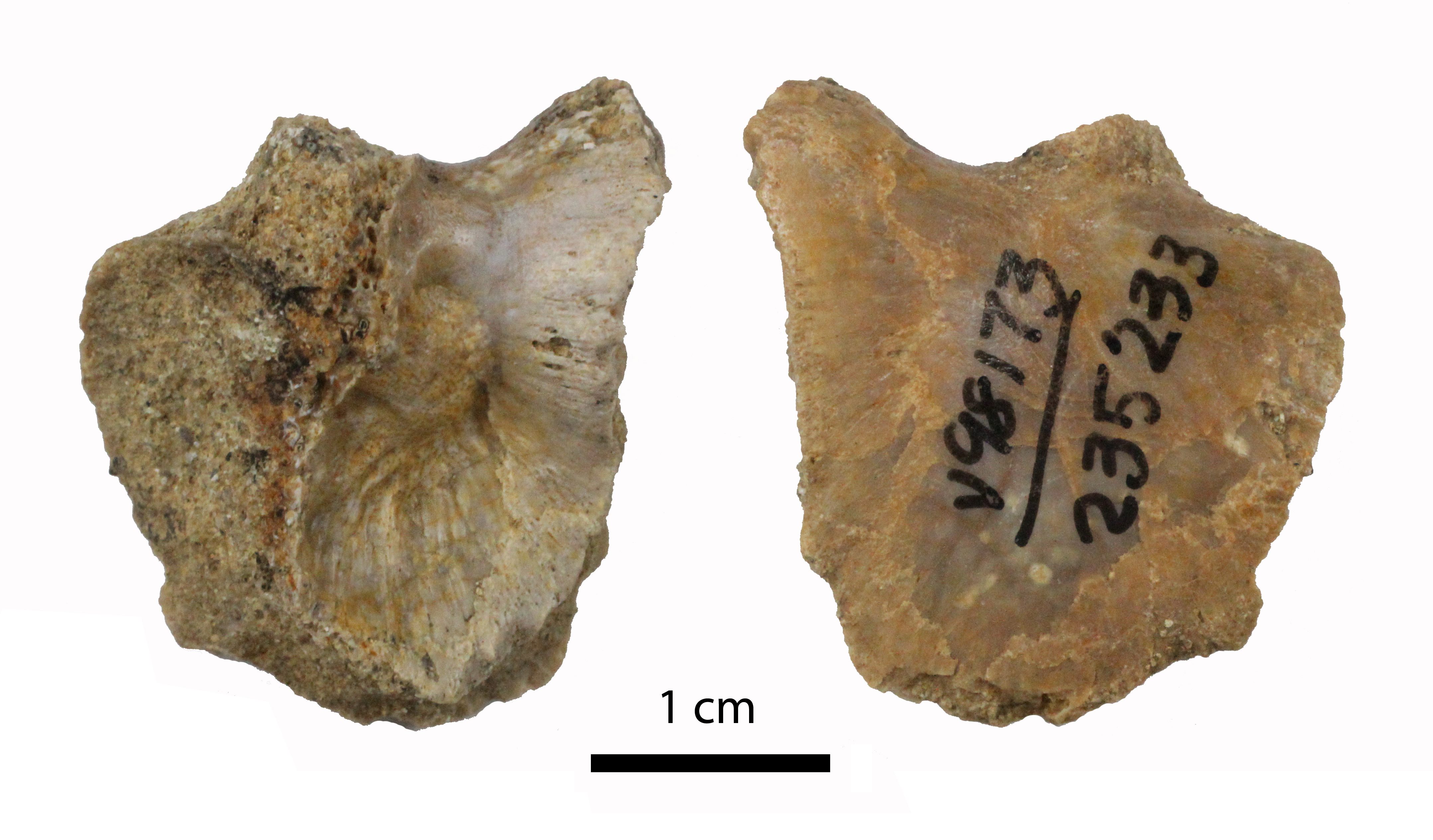
Hutchison, J.H.+Munthe, J.+Ramsey, B. · CC BY 4.0 · via GBIF. May be a photograph of a specimen, or an artist’s reconstruction — an interpretation of a skeleton, since colour and soft tissue are almost never preserved.
On record
Recorded, not inferred- Sits inside
- VidalamiinaePBDB
- Diet
- carnivore, piscivorePBDB, for Amiiformes
- Life habit
- nektobenthicPBDB, for Amiiformes
- Motility
- actively mobilePBDB, for Amiiformes
Time the record covers
At least 41 million years on record.
The record covers at least 113.2 Mya to 72.2 Mya. No occurrence read is dated outside 119.57 Mya to 66 Mya.
87 occurrences of Melvius on record, most of them in the Late Cretaceous. Bar height is expected occurrences, not a count: each fossil is spread across the span it is dated to, so a tall narrow bar means tight dating and a low wide one means loose.
When
87 occurrencesThese are dates about fossils, not the animal: the record can only begin after it arose and end before it died out, so either end may reach further. Shares are expected occurrences: a fossil dated to a span is counted partly in each period it straddles. More on what this infers.
Found in
21 formations
- Hell Creek Formation · Montana Group39
- Lance Formation7
- Iron Springs Formation7
- Cerro del Pueblo Formation · Difunta Group4
- Paluxy Formation · Trinity Group4
- Kirtland Formation3
Loading coastlines…
The named rock units Melvius has been recovered from, largest first. Drawn where the rock is now, not where it formed.
Melvius and its relatives
Late CretaceousWhere Melvius and its relatives were recorded in the Late Cretaceous.
Found in the same rock
498 taxa- Trionychidae48 sites
- Adocus38 sites
- Ceratopsidae32 sites
- Compsemys victa30 sites
- Lepisosteus occidentalis28 sites
- Hadrosauridae27 sites
- Baenidae26 sites
- Brachychampsa montana26 sites
- Lepisosteidae26 sites
- Champsosaurus25 sites
- Chelydridae24 sites
- Crocodylia24 sites
- Borealosuchus sternbergii23 sites
- Myledaphus bipartitus22 sites
- Paronychodon22 sites
- Scapherpeton tectum22 sites
- Cyclurus fragosus19 sites
- Helopanoplia beecheri19 sites
- Lonchidion selachos19 sites
- Hadrosaurinae18 sites
- Testudines18 sites
- Meniscoessus robustus17 sites
- Theropoda17 sites
- Urodela17 sites
The Paleobiology Database records 87 sites for Melvius, and this reads all of them. The number is how many of those sites it was catalogued from too. The 24 sharing the most are listed.
This is not a list of everything alive at the time. It is only what has come out of the same ground as this animal and been written down.
Entered from
25 references- A new genus and species of Amiidae (Holostei; Osteichthyes) from the Late Cretaceous of North America, with comments on the phylogeny of the Amiidae24
- Vertebrate biostratigraphy of the Hell Creek Formation in southwestern North Dakota and northwestern South Dakota15
- Patterns of geographic variation in latest Cretaceous vertebrates: evidence from the turtle component11
- Vertebrates of the Iron Springs Formation, Upper Cretaceous, southwestern Utah7
- Stratigraphy and vertebrate fauna of the lower shale member of the Aguja Formation (lower Campanian) in West Texas3
- Non-marine fishes of the late Santonian Milk River Formation of Alberta, Canada – evidence from vertebrate microfossil localities3
- Vertebrates of the El Pelillal locality (Campanian, Cerro del Pueblo Formation), southeastern Coahuila, Mexico3
- Early Cretaceous (Comanchean) vertebrates of central Texas3
- The nonmammalian vertebrate microfossil assemblages of the Mesaverde Formation (Upper Cretaceous, Campanian) of the Wind River and Bighorn Basins, Wyoming2
- New Late Cretaceous microvertebrate assemblage from the Campanian–Maastrichtian Williams Fork Formation, northwestern Colorado, USA, and its paleoenvironmental implications1
- Geology and taphonomy of a unique tyrannosaurid bonebed from the upper Campanian Kaiparowits Formation of southern Utah: implications for tyrannosaurid gregariousness1
- Chondrichthyan and osteichthyan paleofaunas from the Cretaceous (Late Maastrichtian) Fox Hills Formation of North Dakota, USA: paleoecology, paleogeography, and extinction1
Each of the 87 occurrences read was entered from one of these publications, ordered by how many each accounts for. This is not a search for papers mentioning the name. 13 further references are not listed. Entries link to doi.org where the Paleobiology Database holds an identifier, and to its own record where it does not. Relayed as the Paleobiology Database holds them, not checked against what they resolve to.
Media and terms
Media content2
Picture of Melvius
- Source
- GBIF
- Credit
- Hutchison, J.H.+Munthe, J.+Ramsey, B.
- Licence
- CC BY 4.0
- Commercial use
- the licence allows it

Structured light scan
- Source
- MorphoSource
- Licence
- not stated by the source
- Commercial use
- cannot be read from the licence given — check the record
- Specimen
- Melvius sp. · dmnh:epv:149538
The description on this site
- Source
- Wikipedia, “Melvius”
- Licence
- CC BY-SA 4.0
This is what the site found, which is not the same as what exists.
Keep going
What may have been alongside itVidalamiinae through timeFormations of the Late CretaceousThe world it lived on
Occurrence data from the Paleobiology Database, CC BY 4.0. Bryant 1988