Modiolus attenuatus
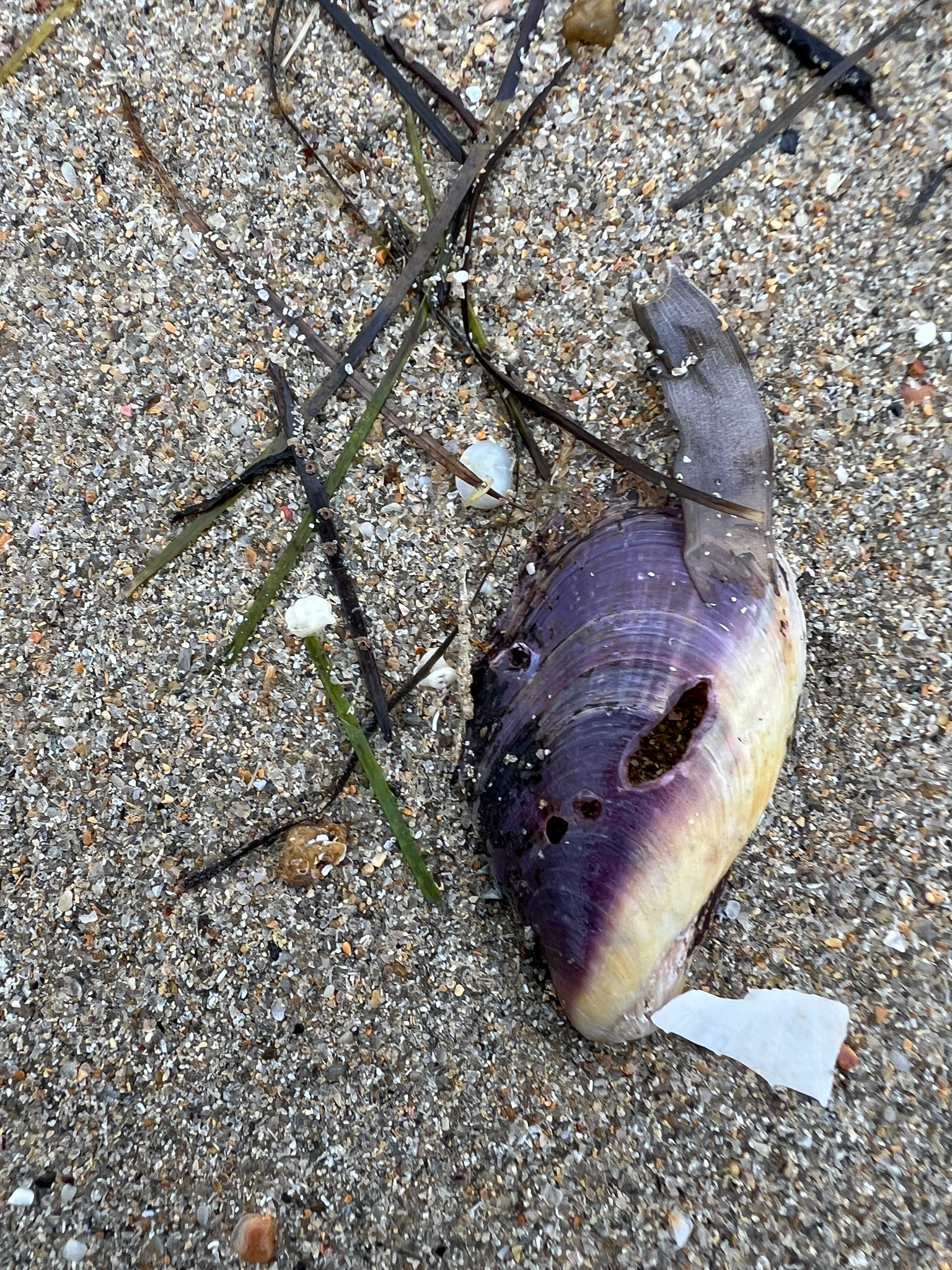
loisstephens1 · CC BY-NC 4.0 · via GBIF. May be a photograph of a specimen, or an artist’s reconstruction — an interpretation of a skeleton, since colour and soft tissue are almost never preserved.
On record
Recorded, not inferred- Sits inside
- ModiolusPBDB
- Diet
- suspension feederPBDB, for Modiolus
- Life habit
- semi-infaunalPBDB, for Modiolus
- Motility
- stationary, attached, epibiontPBDB, for Modiolus
- Vision
- blindPBDB, for Bivalvia
- Environment
- lagoonal,coastal,inner shelf,outer shelf,oceanic,brackish,freshwaterPBDB, for Mytilidae
Time the record covers
At least 21 million years on record.
The record covers at least 93.9 Mya to 72.2 Mya. No occurrence read is dated outside 100.5 Mya to 66 Mya.
4 occurrences of Modiolus attenuatus on record, most of them in the Late Cretaceous. Bar height is expected occurrences, not a count: each fossil is spread across the span it is dated to, so a tall narrow bar means tight dating and a low wide one means loose.
When
4 occurrences- Late Cretaceous100%
These are dates about fossils, not the animal: the record can only begin after it arose and end before it died out, so either end may reach further. Shares are expected occurrences: a fossil dated to a span is counted partly in each period it straddles. More on what this infers.
Found in
4 formations
Loading coastlines…
The named rock units Modiolus attenuatus has been recovered from, largest first. Drawn where the rock is now, not where it formed.
Modiolus attenuatus and its relatives
Late CretaceousWhere Modiolus attenuatus and its relatives were recorded in the Late Cretaceous.
Found in the same rock
146 taxa- Actinosepia canadensis2 sites
- Anchura2 sites
- Crenella elegantula2 sites
- Cymbophora warrenana2 sites
- Dosiniopsis deweyi2 sites
- Glossus moreauensis2 sites
- Malletia evansi2 sites
- Modiolus galpinianus2 sites
- Nucula cancellata2 sites
- Nucula planomarginata2 sites
- Nuculana (Jupiteria) scitula2 sites
- Nymphalucina occidentalis2 sites
- Phelopteria linguaeformis2 sites
- Protocardia subquadrata2 sites
- Rhombopsis2 sites
- Syncyclonema2 sites
- Vanikoropsis2 sites
- Veniella2 sites
- ? Gregania sp.1 site
- ? Mathilia sp.1 site
- Acanthoscaphites1 site
- Acanthoscaphites plenus1 site
- Acirsa1 site
- Anisomyon centrale1 site
The Paleobiology Database records 4 sites for Modiolus attenuatus, and this reads all of them. The number is how many of those sites it was catalogued from too. The 24 sharing the most are listed.
This is not a list of everything alive at the time. It is only what has come out of the same ground as this animal and been written down.
Entered from
3 references- Paleontology of the Greenhorn cylcothem (Cretaceous: late Cenomanian to middle Turonian) at Black Mesa, northeastern Arizona2
- Scaphitid ammonites of the Upper Cretaceous (Maastrichtian) Fox Hills Formation in South Dakota and Wyoming1
- Geology of the Southern Alberta Plains. Part II. Paleontology of the marine formations of the Montana Group1
Each of the 4 occurrences read was entered from one of these publications, ordered by how many each accounts for. This is not a search for papers mentioning the name. Each entry links to the Paleobiology Database's own record for the work.
Media and terms
Media content1
Picture of Modiolus attenuatus
- Source
- GBIF
- Credit
- loisstephens1
- Licence
- CC BY-NC 4.0
- Commercial use
- the licence does not allow it
No 3D scan was found. Smithsonian Open Access, MorphoSource and Sketchfab were all searched.
This is what the site found, which is not the same as what exists.
Keep going
What may have been alongside itModiolus through timeFormations of the Late CretaceousThe world it lived on
Occurrence data from the Paleobiology Database, CC BY 4.0. (Meek and Hayden 1857)