Monopleuridae
Monopleuridae is a family of bivalves that belongs to the order Hippuritida (rudists). Some genera such as Monopleura are known to have a global distribution with a wide temporal range from the Tithonian age of the Jurassic period to the Maastrichtian age of the Cretaceous period.
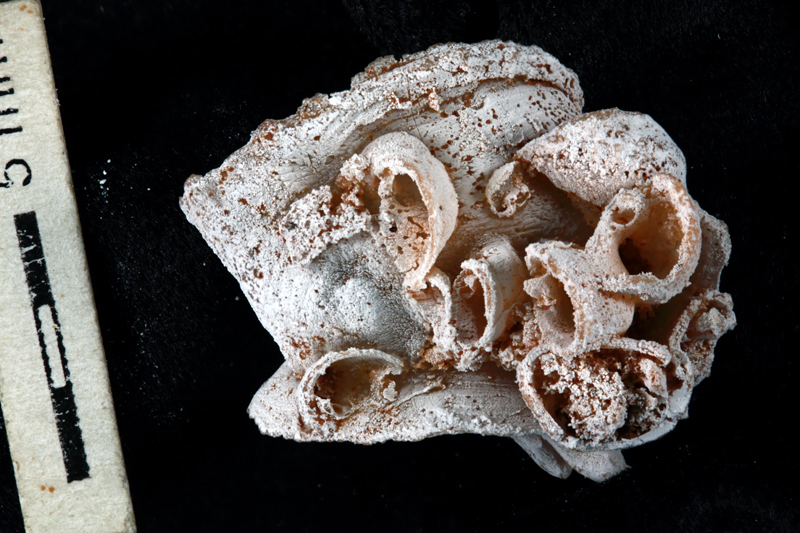
Not Monopleuridae. This is Monopleura Matheron, 1842, a relative — both are Monopleuridae.
McCall, Linda · CC0 · via GBIF. May be a photograph of a specimen, or an artist’s reconstruction — an interpretation of a skeleton, since colour and soft tissue are almost never preserved.
On record
Recorded, not inferred- Sits inside
- RadiolitoideaPBDB
- Diet
- suspension feederPBDB, for Hippuritida
- Life habit
- intermediate-level epifaunal, gregariousPBDB, for Hippuritida
- Motility
- stationary, attachedPBDB, for Hippuritida
- Vision
- blindPBDB, for Bivalvia
- Environment
- marinePBDB, for Hippuritida
Time the record covers
At least 60 million years on record.
The record covers at least 132.6 Mya to 72.2 Mya. No occurrence read is dated outside 137.05 Mya to 66 Mya.
122 occurrences of Monopleuridae on record, most of them in the Early Cretaceous. Bar height is expected occurrences, not a count: each fossil is spread across the span it is dated to, so a tall narrow bar means tight dating and a low wide one means loose.
When
122 occurrencesThese are dates about fossils, not the animal: the record can only begin after it arose and end before it died out, so either end may reach further. Shares are expected occurrences: a fossil dated to a span is counted partly in each period it straddles. More on what this infers.
Found in
29 formations
- Mural Limestone Formation · Bisbee Group10
- Shuaiba Formation5
- El Abra Formation4
- opoka Formation3
- Magyaregregy Conglomerate Formation2
- Collades de Basturs Formation2
Loading coastlines…
The named rock units Monopleuridae has been recovered from, largest first. Drawn where the rock is now, not where it formed. 5 further formations hold fewer occurrences each and are not listed. 68 occurrences have no formation on record, which is common for older literature.
Monopleuridae and its relatives
Early CretaceousWhere Monopleuridae and its relatives were recorded in the Early Cretaceous.
Found in the same rock
941 taxa- Monopleura32 sites
- Gyropleura19 sites
- Spondylus19 sites
- Lyriochlamys17 sites
- Pholadomya15 sites
- Agriopleura14 sites
- Panopea14 sites
- Pycnodonte vesicularis13 sites
- Plagiostoma hoperi12 sites
- Pseudolimea12 sites
- Spondylus fimbriatus12 sites
- Entolium membranaceum11 sites
- Hyotissa semiplana11 sites
- Dhondtichlamys10 sites
- Granocardium10 sites
- Lima10 sites
- Limatula10 sites
- Praeradiolites10 sites
- Astarte9 sites
- Barbatia9 sites
- Biradiolites9 sites
- Dhondtichlamys pulchellus9 sites
- Merklinia variabilis9 sites
- Nemocardium9 sites
The Paleobiology Database records 71 sites for Monopleuridae, and this reads all of them. The number is how many of those sites it was catalogued from too. The 24 sharing the most are listed.
This is not a list of everything alive at the time. It is only what has come out of the same ground as this animal and been written down.
Entered from
44 references- Unpublished data on Cretaceous-Paleocene molluscan assemblages24
- Carbon and oxygen stable isotopes of selected Cenomanian and Turonian rudists from Egypt and Czech Republic, and a note on changes in rudist diversity8
- Rudist Biostratigraphy in the Campanian-Maastrichtian of the south-central Pyrenees, Spain7
- Maastrichtian non-cephalopod mollusks: Scaphopoda, Gastropoda and Bivalvia of the Middle Vistula Valley, central Poland7
- Sequence stratigraphic and paleoecologic analysis of an Albian coral-rudist patch reef, Arizona, USA6
- Debrunia, a new Barremian genus of petalodontid Monopleuridae (Bivalvia, Hippuritoidea) from the Mediterranean region6
- Rudists of Mexico: Historical Aspects and Selected Areas of Research4
- Homopleura new genus (Hippuritida, Monopleuridae) and the origin of the Polyconitidae3
- Lower Cretaceous Rudist faunas of Southeast Spain: an overview3
- A platform-to-basin transition for lower Aptian carbonates (Shuaiba Formation) of the northeastern Jebel Akhdar (Sultanate of Oman)3
- Vestiges of atoll-like formations in the Lower Cretaceous of the Mecsek Mountains , Hungary3
- Les constructions a cnidaires des calcaires urgoniens (Barremien) de Provence, et leur environnement [Constructions of Cnidaria from the Urgonian Limestones (Barremian) from Provence, and their environment]3
Each of the 122 occurrences read was entered from one of these publications, ordered by how many each accounts for. This is not a search for papers mentioning the name. 32 further references are not listed. Entries link to doi.org where the Paleobiology Database holds an identifier, and to its own record where it does not. Relayed as the Paleobiology Database holds them, not checked against what they resolve to.
Media and terms
Media content1
Picture of Monopleura Matheron, 1842
- Source
- GBIF
- Credit
- McCall, Linda
- Licence
- CC0
- Commercial use
- the licence allows it
No 3D scan was found. Smithsonian Open Access, MorphoSource and Sketchfab were all searched.
The description on this site
- Licence
- CC BY-SA 4.0
This is what the site found, which is not the same as what exists.
Keep going
What may have been alongside itRadiolitoidea through timeFormations of the Early CretaceousThe world it lived on
Occurrence data from the Paleobiology Database, CC BY 4.0. Munier-Chalmas 1873