Morelia
Morelia is a genus of large snakes in the family Pythonidae. The genus is native to Australia, Indonesia, and New Guinea. As of 2024, up to eight species are recognized.

Benchill · CC BY 3.0 · via Wikipedia/Commons. May be a photograph of a specimen, or an artist’s reconstruction — an interpretation of a skeleton, since colour and soft tissue are almost never preserved.
On record
Recorded, not inferred- Sits inside
- PythonidaePBDB
- Diet
- carnivorePBDB, for Pythonidae
- Life habit
- ground dwellingPBDB, for Pythonidae
- Motility
- actively mobilePBDB, for Osteichthyes
- Environment
- terrestrialPBDB, for Pythonidae
Time the record covers
At least 23 million years on record.
The record covers at least 23.04 Mya to 11.7 ka. No occurrence read is dated outside 27.3 Mya to 0 Mya.
17 occurrences of Morelia on record, most of them in the Miocene. The Paleobiology Database records this as a living group. Bar height is expected occurrences, not a count: each fossil is spread across the span it is dated to, so a tall narrow bar means tight dating and a low wide one means loose.
When
17 occurrencesThese are dates about fossils, not the animal: the record can only begin after it arose and end before it died out, so either end may reach further. Shares are expected occurrences: a fossil dated to a span is counted partly in each period it straddles. More on what this infers.
Found in
4 formations
Loading coastlines…
The named rock units Morelia has been recovered from, largest first. Drawn where the rock is now, not where it formed. 12 occurrences have no formation on record, which is common for older literature.
Morelia and its relatives
MioceneWhere Morelia and its relatives were recorded in the Miocene.
Found in the same rock
161 taxa- Hydrophiinae3 sites
- Yurlunggur3 sites
- Agamidae2 sites
- Cookeroo hortusensis2 sites
- Elapidae2 sites
- Gumardee keari2 sites
- Gumardee webbi2 sites
- Macropodidae2 sites
- Paljara2 sites
- Teleostei2 sites
- Wakaleo oldfieldi2 sites
- Acanthopagrus australis1 site
- Achoerodus1 site
- Anhinga1 site
- Anura1 site
- Arctocephalus doriferus1 site
- Ardenna bulleri1 site
- Ardenna grisea1 site
- Ardenna tenuirostris1 site
- Argyrosomus1 site
- Balbaroo fangaroo1 site
- Balbaroo nalima1 site
- Barawertornis tedfordi1 site
- Barguru maru1 site
The Paleobiology Database records 14 sites for Morelia, and this reads all of them. The number is how many of those sites it was catalogued from too. The 24 sharing the most are listed.
This is not a list of everything alive at the time. It is only what has come out of the same ground as this animal and been written down.
Entered from
6 references- Montypythonoides: the Miocene snake Morelia riversleighensis (Smith & Plane, 1985) and the geographical origin of pythons9
- Pythonine snakes (Boidae) from the Miocene of Australia4
- Late Holocene hunting economies in coastal southeastern Australia: Insights from the archaeological fauna of Curracurrang 1 Rockshelter, Royal National Park1
- A New, Giant Platypus, Obdurodon tharalkooschild, sp. nov. (Monotremata, Ornithorhynchidae), from the Riversleigh World Heritage Area, Australia1
- Fossil mammals of Riversleigh, northwestern Queensland; preliminary overview of biostratigraphy, correlation and environmental change1
- Results of the Ray E. Lemley expeditions; Part 1, the Allingham Formation and a new Pliocene vertebrate fauna from northern Queensland1
Each of the 17 occurrences read was entered from one of these publications, ordered by how many each accounts for. This is not a search for papers mentioning the name. Entries link to doi.org where the Paleobiology Database holds an identifier, and to its own record where it does not. Relayed as the Paleobiology Database holds them, not checked against what they resolve to.
Media and terms
Media content3
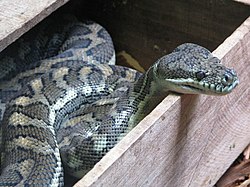
Picture of Morelia
- Source
- Wikipedia/Commons
- Credit
- Benchill
- Licence
- CC BY 3.0
- Commercial use
- the licence allows it
CT scan
- Source
- MorphoSource
- Licence
- In Copyright
- Commercial use
- cannot be read from the licence given — check the record
- Specimen
- Morelia spilota · nmv:herpetology:D76156

The description on this site
- Licence
- CC BY-SA 4.0
This is what the site found, which is not the same as what exists.
Keep going
What may have been alongside itPythonidae through timeFormations of the MioceneThe world it lived on
Occurrence data from the Paleobiology Database, CC BY 4.0. Gray 1842