Muderongia
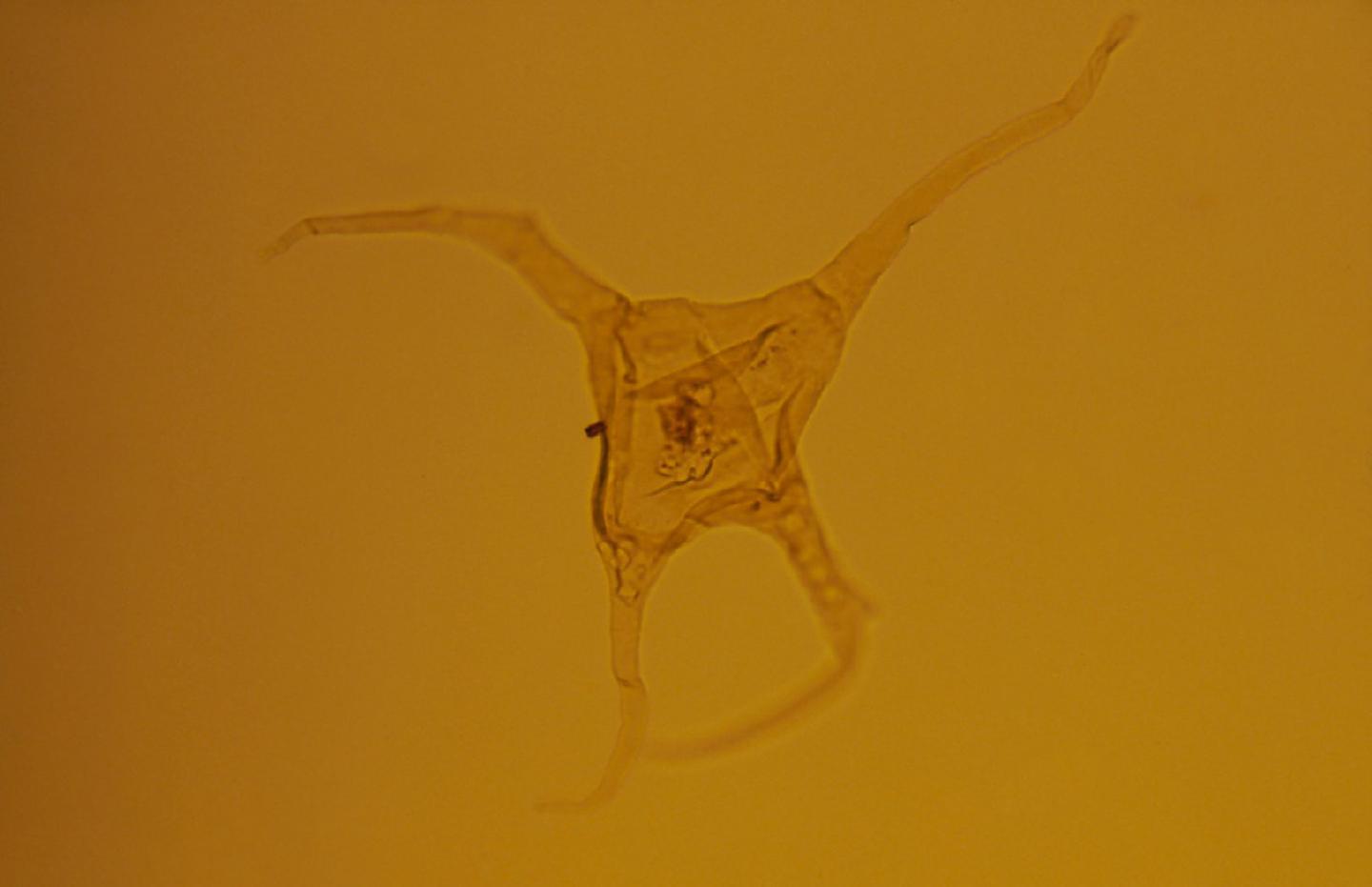
via iDigBio · CC BY · via iDigBio. May be a photograph of a specimen, or an artist’s reconstruction — an interpretation of a skeleton, since colour and soft tissue are almost never preserved.
On record
Recorded, not inferred- Sits inside
- CeratiaceaePBDB
- Diet
- "photoautotroph"PBDB, for Dinoflagellata
- Environment
- freshwaterPBDB, for Dinophyceae
Time the record covers
At least 19 million years on record.
The record covers at least 132.6 Mya to 113.2 Mya. No occurrence read is dated outside 137.05 Mya to 100.5 Mya.
20 occurrences of Muderongia on record, most of them in the Early Cretaceous. Bar height is expected occurrences, not a count: each fossil is spread across the span it is dated to, so a tall narrow bar means tight dating and a low wide one means loose.
When
20 occurrences- Early Cretaceous100%
These are dates about fossils, not the animal: the record can only begin after it arose and end before it died out, so either end may reach further. Shares are expected occurrences: a fossil dated to a span is counted partly in each period it straddles. More on what this infers.
Found in
7 formations
- Kotick Point Formation · Gustav Group5
- Agrio Formation5
- Lagrelius Point Formation3
- Tunbridge Wells Sand Formation · Wealden Group1
- Weald Clay Formation · Wealden Group1
- Ladegardsaen Formation1
Loading coastlines…
The named rock units Muderongia has been recovered from, largest first. Drawn where the rock is now, not where it formed. 3 occurrences have no formation on record, which is common for older literature.
Muderongia and its relatives
Early CretaceousWhere Muderongia and its relatives were recorded in the Early Cretaceous.
Found in the same rock
116 taxa- Oligosphaeridium complex4 sites
- Gonyaulacysta3 sites
- Hystrichodinium pulchrum3 sites
- Sirmiodinium grossii3 sites
- Spiniferites3 sites
- Trichodinium3 sites
- Apteodinium2 sites
- Astacolus2 sites
- Cribroperidinium2 sites
- Cristellaria (Marginulina)2 sites
- Cyclonephelium2 sites
- Dichotomites2 sites
- Globulina2 sites
- Glomospirella2 sites
- Gongylodinium acineum2 sites
- Nodosaria2 sites
- Rhynchodiniopsis2 sites
- Sentusidinium2 sites
- Valensiella2 sites
- Wallodinium krutzschii2 sites
- Adnatosphaeridium filiferum1 site
- Alisporites grandis1 site
- Alisporites similis1 site
- Araucariacites australis1 site
The Paleobiology Database records 7 sites for Muderongia, and this reads all of them. The number is how many of those sites it was catalogued from too. The 24 sharing the most are listed.
This is not a list of everything alive at the time. It is only what has come out of the same ground as this animal and been written down.
Entered from
6 references- Palynofacies analysis and palynology of the Agua de la Mula Member (Agrio Formation) in a sequence stratigraphy framework, Lower Cretaceous, Neuquén Basin, Argentina5
- Aptian to Coniacian (Early–Late Cretaceous) palynostratigraphy of the Gustav Group, James Ross Basin, Antarctica5
- Cretaceous palynomorphs from the James Ross Island area, Antarctica - A pilot Study4
- Distribution of ammonites, foraminifera and dinoflagellate cysts in the Lower Cretaceous reference sections of the Khatanga Basin, and Boreal Valanginian biogeography3
- Palynofacies and salinity in the Purbeck and Wealden of southern England2
- Jurassic-Cretaceous boundary of the extreme Arctic (Peary Land, North Greenland)1
Each of the 20 occurrences read was entered from one of these publications, ordered by how many each accounts for. This is not a search for papers mentioning the name. Entries link to doi.org where the Paleobiology Database holds an identifier, and to its own record where it does not. Relayed as the Paleobiology Database holds them, not checked against what they resolve to.
Media and terms
Media content1
Picture of Muderongia
- Source
- iDigBio
- Credit
- via iDigBio
- Licence
- CC BY
- Commercial use
- the licence allows it
No 3D scan of Muderongia was found in Sketchfab.
Smithsonian Open Access and MorphoSource were not reached for this taxon, so this list is what the others held rather than everything there is.
This is what the site found, which is not the same as what exists.
Keep going
What may have been alongside itCeratiaceae through timeFormations of the Early CretaceousThe world it lived on
Occurrence data from the Paleobiology Database, CC BY 4.0. Cookson and Eisenack 1958