Mulinia edulis
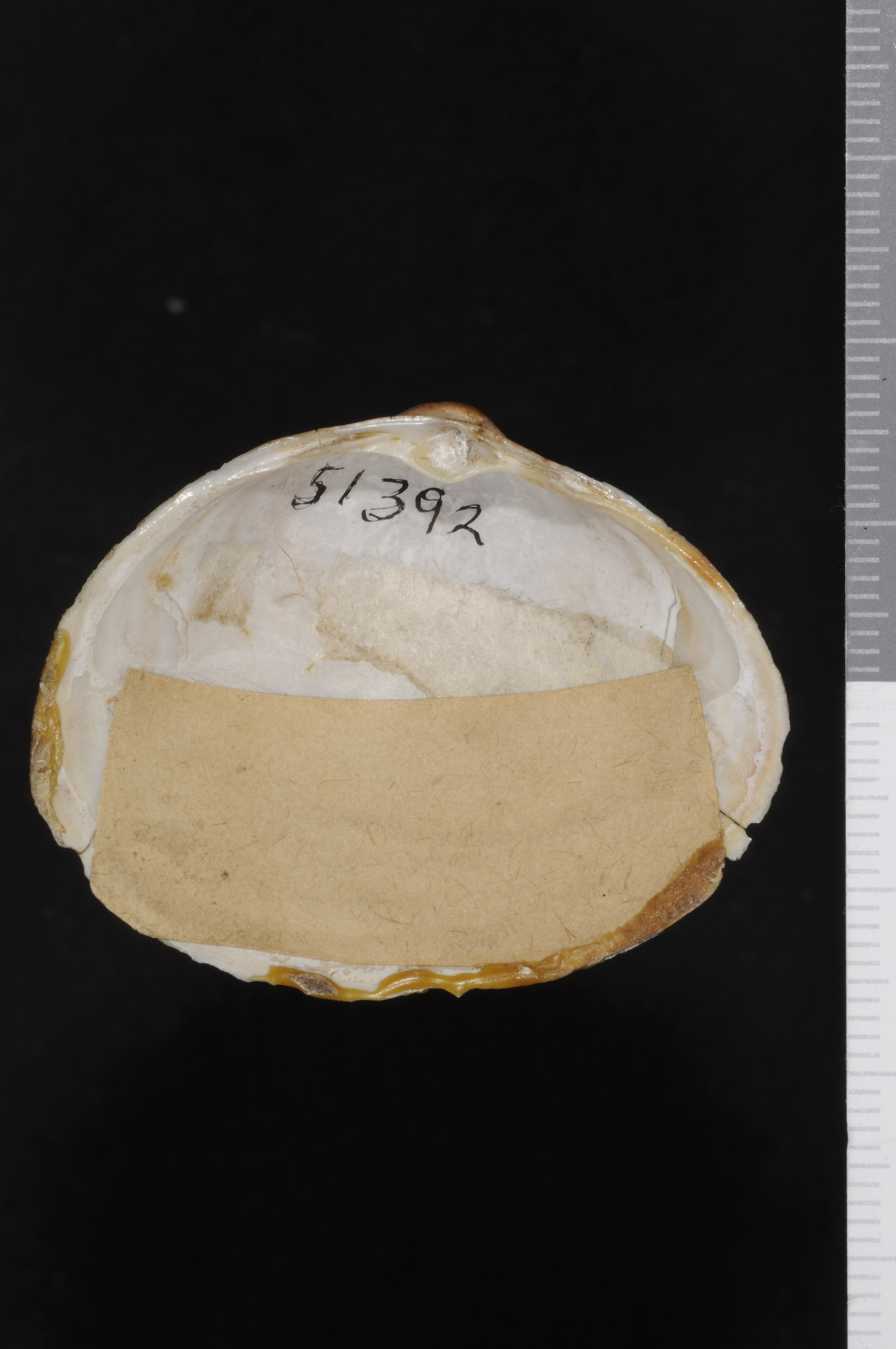
via iDigBio · via iDigBio. May be a photograph of a specimen, or an artist’s reconstruction — an interpretation of a skeleton, since colour and soft tissue are almost never preserved.
On record
Recorded, not inferred- Sits inside
- MuliniaPBDB
- Diet
- suspension feederPBDB, for Mulinia
- Life habit
- infaunalPBDB, for Mulinia
- Motility
- facultatively mobilePBDB, for Mulinia
- Vision
- blindPBDB, for Bivalvia
Time the record covers
At least 3.5 million years on record.
The record covers at least 3.6 Mya to 11.7 ka. No occurrence read is dated outside 5.333 Mya to 0 Mya.
32 occurrences of Mulinia edulis on record, most of them in the Pleistocene. The Paleobiology Database records this as a living group. Bar height is expected occurrences, not a count: each fossil is spread across the span it is dated to, so a tall narrow bar means tight dating and a low wide one means loose.
When
32 occurrences- Pliocene6%
- Pleistocene84%
- Holocene9%
These are dates about fossils, not the animal: the record can only begin after it arose and end before it died out, so either end may reach further. Shares are expected occurrences: a fossil dated to a span is counted partly in each period it straddles. More on what this infers.
Found in
8 formations
- Pampa del Palo terrace Formation11
- Estratos de Caldera Formation10
- Pongo Formation2
- Bahía Inglesa Formation1
- Lomas Terrace Formation1
- San Juan Terrace Formation1
Loading coastlines…
The named rock units Mulinia edulis has been recovered from, largest first. Drawn where the rock is now, not where it formed. 4 occurrences have no formation on record, which is common for older literature.
Mulinia edulis and its relatives
PleistoceneWhere Mulinia edulis and its relatives were recorded in the Pleistocene.
Found in the same rock
112 taxa- Choromytilus chorus12 sites
- Concholepas concholepas12 sites
- Mesodesma (Mesodesma) donacium10 sites
- Crepipatella dilatata9 sites
- Oliva peruviana9 sites
- Argopecten purpuratus8 sites
- Retrotapes lenticularis8 sites
- Semele (Semele) solida7 sites
- Incatella cingulata6 sites
- Leukoma thaca6 sites
- Tagelus dombeii6 sites
- Ameghinomya antiqua5 sites
- Crassilabrum crassilabrum5 sites
- Crucibulum5 sites
- Mexicardia procera5 sites
- Nucella5 sites
- Xanthochorus cassidiformis5 sites
- Diplodonta inconspicua4 sites
- Eurhomalea rufa4 sites
- Glycymeris ovata4 sites
- Nassarius gayi4 sites
- Priene scabrum4 sites
- Acanthina unicornis3 sites
- Calyptraea trochiformis3 sites
The Paleobiology Database records 22 sites for Mulinia edulis, and this reads all of them. The number is how many of those sites it was catalogued from too. The 24 sharing the most are listed.
This is not a list of everything alive at the time. It is only what has come out of the same ground as this animal and been written down.
Entered from
11 references- Pampa del Palo: an anomalous composite marine terrace on the uprising coast of southern Peru11
- Carta Caldera, Región de Atacama. Servicio Nacional de Geología y Minería, Carta Geológica de Chile, Serie Geología Básica, No. 76, 38 p. 1 mapa escala 1:100.0008
- Lithostratigraphy and Biostratigraphy of Pliocene and Pleistocene Marine Deposits and Age of the highest Marine Terrace from the Sacaco Basin and its Environs (southern Peru)2
- Cartas Castilla y Totoral Bajo, Región de Atacama. 1 mapa escala 1:100.0002
- Paleoecologia de moluscos marinos del Holoceno medio de Isla Gable, Canal Beagle, Tierra del Fuego, Argentina2
- Occurrence de Chione broggi (Pilsbry & Olsson, 1943) (Pelecypoda) en depositos litorales cuaternarios del sur del Peru: implicaciones paleoceanograficas2
- Geología del Área Carrizal Bajo - Chacritas, Región de Atacama. Servicio Nacional de Geología y Minería, Carta Geológica de Chile, Serie Geología Básica 111: 67 p, 1 mapa escala 1:100.000. Santiago1
- A Late Pleistocene macrobenthic assemblage in Caleta Patillos, northern Chile: paleoecological and paleobiogeographical interpretations1
- Pterorytis pacanana new species (Gastropoda: Muricidae): circumstantial evidence for late Pliocene El Niño events in southern Peru1
- A new Neogene marine avian assemblage from north-central Chile1
- Thermally-anomalous Holocene molluscan assemblages from coastal Peru: evidence for paleogeographic, not climatic change1
Each of the 32 occurrences read was entered from one of these publications, ordered by how many each accounts for. This is not a search for papers mentioning the name. Entries link to doi.org where the Paleobiology Database holds an identifier, and to its own record where it does not. Relayed as the Paleobiology Database holds them, not checked against what they resolve to.
Media and terms
Media content1
Picture of Mulinia edulis
- Source
- iDigBio
- Credit
- via iDigBio
- Licence
- not stated by the source
- Commercial use
- cannot be read from the licence given — check the record
No 3D scan was found. Smithsonian Open Access, MorphoSource and Sketchfab were all searched.
This is what the site found, which is not the same as what exists.
Keep going
What may have been alongside itMulinia through timeFormations of the PleistoceneThe world it lived on
Occurrence data from the Paleobiology Database, CC BY 4.0. King 1831