Munididae
Munididae is a family of squat lobsters, taxonomically separated from the family Galatheidae in 2010.

Macpherson E, Chan T-Y, Kumar AB, Rodríguez-Flores PC (2020) On some squat lobsters from India (Decapoda, Anomura, Mu… · CC BY 4.0 · via Wikipedia/Commons. May be a photograph of a specimen, or an artist’s reconstruction — an interpretation of a skeleton, since colour and soft tissue are almost never preserved.
On record
Recorded, not inferred- Sits inside
- GalatheoideaPBDB
- Diet
- carnivorePBDB, for Decapoda
- Life habit
- epifaunalPBDB, for Decapoda
- Motility
- actively mobilePBDB, for Malacostraca
- Vision
- well-developedPBDB, for Malacostraca
Time the record covers
At least 131 million years on record.
The record covers at least 143.1 Mya to 11.63 Mya. No occurrence read is dated outside 149.2 Mya to 5.333 Mya.
31 occurrences of Munididae on record, most of them in the Miocene. The Paleobiology Database records this as a living group, and the chart stops with its fossils rather than at the present. Bar height is expected occurrences, not a count: each fossil is spread across the span it is dated to, so a tall narrow bar means tight dating and a low wide one means loose.
When
31 occurrences- Late Jurassic6%
- Late Cretaceous6%
- Paleocene33%
- Eocene15%
- Oligocene6%
- Miocene33%
These are dates about fossils, not the animal: the record can only begin after it arose and end before it died out, so either end may reach further. Shares are expected occurrences: a fossil dated to a span is counted partly in each period it straddles. More on what this infers.
Found in
17 formations
- Basilika Formation5
- Rio Foyel Formation2
- Gram Formation2
- Ernstbrunn Formation2
- Estancia 25 de Mayo Formation1
- Akrabou Formation1
Loading coastlines…
The named rock units Munididae has been recovered from, largest first. Drawn where the rock is now, not where it formed. 7 occurrences have no formation on record, which is common for older literature.
Munididae and its relatives
MioceneWhere Munididae and its relatives were recorded in the Miocene.
Found in the same rock
310 taxa- Protomunida eurekantha3 sites
- Rhacothyas spitzbergensis3 sites
- Valamunida haeggi3 sites
- Yoldiella spitsbergensis3 sites
- Aporrhais gracilis2 sites
- Archaeotetra lessinea2 sites
- Austromunida casadioi2 sites
- Bolcagalathea corallina2 sites
- Caloxanthus ornatus2 sites
- Conchocele conradii2 sites
- Cyamocarcinus angustifrons2 sites
- Disipia sorbinii2 sites
- Dromiopsis2 sites
- Faxegalathea valeccensis2 sites
- Galenopsis similis2 sites
- Globularia isfjordensis2 sites
- Inoperna plenicostata2 sites
- Lessinigalathea regalis2 sites
- Lessinithalamita gioiae2 sites
- Munida2 sites
- Munida nishioi2 sites
- Musculus2 sites
- Mytilus hauniensis2 sites
- Palladiocarcinus brevidentatus2 sites
The Paleobiology Database records 25 sites for Munididae, and this reads all of them. The number is how many of those sites it was catalogued from too. The 24 sharing the most are listed.
This is not a list of everything alive at the time. It is only what has come out of the same ground as this animal and been written down.
Entered from
19 references- A late Paleocene fauna from shallow-water chemosynthesis-based ecosystems, Spitsbergen, Svalbard5
- Systematics of 12 Jurassic, Cretaceous, and Paleogene squat lobster taxa (Galatheoidea)4
- First notice of the Chirostylidae (Decapoda) in the fossil record and new Tertiary Galatheidae (Decapoda) from the Americas3
- New fossil squat lobsters (Crustacea: Anomura: Munididae) from the Eastern Pacific2
- The Oldest Munididae (Decapoda: Anomura: Galatheoidea) from Ernstbrunn, Austria (Tithonian)2
- Cenozoic Decapod Crustacea from Southwest Japan2
- New Decapoda (Anomura) from the Paleocene Kambühel Formation, Austria1
- Contributo ai crostacei decapodi dell’Eocene inferiore dei Monti Lessini orientali (Italia nordorientale)1
- Reappraisal of anomuran and brachyuran decapods from the lower Miocene Morozaki Group, Japan, collected by the Tokai Fossil Society1
- I crostacei associati a coralli nell’Eocene inferiore dell’area di Bolca (Verona e Vicenza, Italia nordorientale)1
- Clarification of the South American genus Austromunida Schweitzer & Feldmann, 2000 (Crustacea: Decapoda: Anomura), with the establishment of a new species1
- An Early Miocene deep-water decapod crustacean faunule from the Vienna Basin (western Carpathians, Slovakia)1
Each of the 31 occurrences read was entered from one of these publications, ordered by how many each accounts for. This is not a search for papers mentioning the name. 7 further references are not listed. Entries link to doi.org where the Paleobiology Database holds an identifier, and to its own record where it does not. Relayed as the Paleobiology Database holds them, not checked against what they resolve to.
Media and terms
Media content1
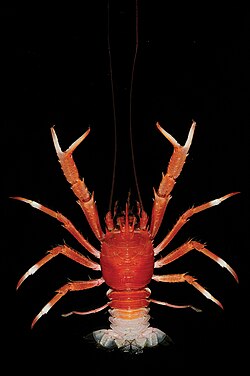
Picture of Munididae
- Source
- Wikipedia/Commons
- Credit
- Macpherson E, Chan T-Y, Kumar AB, Rodríguez-Flores PC (2020) On some squat lobsters from India (Decapoda, Anomura, Mu…
- Licence
- CC BY 4.0
- Commercial use
- the licence allows it
No 3D scan was found. Smithsonian Open Access, MorphoSource and Sketchfab were all searched.
The description on this site
- Source
- Wikipedia, “Munididae”
- Licence
- CC BY-SA 4.0
This is what the site found, which is not the same as what exists.
Keep going
What may have been alongside itGalatheoidea through timeFormations of the MioceneThe world it lived on
Occurrence data from the Paleobiology Database, CC BY 4.0. Ayhong et al. 2010