Mystacina robusta
The New Zealand greater short-tailed bat is one of two species of New Zealand short-tailed bats, a family (Mystacinidae) unique to New Zealand. Larger than the New Zealand lesser short-tailed bat, there have been no confirmed sightings of this species since 1965 and it is considered to be critically endangered, if not extinct. In prehistoric times it lived in the North and South Islands but by the time of European arrival was restricted to small islands near Stewart Island / Rakiura. A rat invasion of Taukihepa/Big South Cape Island in 1963 was thought to have led to the species' extinction, however, recent surveys have raised hopes that the species may still exist.

Auckland War Memorial Museum · CC BY 4.0 · via Wikipedia/Commons. May be a photograph of a specimen, or an artist’s reconstruction — an interpretation of a skeleton, since colour and soft tissue are almost never preserved.
On record
Recorded, not inferred- Sits inside
- MystacinaPBDB
- Diet
- frugivore, insectivorePBDB, for Mystacinidae
- Life habit
- volantPBDB, for Chiroptera
- Motility
- actively mobilePBDB, for Osteichthyes
- Environment
- terrestrialPBDB, for Chiroptera
Time the record covers
At most 129 thousand years on record.
Every occurrence read is dated to somewhere between 129 ka and 0 Mya, and nothing in the dating separates them, so that window is what the record shows rather than a span.
15 occurrences of Mystacina robusta on record, most of them in the Holocene. The Paleobiology Database records this as a living group. Bar height is expected occurrences, not a count: each fossil is spread across the span it is dated to, so a tall narrow bar means tight dating and a low wide one means loose.
When
15 occurrences- Pleistocene18%
- Holocene82%
These are dates about fossils, not the animal: the record can only begin after it arose and end before it died out, so either end may reach further. Shares are expected occurrences: a fossil dated to a span is counted partly in each period it straddles. More on what this infers.
Mystacina robusta and its relatives
HoloceneWhere Mystacina robusta and its relatives were recorded in the Holocene.
Found in the same rock
82 taxa- Coenocorypha aucklandica12 sites
- Cyanoramphus12 sites
- Hoplodactylus maculatus12 sites
- Aegotheles novaezealandiae10 sites
- Coturnix novaezelandiae10 sites
- Rattus exulans10 sites
- Turnagra capensis10 sites
- Mohoua ochrocephala9 sites
- Petroica australis9 sites
- Rhipidura fuliginosa8 sites
- Tadorna variegata8 sites
- Xenicus8 sites
- Anthornis melanura7 sites
- Hemiphaga novaeseelandiae7 sites
- Hoplodactylus duvaucelii7 sites
- Gallirallus australis6 sites
- Mus musculus6 sites
- Prosthemadera novaeseelandiae6 sites
- Callaeas cinereus5 sites
- Mohoua novaeseelandiae5 sites
- Ninox novaeseelandiae5 sites
- Oligosoma lineoocellatum5 sites
- Passer domesticus5 sites
- Petroica macrocephala5 sites
The Paleobiology Database records 15 sites for Mystacina robusta, and this reads all of them. The number is how many of those sites it was catalogued from too. The 24 sharing the most are listed.
This is not a list of everything alive at the time. It is only what has come out of the same ground as this animal and been written down.
Entered from
3 references- Quaternary fossil fauna of South Canterbury, South Island, New Zealand12
- Taphonomy of two holocene microvertebrate deposits, Takaka Hill, Nelson, New Zealand, and identification of the avian predator responsible2
- Quaternary fossil faunas from caves in Takaka Valley and on Takaka Hill, northwest Nelson, South Island, New Zealand1
Each of the 15 occurrences read was entered from one of these publications, ordered by how many each accounts for. This is not a search for papers mentioning the name. Each entry links to doi.org. Relayed as the Paleobiology Database holds them, not checked against what they resolve to.
Media and terms
Media content1
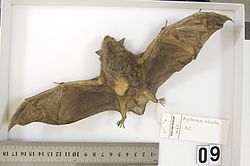
Picture of Mystacina robusta
- Source
- Wikipedia/Commons
- Credit
- Auckland War Memorial Museum
- Licence
- CC BY 4.0
- Commercial use
- the licence allows it
No 3D scan of Mystacina robusta was found in MorphoSource and Sketchfab.
Smithsonian Open Access was not reached for this taxon, so this list is what the others held rather than everything there is.
The description on this site
- Licence
- CC BY-SA 4.0
This is what the site found, which is not the same as what exists.
Keep going
What may have been alongside itMystacina through timeFormations of the HoloceneThe world it lived on
Occurrence data from the Paleobiology Database, CC BY 4.0. Dwyer 1962