Neobrachytherium
Neobrachytherium is an extinct genus of proterotheriid mammal from the Late Miocene of Argentina and Uruguay. It is represented by multiple species, including the type N. intermedium, originally named in 1891 by Moreno and Mercerat as a species of Licaphrium, N. morenoi, originally named in 1914 by Rovereto as a species of Brachytherium, and N. ameghinoi and N. ullumense, named in 2001 by Soria, who reclassified all the species in the new genus Neobrachytherium. The various species are known from cranial and dental material from the Corral Quemado, Loma de las Tapias and Ituzaingó Formations. Neobrachytherium may be closely related to Thoatherium, Diadiaphorus and Thoatheriopsis.

Schmidt, G. I.; Montalvo, C. I.; Cerdeño, E.; Sostillo, R.; Tomassini, R. L.; Bonini, R. A. · CC BY 4.0 · via Wikipedia/Commons. May be a photograph of a specimen, or an artist’s reconstruction — an interpretation of a skeleton, since colour and soft tissue are almost never preserved.
On record
Recorded, not inferred- Sits inside
- ProterotheriinaePBDB
- Diet
- herbivorePBDB, for Litopterna
- Life habit
- scansorialPBDB, for Eutheria
- Motility
- actively mobilePBDB, for Osteichthyes
- Environment
- terrestrialPBDB, for Eutheria
Time the record covers
At least 754 thousand years on record.
The record covers at least 8 Mya to 7.246 Mya. No occurrence read is dated outside 11.63 Mya to 3.6 Mya.
11 occurrences of Neobrachytherium on record, most of them in the Miocene. Bar height is expected occurrences, not a count: each fossil is spread across the span it is dated to, so a tall narrow bar means tight dating and a low wide one means loose.
When
11 occurrencesThese are dates about fossils, not the animal: the record can only begin after it arose and end before it died out, so either end may reach further. Shares are expected occurrences: a fossil dated to a span is counted partly in each period it straddles. More on what this infers.
Found in
7 formations
- Cerro Azul Formation3
- Arroyo Chasicó Formation2
- Salicas Formation1
- Ituzaingo Formation1
- Epecuén Formation1
- Camacho Formation1
Loading coastlines…
The named rock units Neobrachytherium has been recovered from, largest first. Drawn where the rock is now, not where it formed. 1 occurrence has no formation on record, which is common for older literature.
Neobrachytherium and its relatives
MioceneWhere Neobrachytherium and its relatives were recorded in the Miocene.
Found in the same rock
281 taxa- Paedotherium minor6 sites
- Chasicotatus ameghinoi4 sites
- Proeuphractus4 sites
- Scalabrinitherium bravardi4 sites
- Cardiomys3 sites
- Lagostomus pretrichodactyla3 sites
- Macraucheniinae3 sites
- Macrochorobates scalabrinii3 sites
- Palaeocavia3 sites
- Proscelidodon gracillimus3 sites
- Proterotheriidae3 sites
- Tremacyllus impressus3 sites
- Anura2 sites
- Aspidocalyptus castroi2 sites
- Brachytherium cuspidatum2 sites
- Cardiatherium2 sites
- Cullinia2 sites
- Cyonasua2 sites
- Diplasiotherium pampa2 sites
- Eosclerocalyptus2 sites
- Eosclerocalyptus proximus2 sites
- Glyptodontidae2 sites
- Hemihegetotherium achataleptum2 sites
- Hemihegetotherium torresi2 sites
The Paleobiology Database records 10 sites for Neobrachytherium, and this reads all of them. The number is how many of those sites it was catalogued from too. The 24 sharing the most are listed.
This is not a list of everything alive at the time. It is only what has come out of the same ground as this animal and been written down.
Entered from
8 references- Updated data on Litopterna from the Huayquerian Stage/Age (Late Miocene-Early Pliocene) of central-east Argentina3
- Proterotheriidae (Mammalia, Litopterna) from the Cerro Azul Formation (late Miocene), La Pampa Province, Argentina2
- On the validity of the Macrochorobates scalabrinii Biozone (early Huayquerian Stage/Age, Late Miocene). Multi-proxy analysis of the enigmatic Arenas Blancas site (Buenos Aires Province, Argentina)1
- Cranial morphology and phylogenetic relationships of Trigonostylops wortmani, an Eocene South American native ungulate1
- A new genus and species and additional reports of the native South American ungulates Proterotheriidae (Mammalia, Litopterna) in the Late Miocene of Uruguay1
- Los ungulados nativos (Litopterna y Notoungulata: Mammalia) del "Mesopotamiense" (Mioceno tardío) de Entre Ríos, Argentina1
- Mammals from the Salicas Formation (Late Miocene), la Rioja Province, northwestern Argentina: Paleobiogeography, age and environment1
- Neobrachytherium ullumense (Proterotheriidae, Litopterna) en el Mioceno Superior de la Provincia de Buenos Aires (Argentina)1
Each of the 11 occurrences read was entered from one of these publications, ordered by how many each accounts for. This is not a search for papers mentioning the name. Entries link to doi.org where the Paleobiology Database holds an identifier, and to its own record where it does not. Relayed as the Paleobiology Database holds them, not checked against what they resolve to.
Media and terms
Media content1
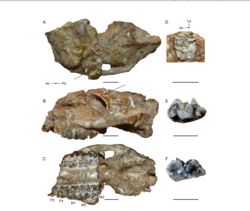
Picture of Neobrachytherium
- Source
- Wikipedia/Commons
- Credit
- Schmidt, G. I.; Montalvo, C. I.; Cerdeño, E.; Sostillo, R.; Tomassini, R. L.; Bonini, R. A.
- Licence
- CC BY 4.0
- Commercial use
- the licence allows it
No 3D scan was found. Smithsonian Open Access, MorphoSource and Sketchfab were all searched.
The description on this site
- Licence
- CC BY-SA 4.0
This is what the site found, which is not the same as what exists.
Keep going
What may have been alongside itProterotheriinae through timeFormations of the MioceneThe world it lived on
Occurrence data from the Paleobiology Database, CC BY 4.0. Soria 2001