Neotragus
Neotragus is a genus of dwarf antelope, native to Africa. The genus includes only a single species without any dispute, namely Neotragus pygmaeus. This species, the royal antelope, is the smallest antelope in the world, usually weighing around 5 to 7 pounds. They live in conditions that are warm and moist and are found in the tropical forests of Western Africa. The royal antelope's diet consists of high-nutrient food sources, such as leaves, flowers, plants, fruits, and the growing tips of shoots. Recent nucleic acid studies now suggest that the other two species formerly included in the genus are not closely related, and should be assigned to the genus Nesotragus. Members of the Nesotragus genus are the only surviving members of the subfamily Nesotraginae or tribe Nesotragini and are more closely related to the impala, while the royal antelope is still considered a member of the subfamily Antilopinae or tribe Antilopini.

Mirko Raner · CC BY-SA 3.0 · via Wikipedia/Commons. May be a photograph of a specimen, or an artist’s reconstruction — an interpretation of a skeleton, since colour and soft tissue are almost never preserved.
On record
Recorded, not inferred- Sits inside
- NeotraginiPBDB
- Diet
- grazer, browserPBDB, for Bovidae
- Life habit
- ground dwellingPBDB, for Bovidae
- Motility
- actively mobilePBDB, for Osteichthyes
- Environment
- terrestrialPBDB, for Artiodactyla
Time the record covers
At most 2.6 million years on record.
Every occurrence read is dated to somewhere between 2.58 Mya and 0 Mya, and nothing in the dating separates them, so that window is what the record shows rather than a span.
2 occurrences of Neotragus on record, most of them in the Pleistocene. The Paleobiology Database records this as a living group. Bar height is expected occurrences, not a count: each fossil is spread across the span it is dated to, so a tall narrow bar means tight dating and a low wide one means loose.
When
2 occurrences- Pleistocene50%
- Holocene50%
These are dates about fossils, not the animal: the record can only begin after it arose and end before it died out, so either end may reach further. Shares are expected occurrences: a fossil dated to a span is counted partly in each period it straddles. More on what this infers.
Neotragus and its relatives
PleistoceneWhere Neotragus and its relatives were recorded in the Pleistocene.
Found in the same rock
96 taxa- Amphibia2 sites
- Atherus africanus2 sites
- Bovidae2 sites
- Canis2 sites
- Cephalophus2 sites
- Cephalophus monticola2 sites
- Cercopithecidae2 sites
- Cercopithecus2 sites
- Cricetomys2 sites
- Funisciurus2 sites
- Galagoides2 sites
- Gonaxis pusillus2 sites
- Hylochoerus meinertzhageni2 sites
- Hystrix2 sites
- Kobus kob2 sites
- Leporidae2 sites
- Limicolaria2 sites
- Maizania2 sites
- Mammalia2 sites
- Ophidia2 sites
- Orycteropus afer2 sites
- Ourebia ourebi2 sites
- Papio anubis2 sites
- Potamochoerus porcus2 sites
The Paleobiology Database records 2 sites for Neotragus, and this reads all of them. The number is how many of those sites it was catalogued from too. The 24 sharing the most are listed.
This is not a list of everything alive at the time. It is only what has come out of the same ground as this animal and been written down.
Entered from
2 references- Les faunes de vertebres quaternaires en Afrique centrale1
- The use of fish remains in African archaeozoology1
Each of the 2 occurrences read was entered from one of these publications, ordered by how many each accounts for. This is not a search for papers mentioning the name. Each entry links to the Paleobiology Database's own record for the work.
Media and terms
Media content2
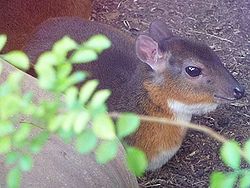
Picture of Neotragus
- Source
- Wikipedia/Commons
- Credit
- Mirko Raner
- Licence
- CC BY-SA 3.0
- Commercial use
- the licence allows it
CT scan
- Source
- MorphoSource
- Licence
- In Copyright
- Commercial use
- cannot be read from the licence given — check the record
- Specimen
- Neotragus batsei · ummz:mammals:39519
Smithsonian Open Access was not reached for this taxon, so this list is what the others held rather than everything there is.
The description on this site
- Source
- Wikipedia, “Neotragus”
- Licence
- CC BY-SA 4.0
This is what the site found, which is not the same as what exists.
Keep going
What may have been alongside itNeotragini through timeFormations of the PleistoceneThe world it lived on
Occurrence data from the Paleobiology Database, CC BY 4.0. Hamilton Smith 1827