Onagraceae
The Onagraceae are a family of flowering plants known as the willowherb family or evening primrose family. They include about 650 species of herbs, shrubs, and trees in 17 genera. The family is widespread, occurring on every continent from boreal to tropical regions.

USDA-NRCS PLANTS Database · Public Domain · via Wikipedia/Commons. May be a photograph of a specimen, or an artist’s reconstruction — an interpretation of a skeleton, since colour and soft tissue are almost never preserved.
On record
Recorded, not inferred- Also called
- willowherbPBDB
- Sits inside
- MyrtalesPBDB
- Diet
- "photoautotroph"PBDB, for Angiospermae
Time the record covers
At least 55 million years on record.
The record covers at least 56 Mya to 11.7 ka. No occurrence read is dated outside 66 Mya to 0 Mya.
105 occurrences of Onagraceae on record, most of them in the Eocene. The Paleobiology Database records this as a living group. Bar height is expected occurrences, not a count: each fossil is spread across the span it is dated to, so a tall narrow bar means tight dating and a low wide one means loose.
When
105 occurrencesThese are dates about fossils, not the animal: the record can only begin after it arose and end before it died out, so either end may reach further. Shares are expected occurrences: a fossil dated to a span is counted partly in each period it straddles. More on what this infers.
Found in
22 formations
- Yaw Formation10
- Arcillas de el Limbo Formation9
- San Fernando Formation5
- Monte León Formation5
- Mirador Formation4
- Chenque Formation4
Loading coastlines…
The named rock units Onagraceae has been recovered from, largest first. Drawn where the rock is now, not where it formed. 43 occurrences have no formation on record, which is common for older literature.
Onagraceae and its relatives
EoceneWhere Onagraceae and its relatives were recorded in the Eocene.
Found in the same rock
1,117 taxa- Proxapertites operculatus19 sites
- Corsinipollenites18 sites
- Mauritiidites franciscoi franciscoi16 sites
- Psilamonocolpites medius16 sites
- Poaceae15 sites
- Monocolpopollenites ovatus14 sites
- Laevigatosporites tibuensis13 sites
- Asteraceae12 sites
- Apiaceae11 sites
- Deltoidospora11 sites
- Ilex11 sites
- Laevigatosporites11 sites
- Longapertites11 sites
- Mauritiidites franciscoi minutus11 sites
- Selaginella11 sites
- Verrucatosporites11 sites
- Cupanieidites10 sites
- Cyperaceae10 sites
- Ludwigia10 sites
- Myriophyllum10 sites
- Sapotaceoidaepollenites10 sites
- Striatopollis catatumbus10 sites
- Tetracolporopollenites10 sites
- Verrucatosporites usmensis10 sites
The Paleobiology Database records 56 sites for Onagraceae, and this reads all of them. The number is how many of those sites it was catalogued from too. The 24 sharing the most are listed.
This is not a list of everything alive at the time. It is only what has come out of the same ground as this animal and been written down.
Entered from
32 references- Die mittelmiozaenen und obermiozaenen Floren aus der Meuroer und Raunoer Folge in der Lausitz. III. Fundstellen und Palaeobiologie21
- Middle Paleogene palynology of Central Colombia, South America: A study of pollen and spores from tropical latitudes18
- A proto-monsoonal climate in the late Eocene of Southeast Asia: evidence from a sedimentary record in central Myanmar10
- A Catalogue of Fossil Plants from India Part 6: Cenozoic (Quaternary) Palynology and Palaeobotany8
- Palaeofloristic and palaeovegetational changes across the Paleocene/Eocene boundary in northern South America6
- Palinoestratigrafía de depósitos del Oligoceno tardío-Mioceno en el área sur del Golfo San Jorge, provincia de Santa Cruz, Argentina3
- Palinomorph assemblage of the Chenque Formation, Late Oligocene?- Miocene from Golfo San Jorge Basin, Patagonia, Argentina, Part 4: polycolporate and porate pollen3
- Die pliozaenen Floren von Thueringen, Deutsche Demokratische Republik3
- A palynological study on the upper Los Cuervos and Mirador formations (Lower and middle Eocene; Tibu area, Colombia)3
- The section of Torre Picchio (Terni, Umbria, Central Italy): A Villafranchian site rich in vertebrates, molluscs, ostracods and plants.2
- Palinomorfos continentales y marinos de la Formación Monte León en su área tipo, provincia de Santa Cruz, Argentina2
- Palinoflora y ambiente en el Terciario del nordeste de Tierra del Fuego, Argentina2
Each of the 105 occurrences read was entered from one of these publications, ordered by how many each accounts for. This is not a search for papers mentioning the name. 20 further references are not listed. Entries link to doi.org where the Paleobiology Database holds an identifier, and to its own record where it does not. Relayed as the Paleobiology Database holds them, not checked against what they resolve to.
Media and terms
Media content1
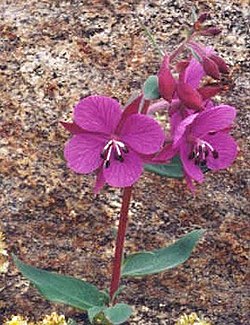
Picture of Onagraceae
- Source
- Wikipedia/Commons
- Credit
- USDA-NRCS PLANTS Database
- Licence
- Public Domain
- Commercial use
- the licence allows it
No 3D scan of Onagraceae was found in Sketchfab.
Smithsonian Open Access and MorphoSource were not reached for this taxon, so this list is what the others held rather than everything there is.
The description on this site
- Source
- Wikipedia, “Onagraceae”
- Licence
- CC BY-SA 4.0
This is what the site found, which is not the same as what exists.
Keep going
What may have been alongside itMyrtales through timeFormations of the EoceneThe world it lived on
Occurrence data from the Paleobiology Database, CC BY 4.0. de Jussieu 1789