Orectolobidae
Wobbegong is the common name given to the 12 species of carpet shark in the family Orectolobidae. They are found in shallow temperate and tropical waters of the western Pacific Ocean and eastern Indian Ocean, chiefly around Australia and Indonesia, although one species occurs as far north as Japan.

Uncredited · via Wikipedia/Commons. May be a photograph of a specimen, or an artist’s reconstruction — an interpretation of a skeleton, since colour and soft tissue are almost never preserved.
On record
Recorded, not inferred- Also called
- wobbegongPBDB
- Sits inside
- OrectoloboideiPBDB
- Diet
- carnivorePBDB, for Orectolobiformes
- Life habit
- nektobenthicPBDB, for Orectolobiformes
- Motility
- actively mobilePBDB, for Orectolobiformes
Time the record covers
At least 137 million years on record.
The record covers at least 145.06 Mya to 7.246 Mya. No occurrence read is dated outside 149.2 Mya to 2.58 Mya.
179 occurrences of Orectolobidae on record, most of them in the Late Cretaceous. The Paleobiology Database records this as a living group, and the chart stops with its fossils rather than at the present. Bar height is expected occurrences, not a count: each fossil is spread across the span it is dated to, so a tall narrow bar means tight dating and a low wide one means loose.
When
179 occurrences- Late Jurassicunder 1%
- Early Cretaceous13%
- Late Cretaceous68%
- Paleocene2%
- Eocene14%
- Miocene2%
- Plioceneunder 1%
These are dates about fossils, not the animal: the record can only begin after it arose and end before it died out, so either end may reach further. Shares are expected occurrences: a fossil dated to a span is counted partly in each period it straddles. More on what this infers.
Found in
54 formations
- Mesaverde Formation21
- Judith River Formation · Montana Group14
- Hell Creek Formation · Montana Group13
- Dinosaur Park Formation · Belly River Group9
- Speeton Clay Formation8
- Matam Formation6
Loading coastlines…
The named rock units Orectolobidae has been recovered from, largest first. Drawn where the rock is now, not where it formed. 30 further formations hold fewer occurrences each and are not listed. 24 occurrences have no formation on record, which is common for older literature.
Orectolobidae and its relatives
Late CretaceousWhere Orectolobidae and its relatives were recorded in the Late Cretaceous.
Found in the same rock
1,596 taxa- Myledaphus bipartitus38 sites
- Archaeolamna kopingensis35 sites
- Cretorectolobus olsoni33 sites
- Ischyrhiza mira27 sites
- Squalicorax kaupi27 sites
- Meristodonoides montanensis26 sites
- Protoplatyrhina renae26 sites
- Restesia americana26 sites
- Texatrygon avonicola25 sites
- Teleostei23 sites
- Odontaspis aculeatus22 sites
- Synechodus dubrisiensis21 sites
- Trionychidae20 sites
- Hybodus19 sites
- Lonchidion selachos19 sites
- Rhinobatos19 sites
- Lepisosteidae17 sites
- Squatina (Cretascyllium) cranei17 sites
- Theropoda17 sites
- Baenidae16 sites
- Hadrosauridae16 sites
- Paralbula casei16 sites
- Paronychodon16 sites
- Scapanorhynchus texanus16 sites
The Paleobiology Database records 157 sites for Orectolobidae, and this reads all of them. The number is how many of those sites it was catalogued from too. The 24 sharing the most are listed.
This is not a list of everything alive at the time. It is only what has come out of the same ground as this animal and been written down.
Entered from
79 references- A new selachian fauna from the late Campanian of Wyoming (Teapot Sandstone Member, Mesaverde Formation, Big Horn Basin)18
- Sharks (Elasmobranchii: Euselachii) from the Late Cretaceous of France and the UK10
- Albian and Cenomanian selachian assemblages from north-east England7
- Revision of Cretorectolobus (Neoselachii) and description of Cederstroemia n. gen., a Cretaceous carpet shark (Orectolobiformes) with a cutting dentition7
- Chondrichthyan and osteichthyan paleofaunas from the Cretaceous (Late Maastrichtian) Fox Hills Formation of North Dakota, USA: paleoecology, paleogeography, and extinction6
- The selachian fauna (sharks and rays) of the phosphate series of Ndendouri-Ouali Diala (Matam, Western Senegal): Dating and paleoenvironmental interests6
- Les Orectolobiformes, Carcharhiniformes et Myliobatiformes (Elasmobranchii, Neoselachii) des bassins à phosphate du Maroc (Maastrichtien-Lutétien basal). Systématique, biostratigraphie, évolution et dynamique des faunes6
- A new selachian fauna from the Judith River Formation (Campanian) of Montana6
- Shark and Ray teeth from the Hauterivian (Lower Cretaceous) of north-east England5
- Non-marine fishes of the late Santonian Milk River Formation of Alberta, Canada – evidence from vertebrate microfossil localities4
- Fossil Vertebrate Collections4
- Les Elasmobranches de l'Albien inferieur et moyen (Cretace inferieur) de la Marne et de la Haute-Marne (France)4
Each of the 179 occurrences read was entered from one of these publications, ordered by how many each accounts for. This is not a search for papers mentioning the name. 67 further references are not listed. Entries link to doi.org where the Paleobiology Database holds an identifier, and to its own record where it does not. Relayed as the Paleobiology Database holds them, not checked against what they resolve to.
Media and terms
Media content1
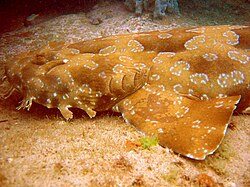
Picture of Orectolobidae
- Source
- Wikipedia/Commons
- Credit
- nobody named on the record
- Licence
- not stated by the source
- Commercial use
- cannot be read from the licence given — check the record
No 3D scan of Orectolobidae was found in MorphoSource and Sketchfab.
Smithsonian Open Access was not reached for this taxon, so this list is what the others held rather than everything there is.
The description on this site
- Source
- Wikipedia, “Wobbegong”
- Licence
- CC BY-SA 4.0
This is what the site found, which is not the same as what exists.
Keep going
What may have been alongside itOrectoloboidei through timeFormations of the Late CretaceousThe world it lived on
Occurrence data from the Paleobiology Database, CC BY 4.0. Jordan and Fowler 1903