Rhinobatos
Rhinobatos is a genus of fish in the Rhinobatidae family. Although previously used to encompass all guitarfishes, it was found to be polyphyletic, and recent authorities have transferred many species included in the genus to Acroteriobatus, Glaucostegus, and Pseudobatos.

This illustration was made by Citron You must credit this : Citron / CC-BY-SA-3.0 · CC BY-SA 3.0 · via Wikipedia/Commons. May be a photograph of a specimen, or an artist’s reconstruction — an interpretation of a skeleton, since colour and soft tissue are almost never preserved.
On record
Recorded, not inferred- Sits inside
- RhinobatidaePBDB
- Diet
- carnivorePBDB, for Chondrichthyes
- Life habit
- nektonicPBDB, for Chondrichthyes
- Motility
- actively mobilePBDB, for Chondrichthyes
Time the record covers
At least 143 million years on record.
The record covers at least 143.1 Mya to 11.7 ka. No occurrence read is dated outside 149.2 Mya to 0 Mya.
238 occurrences of Rhinobatos on record, most of them in the Late Cretaceous. The Paleobiology Database records this as a living group. Bar height is expected occurrences, not a count: each fossil is spread across the span it is dated to, so a tall narrow bar means tight dating and a low wide one means loose.
When
238 occurrences- Late Jurassicunder 1%
- Early Cretaceous4%
- Late Cretaceous62%
- Paleocene2%
- Eocene18%
- Oligoceneunder 1%
- Miocene6%
- Pliocene5%
- Pleistoceneunder 1%
- Holoceneunder 1%
These are dates about fossils, not the animal: the record can only begin after it arose and end before it died out, so either end may reach further. Shares are expected occurrences: a fossil dated to a span is counted partly in each period it straddles. More on what this infers.
Found in
89 formations
- Greenhorn Limestone Formation · Colorado Group9
- Matam Formation9
- Carlile Shale Formation · Colorado Group7
- Marnes de Donzacq Formation7
- Mesaverde Formation6
- Newhaven Chalk Formation5
Loading coastlines…
The named rock units Rhinobatos has been recovered from, largest first. Drawn where the rock is now, not where it formed. 65 further formations hold fewer occurrences each and are not listed. 83 occurrences have no formation on record, which is common for older literature.
Rhinobatos and its relatives
Late CretaceousWhere Rhinobatos and its relatives were recorded in the Late Cretaceous.
Found in the same rock
2,159 taxa- Dasyatis54 sites
- Squalicorax kaupi46 sites
- Cretalamna appendiculata43 sites
- Archaeolamna kopingensis36 sites
- Squalicorax30 sites
- Squalicorax pristodontus30 sites
- Coupatezia28 sites
- Cretoxyrhina mantelli28 sites
- Myliobatis27 sites
- Carcharias26 sites
- Chiloscyllium26 sites
- Galeorhinus26 sites
- Ischyrhiza mira26 sites
- Scyliorhinus24 sites
- Carcharhinus23 sites
- Squatina (Cretascyllium) hassei23 sites
- Rhinoptera22 sites
- Rhizoprionodon21 sites
- Cretodus semiplicatus20 sites
- Hybodus20 sites
- Squalicorax falcatus20 sites
- Cretomanta canadensis19 sites
- Scapanorhynchus texanus19 sites
- Teleostei19 sites
The Paleobiology Database records 206 sites for Rhinobatos, and this reads all of them. The number is how many of those sites it was catalogued from too. The 24 sharing the most are listed.
This is not a list of everything alive at the time. It is only what has come out of the same ground as this animal and been written down.
Entered from
125 references- Batoids (Elasmobranchii: Batomorphii) from the British and French Late Cretaceous12
- Marine vertebrate faunas from the Maastrichtian phosphates of Benguérir (Ganntour Basin, Morocco): Biostratigraphy, palaeobiogeography and palaeoecology11
- Late Cretaceous and Danian neoselachians from southern Sweden11
- The selachian fauna (sharks and rays) of the phosphate series of Ndendouri-Ouali Diala (Matam, Western Senegal): Dating and paleoenvironmental interests9
- Les sélaciens du Crétacé supérieur du Liban. II. Batoïdes8
- Nouvelle faunes de sélaciens (Elasmobranchii, Neoselachii) de l'Eocène moyen des Landes (Sud-Ouest, France). Implication dans la connaissance des communautés de sélaciens d'eau profondes7
- A new selachian fauna from the late Campanian of Wyoming (Teapot Sandstone Member, Mesaverde Formation, Big Horn Basin)6
- Cretaceous elasmobranchs of the Greenhorn Formation (Middle Cenomanian-Middle Turonian), western South Dakota5
- The marine vertebrate faunas from the Late Cretaceous phosphates of Syria5
- Découverte de nouvelles faunes de sélaciens (Neoselachii) dans les phosphates maastrichtiens de la Mer Rouge, Egypte5
- New biostratigraphical data on the marine Upper Cretaceous and Palaeogene of Jordan4
- Additions aux faunes de sélaciens du Crétacé du Texas (Albien supérieur-Campanien)4
Each of the 238 occurrences read was entered from one of these publications, ordered by how many each accounts for. This is not a search for papers mentioning the name. 113 further references are not listed. Entries link to doi.org where the Paleobiology Database holds an identifier, and to its own record where it does not. Relayed as the Paleobiology Database holds them, not checked against what they resolve to.
Media and terms
Media content2
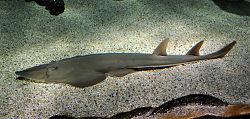
Picture of Rhinobatos
- Source
- Wikipedia/Commons
- Credit
- This illustration was made by Citron You must credit this : Citron / CC-BY-SA-3.0
- Licence
- CC BY-SA 3.0
- Commercial use
- the licence allows it
CT scan
- Source
- MorphoSource
- Licence
- In Copyright
- Commercial use
- cannot be read from the licence given — check the record
- Specimen
- Rhinobatos leucorhynchus · TCWC:Ichthyology:12385.01
The description on this site
- Source
- Wikipedia, “Rhinobatos”
- Licence
- CC BY-SA 4.0
This is what the site found, which is not the same as what exists.
Keep going
What may have been alongside itRhinobatidae through timeFormations of the Late CretaceousThe world it lived on
Occurrence data from the Paleobiology Database, CC BY 4.0. Link 1790