Oudenodon
Oudenodon is an extinct genus of dicynodont. It was common throughout southern Africa during the Late Permian. Several species of Oudenodon are known. Both O. bainii, the type species, and O. grandis are known from South Africa. Specimens of O. luangwensis have been found from Zambia. One species, O. sakamenensis from the Lower Sakamena Formation is the only Permian therapsid yet described from Madagascar. It is the type genus of the family Oudenodontidae, which includes members such as Tropidostoma.

FunkMonk · CC BY-SA 3.0 · via Wikipedia/Commons. May be a photograph of a specimen, or an artist’s reconstruction — an interpretation of a skeleton, since colour and soft tissue are almost never preserved.
On record
Recorded, not inferred- Sits inside
- OudenodontidaePBDB
- Diet
- herbivorePBDB, for Dicynodontia
- Motility
- actively mobilePBDB, for Osteichthyes
- Environment
- terrestrialPBDB, for Amniota
Time the record covers
At least 5.7 million years on record.
The record covers at least 259.857 Mya to 254.14 Mya. No occurrence read is dated outside 264.28 Mya to 251.902 Mya.
103 occurrences of Oudenodon on record, most of them in the Permian. Bar height is expected occurrences, not a count: each fossil is spread across the span it is dated to, so a tall narrow bar means tight dating and a low wide one means loose.
When
103 occurrences- Permian100%
These are dates about fossils, not the animal: the record can only begin after it arose and end before it died out, so either end may reach further. Shares are expected occurrences: a fossil dated to a span is counted partly in each period it straddles. More on what this infers.
Found in
8 formations
- Madumabisa Mudstone Formation15
- Balfour Formation · Beaufort Group12
- Teekloof Formation · Beaufort Group9
- Middleton/Balfour Formation · Beaufort Group6
- Chiweta Beds Formation3
- Kundaram Formation · Gondwana Group1
Loading coastlines…
The named rock units Oudenodon has been recovered from, largest first. Drawn where the rock is now, not where it formed. 55 occurrences have no formation on record, which is common for older literature.
Oudenodon and its relatives
PermianWhere Oudenodon and its relatives were recorded in the Permian.
Found in the same rock
32 taxa- Theriognathus microps4 sites
- Youngina capensis3 sites
- Aelurognathus tigriceps2 sites
- Aulacephalodon bainii2 sites
- Daptocephalus leoniceps2 sites
- Diictodon feliceps2 sites
- Milleretta rubidgei2 sites
- Pareiasaurus serridens2 sites
- Procynosuchus delaharpeae2 sites
- Aulacephalodon1 site
- Basilodon woodwardi1 site
- Cistecephalus1 site
- Cistecephalus microrhinus1 site
- Cynosaurus suppostus1 site
- Cyonosaurus kitchingi1 site
- Cyonosaurus rubidgei1 site
- Dicynodon1 site
- Dicynodontia1 site
- Digalodon rubidgei1 site
- Diictodon1 site
- Dinanomodon gilli1 site
- Eutherocephalia1 site
- Gorgonopsia1 site
- Ictidosuchops intermedius1 site
The Paleobiology Database records 11 sites for Oudenodon, and this reads all of them. The number is how many of those sites it was catalogued from too. The 24 sharing the most are listed.
This is not a list of everything alive at the time. It is only what has come out of the same ground as this animal and been written down.
Entered from
29 references- The distribution of the Karroo vertebrate fauna43
- A report on some Karroo reptiles from the Luangwa Valley, Northern Rhodesia10
- Permian and Triassic Dicynodont (Therapsida: Anomodontia) Faunas of the Luangwa Basin, Zambia: Taxonomic Update and Implications for Dicynodont Biogeography and Biostratigraphy5
- A Second Burnetiamorph Therapsid from the Permian Teekloof Formation of South Africa and its Associated Fauna5
- Therapsids from the Permian Chiweta Beds and the Age of the Karoo Supergroup in Malawi3
- A Contribution to our Knowledge of the Vertebrates of the Karroo Beds of South Africa3
- On some new genera and species of fossil reptiles from the Karroo Beds of Graaff-Reinet3
- Broom, 19323
- On three new species of Dicynodon3
- Descriptive catalogue of the Anomodontia. with special reference to the examples in the South African Museum3
- On some new genera and species of anomodont reptiles from the Karroo beds of South Africa2
- Descriptive and Illustrated catalogue of the Fossil Reptilia of South Africa in the Collection of the British Museum of Natural History2
Each of the 103 occurrences read was entered from one of these publications, ordered by how many each accounts for. This is not a search for papers mentioning the name. 17 further references are not listed. Entries link to doi.org where the Paleobiology Database holds an identifier, and to its own record where it does not. Relayed as the Paleobiology Database holds them, not checked against what they resolve to.
Media and terms
Media content3
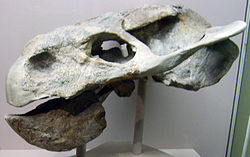
Picture of Oudenodon
- Source
- Wikipedia/Commons
- Credit
- FunkMonk
- Licence
- CC BY-SA 3.0
- Commercial use
- the licence allows it

Photogrammetry
- Source
- MorphoSource
- Licence
- In Copyright
- Commercial use
- cannot be read from the licence given — check the record
- Specimen
- Oudenodon bainii · NHMUK:PAL:PV R 37192
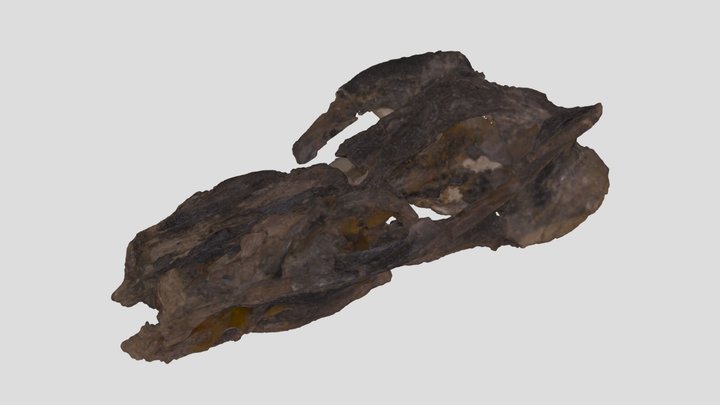
Smithsonian Open Access was not reached for this taxon, so this list is what the others held rather than everything there is.
The description on this site
- Source
- Wikipedia, “Oudenodon”
- Licence
- CC BY-SA 4.0
This is what the site found, which is not the same as what exists.
Keep going
What may have been alongside itOudenodontidae through timeFormations of the PermianThe world it lived on
Occurrence data from the Paleobiology Database, CC BY 4.0. Owen 1859